Quick Summary: Is your current ERP forcing complexity instead of flexibility? This blog explains how Odoo's Composable ERP model, built on modular apps, rapid configuration tools, and seamless integrations, gives enterprises the freedom to scale, adapt, and optimize operations without the burdens of monolithic systems.
Enterprises are moving away from rigid, all-in-one systems and adopting a composable ERP approach powered by an Odoo development company that allows them to build capabilities at their own pace. Unlike older platforms that ship with fixed modules, modern architectures use modular components that fit together like building blocks. This shift is driven by the rising need for agility, faster deployment cycles, and the ability to integrate new digital tools without relying on a tightly coupled core.
As modern ERP systems evolve, organizations want solutions that support rapid changes in processes, data flows, and customer expectations. Odoo development services stand out as an alternative to monolithic ERP since it offer flexibility without forcing businesses to overhaul everything at once.
Why is composable ERP overtaking monolithic suites
Conventional, large-scale ERP suites no longer match the pace at which enterprises operate. Gartner reports that 74% of organizations plan to move away from monolithic ERP models due to high upgrade costs and limited adaptability. This shift accelerates ERP modernization, where businesses adopt modular systems that evolve as their operations grow. The contrast between modular ERP vs monolithic ERP becomes clearer as modular systems offer faster enhancements and better alignment with real-time business demands. This gives leaders greater ERP business agility and allows teams to add or refine features without long development cycles.
The shift toward modular, API-driven business systems
Modern enterprises rely heavily on ecosystem connectivity. Further, Gartner notes that over 60% of enterprise applications will be API-connected by 2026, which highlights the shift toward an API-driven ERP model. This architecture simplifies integrations across CRM, HR, finance, and supply chain systems. Through Odoo ERP integration services, businesses can eliminate data silos, automate processes, and create unified operational flows. With ERP interoperability standards, Odoo enables systems to exchange data smoothly to reduce friction between departments and give leaders a clear operational view without manual stitching of information.
Understanding composable ERP
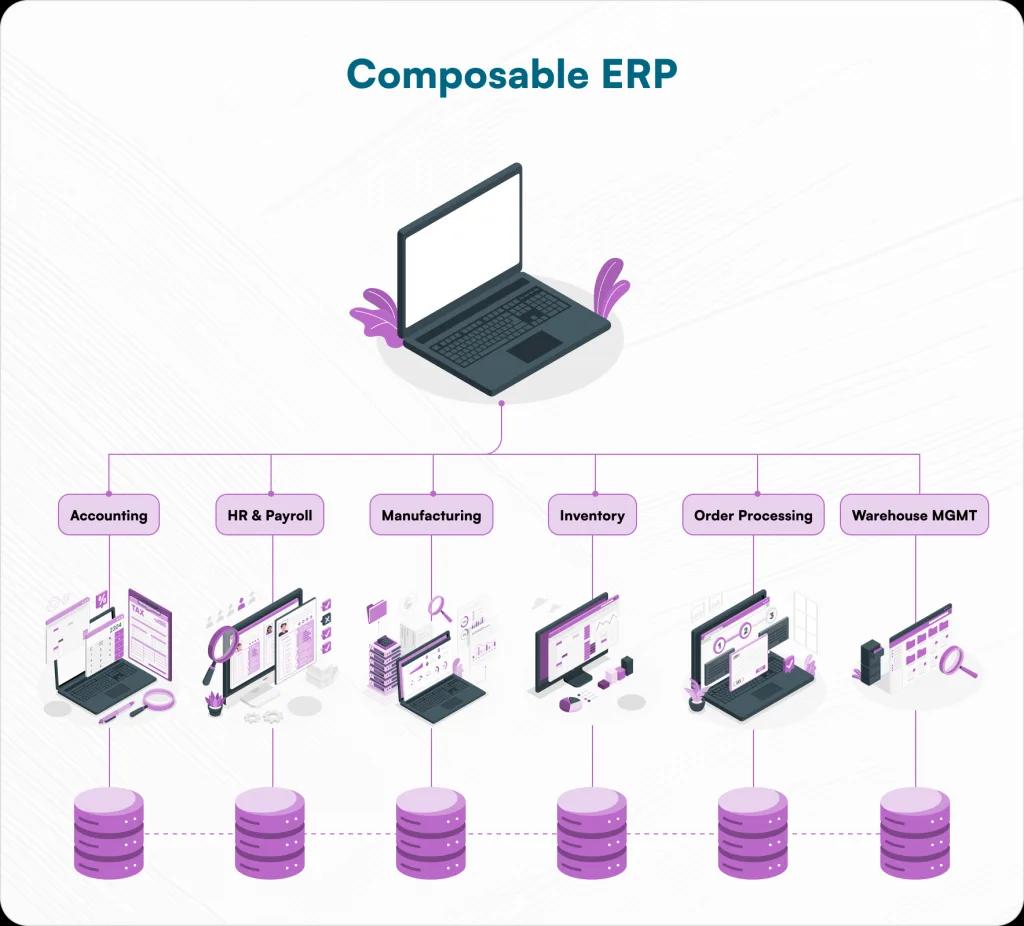
A composable ERP approach gives enterprises the flexibility to build systems using independent, plug-in modules instead of relying on one massive, rigid suite. Unlike conventional systems that force a fixed structure, businesses can adopt a modular ERP architecture and add functionality only when required. This approach not only reduces implementation complexity but also aligns better with fast-changing operational needs. It's why leaders evaluating modernization often label Odoo as the best composable ERP for enterprises, especially those seeking long-term adaptability without steep overhead.
What "Composable" really means for enterprises
For leaders, composability is about choice and control. Modern systems support modularity in enterprise systems, allowing each department to activate the exact tools they need instead of adopting unnecessary bundles. This approach increases ERP cost efficiency, since companies avoid paying for unused features, and it also reduces the long-term ERP total cost of ownership by limiting custom code, shortening upgrade cycles, and simplifying maintenance. The result is an ERP stack that grows with the business rather than forcing teams into fixed workflows.
Core principles: Modularity, extensibility, interoperability
Composable design is based on three principles: modularity, extensibility, and interoperability. With ERP extensibility modules, enterprises can add capabilities without rebuilding their entire system. ERP interoperability standards support seamless data exchange with CRMs, finance tools, HR systems, and industry-specific platforms. These principles position Odoo ERP services as a system that adapts quickly to business shifts while maintaining structural consistency.
How Odoo fits the composable architecture model
Odoo's architecture is built for modular growth, seamless integrations, and rapid adaptation. As a flexible platform, Odoo ERP development company offers hundreds of configurable modules that plug into each other without friction. Backed by a mature ecosystem and supported by an experienced Odoo development company, enterprises can deploy workflows rapidly and scale confidently. Leaders evaluating modernization often ask why choose Odoo ERP, and the answer is clear: it provides the agility of modular systems with the breadth of full-suite ERP capabilities.
Limitations of monolithic ERP systems
Many organizations exploring an alternative to monolithic ERP platforms share a common frustration: traditional systems are too rigid for today's pace of business. These systems were designed for stability, not rapid change, making ERP modernization difficult and expensive. Over time, custom add-ons, manual workarounds, and forced upgrade cycles increase the ERP total cost of ownership, making the platform harder to maintain than the value it delivers.
Forced bundles & slow customization cycles
Monolithic ERPs typically bundle features that companies may never use, yet must still maintain. When teams request changes, vendors often require long development timelines, version upgrades, or complete module overhauls. In contrast, modern systems use low-code ERP customization and allow teams to adjust workflows without deep engineering cycles. The absence of flexible ERP automation tools in monolithic suites slows down innovation. It leaves teams constrained as their business processes evolve.
High ownership costs & vendor lock-in
Traditional ERP vendors often tie customers to long contracts, proprietary integrations, and mandatory upgrade paths. This limits negotiation leverage and pushes costs higher every year. Companies seeking ERP cost efficiency quickly realize that licensing fees, maintenance contracts, and integration overheads add up. Composable platforms like Odoo offer a pay-as-you-grow ERP model. It allows costs to scale with usage rather than forcing enterprises into fixed, inflexible bundles.
Integration headaches across business units
Monolithic systems struggle when new applications need to be added or when different departments use specialized tools. Integrations require custom code, long vendor cycles, and high IT involvement. Modern platforms leverage Odoo ERP integration services, standard APIs, and event-driven patterns to support real-time communication across systems. With webhooks for ERP integrations, companies can trigger updates instantly, reduce manual tasks, and maintain clean data flow across departments.
How Odoo development company enables true composable ERP
Unlike traditional systems that bundle everything into a single, rigid package, Odoo ERP delivers a modular approach built for adaptability. Its architecture allows organizations to assemble their ERP like building blocks, activating only the components they need at any given phase of growth. This aligns perfectly with a modular ERP architecture, where every module operates independently yet integrates seamlessly across departments. With the support of specialized Odoo implementation services, businesses can deploy modules at their pace while keeping the system cohesive and scalable.
Modular apps you activate only when needed
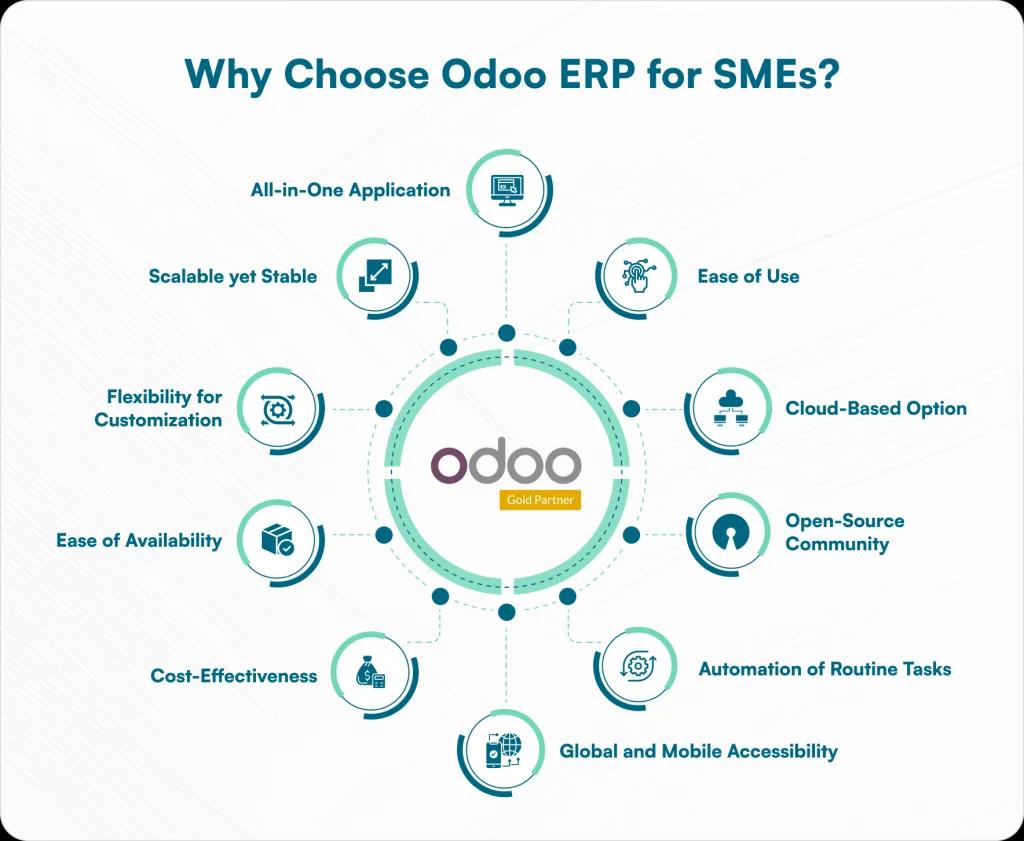
Odoo's app ecosystem makes scaling simple. Companies no longer need to commit to a full suite upfront; they can add modules one at a time. This fits well with a pay-as-you-grow ERP model, where cost aligns directly with usage. The benefits of Odoo for fast-growing companies become clear: teams can roll out CRM, accounting, inventory, HR, or manufacturing tools as their operations expand, without rearchitecting the system or undergoing costly upgrades.
Low-code/no-code customization flexibility
Business teams often need quick adjustments to workflows without heavy engineering involvement. Odoo customization company supports this through Odoo Studio customization, a visual builder that allows users to create forms, automate steps, and extend processes without deep coding expertise. This kind of low-code Odoo ERP customization lets teams adapt processes instantly. It reduces dependency on developers and gives business units greater control over their operations.
API-First integrations with external systems
Modern businesses rely on dozens of interconnected applications. Odoo integration company supports an Odoo API integration model that enables smooth data exchange with CRMs, BI tools, checkout systems, and external platforms. Since it follows API-driven ERP principles, Odoo reduces integration friction and shortens deployment cycles. Enterprises can also rely on Odoo ERP integration services to automate end-to-end workflows, synchronize data, and maintain consistency across multiple systems.
Scalability for SMBs to enterprises
Whether a company is starting small or operating at a global scale, the Odoo ERP solution is designed to grow with them. Its architecture supports ERP scalability for enterprises while still being accessible to emerging organizations. This makes Odoo a rare fit across the spectrum of ERP for SMBs and enterprises, allowing both groups to operate on a unified system without sacrificing performance or flexibility.
Technical foundation of Odoo's composable design
The strength of Odoo's architecture lies in its ability to support modular growth without creating system bottlenecks. Built on a flexible Python ERP framework, Odoo development company facilitates a development environment that is both robust and adaptable. Its structure supports ERP automation workflows and enables organizations to build systems that evolve smoothly as new business needs emerge. The foundation includes strong support for ERP extensibility modules. It allows businesses to add new features without rewriting existing processes.
Modern backend architecture (Python + PostgreSQL)
Odoo's backend architecture is engineered to balance scalability with simplicity. By running as an ERP with Python backend, the system benefits from a language known for readability and rapid development. Combined with a PostgreSQL ERP backend, Odoo gains high performance, strong indexing features, and reliable data integrity. This pairing allows enterprises to handle large transaction volumes, manage real-time updates, and maintain stable operations even as datasets grow.
Reusable business components & reconfigurable modules
One of Odoo's strengths is its approach to modularity. It offers reusable ERP modules that can be configured differently depending on the needs of each department. These are not standalone add-ons—they work together while remaining independently deployable. Since Odoo is built around ERP extensibility modules, teams can add layers of functionality, adjust workflows, or extend capabilities without causing disruptions to other business units.
Event-driven workflows & automated triggers
Automation is central to Odoo's design. The platform supports ERP event-driven workflows. It allows actions to be triggered when specific conditions are met, such as a payment received, an order submitted, or stock levels dropping below a threshold. This approach strengthens ERP automation workflows by reducing manual intervention and allowing processes to execute instantly and consistently across the system.
Odoo studio for rapid configuration
Customization doesn't always require coding expertise. With Odoo Studio customization, business teams can quickly adjust fields, automate steps, or build new forms using a drag-and-drop interface. This supports low-code ERP customization, enabling organizations to adapt processes without waiting on lengthy development cycles. It encourages operational agility and allows teams to keep up with business changes in real time.
AI, automation & composable workflows in Odoo
The leading Odoo development company leverages intelligent automation and modular AI components to create AI-powered ERP systems that adapt to changing business needs. The platform blends rules-based workflows with machine intelligence to support faster decisions, reduce manual work, and improve consistency across departments. As organizations require systems that act contextually rather than react passively, Odoo's design positions it as one of the most intelligent ERP systems available for modular operations. The addition of ERP automation AI lets enterprises automate tasks at scale without overcomplicating system architecture.
Odoo's built-in AI features (Search, Predictions, OCR)
Odoo delivers out-of-the-box intelligence through several embedded capabilities. Its Odoo AI features include smart search powered by vector relevance, automated document parsing, and recommendation models within CRM, sales, and inventory modules. This includes OCR in ERP systems, which extracts data from receipts, invoices, and PDFs. It reduces manual entry. Odoo also incorporates predictive analytics in ERP, supporting forecasting for demand planning, customer behavior, and financial trends, allowing teams to make informed decisions with minimal friction.
Automated business rules & smart flows
Automation in Odoo is driven by business logic that adapts to user actions. Through AI-driven business workflows, companies can configure automated sequences that trigger based on transactions, statuses, or data thresholds. Combined with ERP automation tools, these workflows reduce repetitive tasks such as approvals, notifications, data updates, and inventory adjustments. This lets teams maintain operational accuracy without constant oversight.
Extending Odoo with external AI agents
Odoo's architecture allows external intelligence to be integrated seamlessly. Organizations can add AI agents for ERP to support advanced decision-making or automate multi-step processes. With support for ERP with machine learning, custom models can be connected for fraud detection, churn prediction, risk scoring, or lead qualification. This extends Odoo's capabilities beyond built-in AI and supports industry-specific intelligence needs.
How AI supports composable, context-aware ops
AI strengthens Odoo's modular design by enabling smarter operations across independent applications. As an intelligent ERP systems stack, each module can react to business context, such as customer priority, item availability, or operational constraints. Through AI-driven business workflows, automation becomes dynamic rather than static. It gives enterprises the ability to run adaptive processes that respond to real-time conditions without manual effort.
Integration ecosystem & extensibility
Odoo's architecture supports broad connectivity through Odoo ERP integration services. It enables businesses to link internal tools with third-party systems. Its ERP connector framework simplifies communication between applications, while ERP extensibility modules allow new capabilities to be added without disrupting existing workflows. This flexible ecosystem ensures that Odoo adapts smoothly as enterprise systems expand.
Plug-and-play market modules
A major advantage of Odoo ERP is its extensive marketplace of ready-made modules that can be deployed instantly. These plug-and-play ERP modules cover functions such as accounting, CRM, HR, project management, and supply chain operations. Because they are prebuilt and easily configurable, companies can activate new capabilities in minutes rather than investing in long development cycles. This accelerates adoption while keeping system architecture clean and manageable.
Seamless API, Webhooks, and Middleware integration
Modern organizations rely on smooth data exchange across multiple platforms. With Odoo API integration, enterprises can connect external applications—such as ecommerce stores, payment systems, and data analytics tools—without friction. The platform also supports webhooks for ERP integrations, enabling real-time event notifications such as order confirmations or inventory updates. Middleware connectors further streamline these interactions, giving teams a stable, consistent data flow.
Multi-system orchestration with Odoo's connector framework
Odoo's architecture allows multiple systems to synchronize efficiently through its ERP connector framework. It reduces the complexity often seen in enterprise IT environments. This foundation supports multi-system ERP integration, enabling seamless coordination between CRM platforms, logistics engines, financial tools, and industry-specific applications. As a result, businesses can orchestrate end-to-end workflows without relying on heavy manual intervention or custom-built interfaces.
Security, compliance & governance
Odoo provides strong ERP governance and compliance features designed to safeguard sensitive business data. Its architecture supports GDPR-ready ERP requirements and aligns with SOC2-compliant ERP systems, giving enterprises a reliable framework for access control, auditing, and risk reduction. These controls help maintain trust while keeping systems aligned with global regulatory standards.
Role-Based access & field-level controls
Effective security starts with structured permissions, and Odoo enables strong role-based ERP access models that prevent unauthorized data exposure. Policies tied to job functions restrict what users can view or edit, improving operational discipline. This contributes directly to ERP governance and compliance, reducing internal risk by keeping sensitive details limited to the right groups while offering audit trails that document system activity.
Data governance in modular ERP environments
Managing data across a flexible system requires clear rules. Odoo supports data governance ERP practices through standardized records, consistent metadata, and controlled update workflows. Since it is built on modular ERP architecture, each module follows uniform security and validation rules, allowing teams to maintain reliable information across sales, finance, operations, and analytics without introducing gaps or inconsistencies.
Compliance-ready architecture (GDPR, SOC2, ISO)
Odoo provides a strong compliance foundation through its structured access policies and audit capabilities. As a GDPR-ready ERP, it includes features like data anonymization, consent tracking, and user-level data controls. Its architecture also aligns with SOC2-compliant ERP systems, providing logging, risk evaluations, and process safeguards. Together, these controls support ISO-aligned operational standards for enterprises.
Real-world use cases of composable Odoo ERP
Enterprises across industries now adopt composable ERP models to support rapid change without heavy rework. With strong modularity and flexible integration patterns, Odoo adapts smoothly to sector-specific needs. Through structured rollouts supported by Odoo implementation services, organizations streamline operations and create scalable systems, especially in sectors requiring high process variation, such as ERP for professional services and retail.
Retail - Fast feature add-ons without disruption
Modern commerce moves fast, and ERP for retail businesses must respond to new channels, promotions, and fulfillment demands. Odoo allows retailers to add capabilities through a modular ERP architecture, enabling POS updates, loyalty engines, discount rules, or inventory workflows without halting operations. This modularity supports seasonal scaling, rapid product launches, and smoother omnichannel coordination across warehouses and storefronts.
Manufacturing - Modular MRP + IoT apps
Producers rely on synchronized operations, and Odoo excels as an ERP for manufacturing with modular MRP, shop-floor controls, and automated routing. When paired with ERP with IoT integration, sensors feed real-time insights on machine status, batch quality, and production flow. This lets manufacturers adjust schedules, reduce downtime, and maintain traceability across every stage of the production cycle.
Finance - Composable accounting workflows
Finance teams gain flexibility with a modular accounting ERP that adapts to evolving compliance rules, new revenue streams, or multi-entity consolidation. With Odoo ERP, accounting features, like invoicing, reporting, reconciliation, and ledger management—can be activated or configured independently. This composable structure strengthens audit readiness and delivers real-time clarity into financial performance without forcing rigid system updates.
Services - Scalable project & subscription ops
Service firms rely on continuity and predictable billing cycles, making subscription management ERP capabilities essential. Odoo supports recurring contracts, usage-based billing, and workflow automation tailored for ERP for professional services. Teams can scale from small projects to multi-phase engagements, track utilization, and manage renewals—all while keeping client data, revenue schedules, and project operations aligned within one modular environment.
Cost efficiency & ROI advantages
Enterprises aiming for measurable ERP ROI improvement often turn to Odoo due to its modular structure, predictable scaling, and reduced overhead. Its architecture supports ERP cost efficiency by eliminating forced bundles and minimizing long-term maintenance. With a pay-as-you-grow ERP model, organizations only add features when needed—keeping financial and operational decisions tightly aligned.
Pay-only-for-what-you-use model
The pay-as-you-grow ERP model allows organizations to adopt features gradually instead of committing to an oversized system. With Odoo ERP, teams activate modules only as business volume expands, avoiding wasteful licensing and unused features. This approach aligns cost directly with real operational demand, making it ideal for companies navigating seasonal shifts, fast expansion, or multi-branch rollout cycles.
Reduced custom development costs
Working with an experienced Odoo development company allows organizations to reuse prebuilt components instead of starting from scratch. Combined with Odoo's modular design, enterprises achieve higher ERP cost efficiency by minimizing heavy coding, expensive upgrades, and prolonged maintenance cycles. This reduces technical debt and creates predictable cost structures across financial, operational, and integration workflows.
Faster deployment compared to monolithic ERPs
Legacy systems often slow teams down, but Odoo accelerates rollout through configuration-driven setup and automated processes linked to ERP modernization initiatives. With built-in ERP automation tools, businesses shorten deployment cycles and reduce the need for long integration phases. This results in quicker time-to-value, enabling teams to shift focus back to growth and operational refinement rather than system constraints.
Comparing Odoo with monolithic ERPs
Modern ERP evaluations frequently include Odoo vs SAP, Odoo vs Oracle ERP, and Odoo vs Microsoft Dynamics, especially for organizations looking for adaptability, lower long-term cost, and smoother integration paths. Odoo's composable design gives enterprises room to scale without committing to heavyweight modules or rigid system structures.
SAP vs. Odoo - Flexibility gap
Enterprises comparing Odoo vs SAP often find that SAP's rigid module dependencies slow change cycles. Odoo's modular ERP architecture supports rapid adaptation, allowing teams to activate, extend, or modify features without lengthy redevelopment. For organizations that need pace, Odoo offers a practical alternative that aligns with evolving operational workflows.
Odoo benefits:
- Faster configuration cycles
- Lightweight module onboarding
- Minimal dependency chains
- Lower change management effort
- Faster prototype-to-production flow
Oracle vs. Odoo - Cost & customization delta
In the Odoo vs Oracle ERP comparison, Oracle typically carries higher long-term overhead due to specialized resources and complex governance layers. Odoo delivers meaningful ERP cost efficiency by reducing licensing fees and cutting customization timelines. This makes Odoo more attractive for enterprises wanting predictable budgets without limiting growth or operational expansion.
Odoo benefits:
- Lower implementation cost
- Faster change cycles
- Affordable license structure
- Reduced vendor dependency
- Leaner maintenance footprint
Microsoft Dynamics vs. Odoo - Integration flexibility
When evaluating Odoo vs Microsoft Dynamics, businesses often find Dynamics requires more configuration effort for cross-system connectivity. Odoo's architecture pairs naturally with modern APIs and strong ERP integration services, making it easier to connect CRM, eCommerce, finance, and custom systems. This integration readiness speeds multi-platform operations and lowers total integration overhead.
Odoo benefits:
- Easier API extension
- Faster connector development
- Lower integration cost
- Simplified multi-system orchestration
- Better compatibility with external tools
Migration strategy - Moving from monolithic to Odoo
A structured approach to monolithic to modular ERP migration reduces complexity and downtime. With a well-planned ERP migration strategy, organizations can move from rigid legacy suites to flexible, app-based operations. An Odoo ERP implementation guide provides a phased roadmap that covers assessment, module sequencing, data shifts, integrations, and user adoption, allowing enterprises to modernize without disrupting core operations.
Assessment & module prioritization
A successful transition begins with a clear ERP migration strategy that identifies which legacy capabilities must be retained, improved, or replaced. Teams evaluate workflows, integration points, and compliance needs before mapping them to Odoo's modular ERP architecture. The goal is to avoid rebuilding the old system "as-is" and instead prioritize modules that deliver immediate operational value—such as accounting, inventory, CRM, or HR—while planning secondary modules for later rollout based on complexity and business urgency.
Phased rollout for lower risk
Enterprises often rely on ERP phased rollout strategies to minimize disruption during modernization. Instead of activating all modules at once, Odoo implementations typically start with foundational apps and expand systematically as teams adapt. This staged approach supports ERP modernization by reducing operational risk, keeping change manageable, and giving departments time to validate workflows, monitor performance, and refine configurations before expanding the system footprint across the organization.
Data migration & API mapping strategy
A reliable ERP data migration strategy is essential for moving historic and operational records into Odoo without errors. Data is profiled, cleansed, and aligned with Odoo's schema before import. Parallel to this, teams define API mapping for ERP migration to connect legacy systems, external tools, and third-party apps. This ensures cross-system consistency, seamless integration, and a smoother transition from old processes to Odoo's modular workflows.
Why composable ERP is the future and how Odoo leads the shift in 2026
As enterprises push for agility, 2026 marks a turning point where Composable ERP becomes the preferred model for scalable, modular operations. Organizations want systems that adapt without heavy rebuilds, making Odoo ERP a natural fit. Its modular design, flexible integrations, and rapid configuration capabilities position it as the best composable ERP for enterprises seeking long-term stability and speed.
Partnering with the best Odoo development company enables businesses to tailor workflows, unify data, and streamline processes without the overhead of monolithic suites. For leaders evaluating modernization paths, the question isn't whether to adopt composable systems - but why choose Odoo ERP as the core of their ERP modernization strategy.

Written by
Pratik Kantesiya
AI Engineering Lead
Pratik leads AI engineering at Agile Infoways, where he architects production AI systems for enterprises across healthcare, BFSI, and logistics. He writes about practical AI delivery — what works, what does not, and what most teams miss between proof-of-concept and production.