Quick Summary: What if your ERP improved itself each day? AI-powered Odoo workflows make that real. AI-enhanced Odoo workflows give GCC businesses adaptive operations where approvals, routing, and reconciliation refine themselves over time. This blog explains how hiring expert developers turns Odoo into a self-improving system built for smarter, faster decision-making.
AI-driven capabilities inside Odoo are becoming a priority across GCC enterprises, with Gartner noting that 30% of Middle East organizations plan to automate core operations by 2026. Besides that, over 58% of Middle East organizations will automate at least one core workflow by 2026. This shift positions Odoo + AI workflows as a natural extension for faster approvals, cleaner reconciliation, and guided operations. As adoption rises, Odoo ERP users in the Middle East gain more consistent performance across finance, supply chain, and services.
For business leaders pursuing ERP digital transformation across GCC, an AI-powered Odoo development company adds prediction, context, and precision to daily tasks without adding system burden. It reduces manual reviews, detects exceptions earlier, and directs teams with real-time cues. With rising interest among small to large enterprises in how AI improves Odoo workflows, the region is moving toward adaptive systems that improve accuracy, reduce processing delays, and support operational decision-making with a full suite of Odoo development services.
As operations grow more interconnected, AI becomes essential for smarter, faster Odoo workflows. With the right development expertise, these systems learn continuously and refine performance over time. Let's explore how AI enhances Odoo workflows across approvals, routing, reconciliation, and guided operations.
How AI enhances core Odoo workflows
AI ML development services drastically amplify the capabilities of Odoo by turning routine processes into adaptive, self-improving workflows. With the right Odoo development company, businesses gain AI-driven precision across approvals, routing, reconciliation, and guided operations. These enhancements reduce delays, tighten controls, and improve decision accuracy without complicating existing processes, making AI a practical upgrade for fast-scaling GCC organizations.
Intelligent approvals
AI-driven approval flows upgrade decision accuracy using rule engines, confidence scoring, and conditional logic pipelines. Modern GCC enterprises adopt Odoo approval workflows to cut manual delays and remove subjective guesswork. Automating approvals with Odoo and the Odoo approval engine, enterprises gain faster, cleaner processing supported by AI-powered Odoo ERP solutions.
Benefits:
- Faster approval cycles with AI-based triggers
- Reduced errors through confidence scoring
- Automated routing of exceptions
- Consistent rule-based decisions
- Lower workload for reviewers
Smart routing
AI-powered routing uses LLM-driven logic, prediction models, and SLA-aware decisions to direct tasks to the right teams instantly. With rising interest in Odoo routing automation, enterprises gain more accuracy in workload distribution. Intelligent routing in Odoo, supported by intelligent ERP routing with AI, drives smoother operations and supports Odoo process optimization.
Benefits:
- Balanced task distribution across teams
- Faster completion of high-priority work
- Predictive load forecasting
- Reduced bottlenecks across workflows
- Automated rerouting for SLA compliance
Automated reconciliation
AI automates reconciliation using pattern matching, anomaly detection, and auto-matching for financial and inventory records. Odoo reconciliation automation supports Middle East finance teams aiming for precise daily close cycles. With capabilities aligned to Odoo automation for finance teams and Odoo business automation solutions, enterprises gain tighter control over financial accuracy.
Benefits:
- Faster month-end and daily reconciliation
- Automatic detection of mismatched entries
- Lower risk of duplicate or missing records
- Streamlined audit trails
- Less manual intervention in routine checks
Guided operations
AI-powered guidance elevates user workflows through step-by-step instructions, validation layers, and dynamic process scoring. Enterprises using Odoo guided operations move toward smarter task execution. With support from Odoo machine-learning workflows, Odoo for adaptive business processes, and broader adaptive ERP workflows, teams gain clarity and accuracy in routine processes.
Benefits:
- Clear instructions for every workflow step
- Reduced user mistakes with validation cues
- AI-driven process scoring for consistency
- Faster onboarding for new employees
- Stronger compliance across business units
Technical foundation for adaptive, self-improving operations
Adaptive workflows rely on structured data flows, real-time intelligence, and feedback-driven tuning. These elements turn Odoo into self-improving business systems, where logic evolves as patterns shift. With Odoo predictive operations and AI workflow optimization in Odoo, enterprises gain operational environments that refine accuracy, timing, and routing with each cycle of data processed.
Data pipelines for continuous learning
The leading Odoo development company uses event streams, feedback loops, and vector indexing to allow models to refine predictions. These Odoo machine-learning workflows feed insights back into operational logic, strengthening decision patterns. As Odoo predictive operations mature, the system adapts faster to changes in demand, user behavior, and workload trends.
Benefits:
- Real-time event data sharpens prediction accuracy
- Feedback loops refine task scoring
- Vector indexing improves retrieval quality
- Continual data flow enhances automation timing
- Learning workflows reduce manual oversight
Monitoring & reinforcement patterns
Continuous monitoring and reinforcement tuning maintain system reliability. With Odoo workflow automation GCC, organizations track drift, throughput, and model response quality. Integrated metrics support Odoo process optimization, enabling iterative corrections that stabilize models and maintain consistency across workflows.
Benefits:
- Drift alerts maintain prediction accuracy
- Performance metrics guide iterative adjustments
- Reinforcement signals improve decision scoring
- Automated checks reduce reconciliation lag
- Monitoring improves long-term system resilience
Odoo's modular architecture advantage
Odoo's modularity lets teams reconfigure components, extend workflows, and refine user experiences without overhauls. The best Odoo development company in Dubai often leverages this structure to support regional needs. Both Odoo ERP for UAE companies and Odoo ERP Saudi Arabia deployments benefit from flexible modules that scale and adjust with organizational growth.
Benefits:
- Reconfigurable models adapt to new rules
- Extendable workflows support varied industries
- Low-code tools enable broader team participation
- Modular design reduces deployment friction
- Scalable structure supports long-term expansion
Real use cases for AI-augmented Odoo
Across the region, Odoo partners in Middle East deploy AI-augmented workflows to streamline finance, supply chain, HR, and service operations. This shift drives ERP optimization for Gulf enterprises, offering precision and speed at scale. With tailored Odoo enterprise solutions KSA, organizations gain systems that adjust dynamically to workload changes and compliance demands.
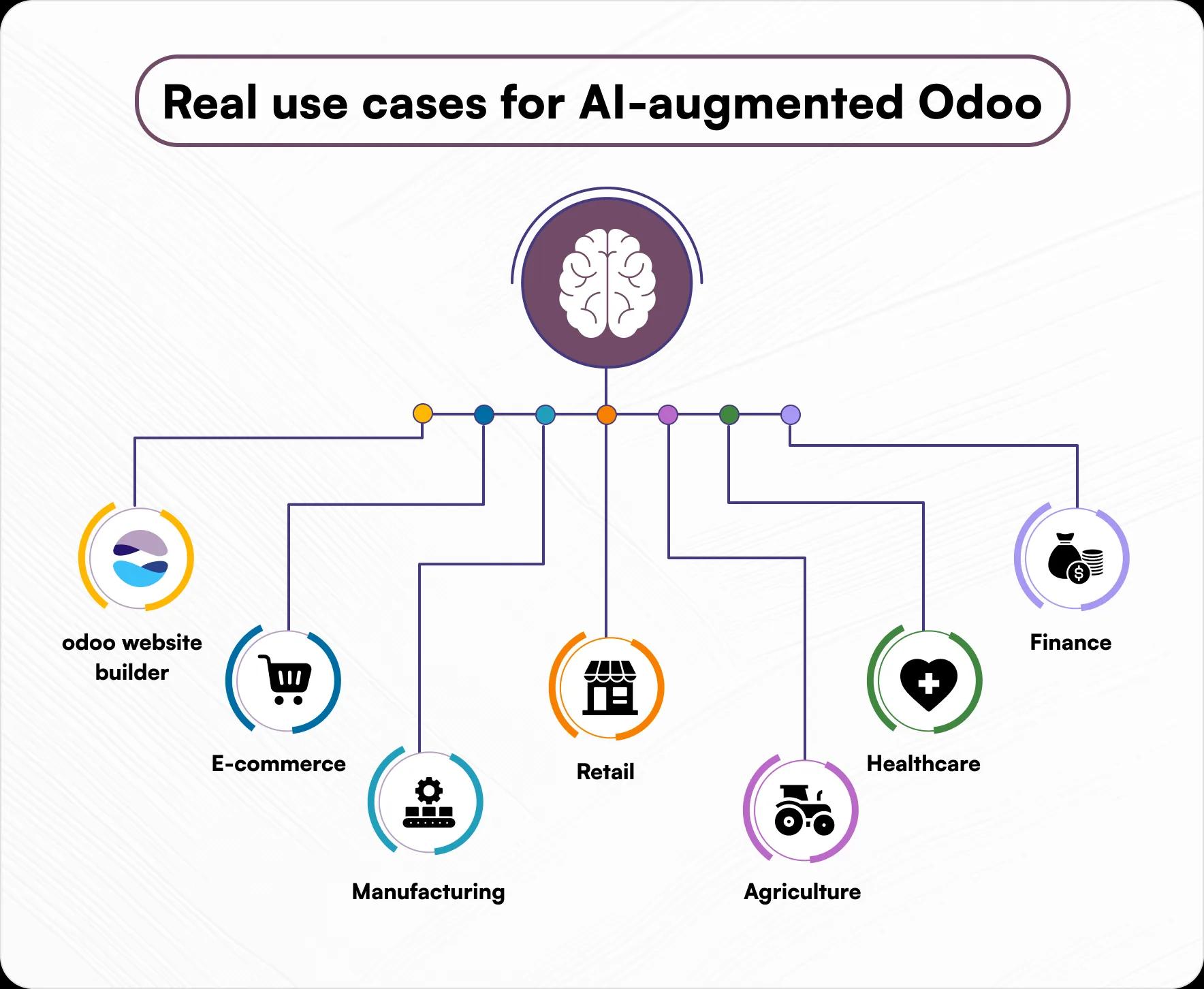
Finance - Automated approvals & reconciliation
Finance teams gain faster decision cycles through automated approvals, anomaly checks, and precise reconciliation. With Odoo automation for finance teams, models analyze patterns and highlight exceptions instantly. Integrated Odoo reconciliation automation brings accuracy to financial workflows, supporting compliance, audit readiness, and real-time visibility into transactional data.
Positive impact:
- Reduced manual verification time
- Lower reconciliation errors
- Faster approval cycle completion
- Early detection of irregularities
- Real-time financial clarity
Supply chain - Routing & predictive workflows
AI-enhanced routing assigns tasks based on workload, deadlines, and capacity. With intelligent routing in Odoo, logistics teams reduce delays and rerouting overhead. Combined with Odoo predictive operations, supply chains gain visibility into demand patterns, replenishment timelines, and resource allocation, improving fulfillment accuracy and operational agility.
Positive impact:
- Optimized task distribution
- Reduced turnaround delays
- Better inventory planning
- Accurate demand forecasting
- Higher SLA compliance
HR & services - Guided operations & compliance
HR and service workflows gain precision with interactive guidance, role-based task cues, and policy-aligned automation. Through Odoo guided operations, teams follow validated sequences that reduce compliance issues. Paired with AI business automation in UAE and Odoo operational automation in Qatar, enterprises streamline onboarding, case handling, and approval chains.
Positive impact:
- Consistent policy alignment
- Faster onboarding cycles
- Reduced human error
- Clear task ownership paths
- Stronger compliance reporting
Why hire Odoo developers for AI-driven systems
AI-enabled Odoo systems require more than plug-and-play configuration. Skilled teams, specifically certified Odoo developers in the Middle East, bring the depth needed to align AI with regional workflows. When companies hire Odoo developers GCC, they gain refined control over automation, data flow, and intelligence. With Odoo development services in UAE, AI becomes a practical asset for Odoo for Gulf businesses targeting smoother, self-adjusting operations.
Custom AI model integration
Embedding OCR, NLP, and forecasting models inside Odoo modules demands precise engineering. With AI agents for Odoo, enterprises gain tailored intelligence suited to local regulatory and operational needs. When integrated with an ERP with AI capabilities, AI elevates accuracy across approvals, forecasting, and classification tasks. Strategic Odoo workflow AI integration ensures the models continuously refine outcomes.
Benefits:
- OCR reduces manual data entry for forms and invoices
- NLP classifies requests and routes them accurately
- Forecasting models improve planning and predict variability
- AI insights improve actionability inside workflows
- Modular integration supports incremental intelligence upgrades
Workflow customization & automation logic
Server actions, automated triggers, and optimized Python logic power deeper automation inside Odoo. With an Odoo development company, businesses create adaptive logic responding to real-time signals. The best AI automation tools for Odoo allow developers to build flows that learn from outcomes. This foundation supports self-improving business systems that refine tasks without heavy manual oversight.
Benefits:
- Automated triggers reduce repetitive actions
- Server actions improve process flow precision
- Python logic boosts speed and control
- AI-assisted rules improve accuracy over time
- Custom workflows reduce operational friction
API-level AI orchestration
True AI-driven operations rely on orchestration across multiple systems. Through Odoo API integration in Middle East, businesses connect Odoo with external intelligence engines, LLMs, and RAG pipelines. With Odoo integration in Dubai, orchestration becomes scalable and secure, and ERP workflow orchestration allows decision logic to flow between systems in real time.
Benefits:
- Smooth data exchange between AI engines and Odoo
- RAG-based insights enrich internal decisions
- Real-time triggers across systems improve response speed
- API-first design supports multi-system intelligence
- Scalable connections support long-term automation growth
The strategic advantage of AI-enhanced Odoo systems
AI-driven workflows position organizations across the Gulf to run smarter, faster, and with greater precision. With Odoo workflow automation GCC, businesses shift from static processes to systems that adjust based on workload, context, and real-time performance signals. This creates a foundation where approvals, routing, reconciliation, and guided operations run seamlessly without constant oversight.
For leaders evaluating long-term scalability, Odoo ERP for scaling operations delivers modular flexibility, strong integration capacity, and AI-ready architecture, all essential for meeting rising customer and regulatory demands. And when assessing the best fit for adaptive, future-ready operations, the answer becomes clear: choosing Odoo ERP is about gaining a platform that grows, adjusts, and improves as your business does.

Written by
Pratik Kantesiya
AI Engineering Lead
Pratik leads AI engineering at Agile Infoways, where he architects production AI systems for enterprises across healthcare, BFSI, and logistics. He writes about practical AI delivery — what works, what does not, and what most teams miss between proof-of-concept and production.