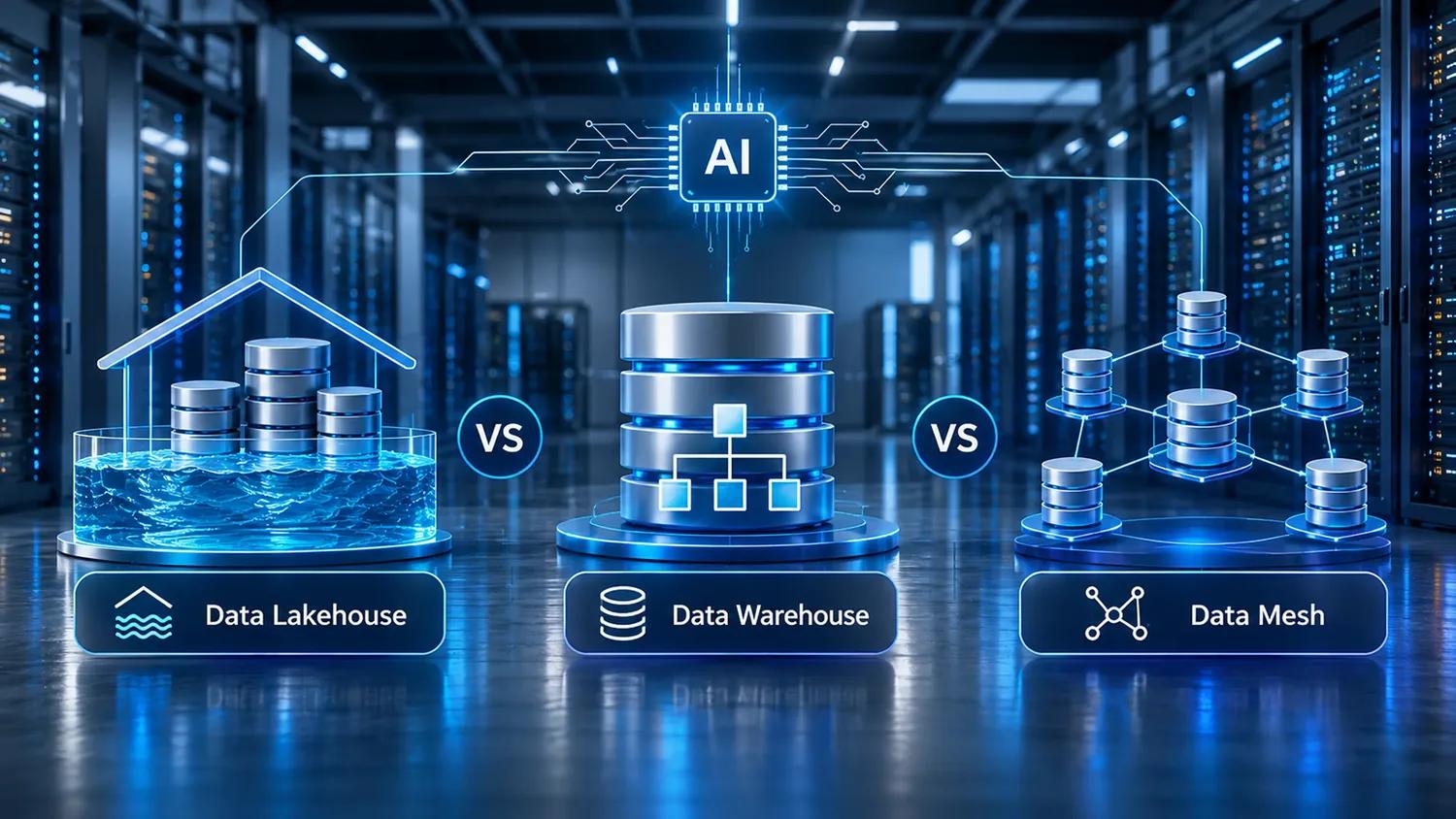
Quick Summary: Is your data architecture holding back your AI initiatives? Explore the technical differences between lakehouses, warehouses, and data mesh, understand their limitations, and learn how to prepare data pipelines for ML, GenAI, and real-time analytics.
The biggest obstacle to scaling AI may not be the model you choose, but the data architecture feeding it. A model can process millions of records, yet produce unreliable results when data is fragmented, poorly governed, or difficult to access. As businesses move from traditional analytics to machine learning, generative AI, and autonomous agents, choosing the right data lakehouse architecture becomes a critical infrastructure decision. Gartner's April 2026 research found that organizations with successful AI initiatives invest up to four times more in foundational areas such as data quality, governance, and AI-ready talent than organizations reporting poor outcomes. So, should you invest in a lakehouse, retain your data warehouse, or adopt data mesh? The answer depends on how your data must serve AI.
How Does a Data Lakehouse Architecture Work?
A data lakehouse combines the storage flexibility of a data lake with the data management capabilities of a traditional data warehouse. It allows businesses to store, process, govern, and analyze different types of data without maintaining completely separate environments for analytics and AI.
Unlike a traditional data lake, which can become difficult to manage without proper structure and governance, a lakehouse introduces capabilities such as ACID transactions, schema enforcement, metadata management, and data versioning.
How Does a Data Lakehouse Differ from a Data Lake?
A data lake stores large volumes of raw information in its original format. This includes structured data from databases, semi-structured JSON files, and unstructured content such as images, documents, audio, and video.
However, storing data does not automatically make it ready for analytics or AI.
A lakehouse adds a management layer that makes this information more reliable and accessible. For example, an organization can store manufacturing sensor readings, equipment maintenance records, production images, and ERP transactions within the same broader architecture.
AI engineers can then use this information to develop predictive maintenance models, detect production anomalies, and analyze equipment performance without repeatedly moving data between disconnected environments.
The distinction is important:
- Data lake: Prioritizes flexible storage of raw data.
- Data warehouse: Prioritizes structured, processed data for reporting and analytics.
- Data lakehouse: Combines flexible storage with stronger data management and analytical capabilities.
What Are the Core Components of a Lakehouse?
A practical lakehouse implementation involves several interconnected components.
- Cloud object storage: Stores data in formats such as Parquet, JSON, and CSV. Storage and compute can be scaled independently.
- Open table formats: Technologies such as Delta Lake and Apache Iceberg manage table metadata, transactions, and schema changes.
- Processing engines: Apache Spark, Flink, and SQL engines process batch and streaming data.
- Metadata and catalog services: Maintain information about datasets, schemas, ownership, permissions, and lineage.
- Governance and security: Apply access controls, data classification, auditing, and quality policies.
- Analytics and AI tools: Connect business intelligence platforms, machine learning frameworks, and AI applications to governed datasets.
One technical consideration deserves particular attention: the table format.
Apache Iceberg is an open table format that supports schema evolution and partition evolution. This allows engineering teams to change table structures and partition strategies as workloads grow without necessarily rewriting all existing data. Its official documentation explains how these changes are managed through table metadata.
For businesses expecting changing AI workloads, this flexibility can reduce the engineering effort involved in maintaining data pipelines.
What Is a Data Warehouse, and Where Does It Fall Short for AI?
A data warehouse organizes processed and structured information for business intelligence, reporting, and analytical queries. It provides a controlled environment where businesses can maintain consistent financial reports, sales dashboards, customer metrics, and operational insights.
For example, a retail company may use a warehouse to combine sales transactions, inventory records, and customer information to calculate monthly revenue and product performance.
The challenge begins when the organization wants to use the same information for more complex AI applications.
How Do Structured and Unstructured Data Requirements Differ?
Traditional data warehouses are particularly effective when information has a predefined structure.
Consider these examples:
- Structured data: Customer IDs, invoice numbers, sales figures, product quantities, and transaction dates.
- Semi-structured data: JSON files, application logs, and API responses.
- Unstructured data: Product images, scanned documents, videos, audio recordings, and maintenance reports.
AI workloads frequently require a combination of all three.
Consider a healthcare organization developing an AI-assisted clinical documentation application. The application may need structured patient information, clinical notes, scanned medical documents, and diagnostic images.
If these sources are maintained in separate environments, engineering teams must build additional ingestion, transformation, and integration processes before AI models can use them.
A lakehouse can simplify this architecture by providing a shared data foundation. However, it does not eliminate the need for document extraction, image processing, access controls, or domain-specific data validation.
Where Do Traditional Data Warehouses Create Limitations for ML and GenAI?
A warehouse is not inherently unsuitable for AI. Modern cloud data warehouses increasingly support machine learning, semi-structured data, and AI integrations.
However, organizations can encounter several limitations when their requirements extend beyond conventional SQL analytics.
1. Data Movement Between Systems
When model training requires information stored outside the warehouse, engineers may need additional pipelines to transfer and transform datasets. Multiple copies can introduce synchronization problems and increase storage and processing costs.
2. Limited Access to Unstructured Information
AI applications involving images, audio, documents, and video require additional processing capabilities. A warehouse-centered architecture may need external storage and specialized processing services.
3. Feature Engineering Complexity
Machine learning models require carefully prepared input variables, commonly called features. Maintaining consistent features across training and production environments becomes difficult when data preparation happens across disconnected systems.
4. Real-Time Data Processing
Predictive applications may need continuous event ingestion and processing. A warehouse designed primarily around scheduled analytical workloads may require additional streaming infrastructure.
5. Governance Across Multiple Environments
When information moves between a warehouse, data lake, feature store, and AI environment, organizations must maintain consistent permissions, lineage, and data quality controls.
The practical question is not whether a warehouse can support AI. It is whether the additional infrastructure required to support AI workloads makes the existing architecture unnecessarily complex.
What Is Data Mesh, and What Problems Does It Solve?
Data mesh addresses a different challenge from a lakehouse or warehouse. It changes how organizations assign responsibility for data, rather than defining a particular storage or processing technology.
In a centralized architecture, one data engineering team often manages datasets from sales, finance, operations, customer service, and other departments.
As the organization grows, this team can become a bottleneck. Every department depends on the same group to prepare datasets, resolve quality issues, manage access, and deliver new analytical requirements.
Data mesh distributes ownership to the business domains that generate and understand the information.
According to Google Cloud's explanation of data mesh, the approach decentralizes data ownership to domain-specific teams while relying on shared infrastructure and governance principles.
What Are the Four Pillars of Data Mesh Architecture?
The data mesh model is based on four principles introduced by Zhamak Dehghani.
Her original explanation of data mesh principles provides the foundation for understanding how the model works.
1. Domain-Oriented Data Ownership
Each business domain manages the data it generates.
For example, the sales department owns customer and sales-related data, while the finance department manages financial transactions and reporting datasets.
This gives domain teams greater responsibility for the quality and availability of their information.
2. Data as a Product
Data must be treated as a product that other teams can discover, understand, and use.
A customer data product, for example, should include:
- Clearly defined data fields and schemas.
- Data ownership and documentation.
- Quality expectations and validation rules.
- Access permissions and security policies.
- Defined interfaces for data consumption.
3. Self-Service Data Infrastructure
Domain teams should not need to build their own infrastructure from scratch.
A shared platform provides reusable capabilities for data ingestion, storage, processing, monitoring, cataloging, and access management.
4. Federated Computational Governance
Decentralized ownership should not result in inconsistent security or incompatible datasets.
A federated governance model establishes common standards for data quality, access controls, privacy, metadata, and interoperability. These standards should be enforced through automated platform controls wherever possible.
How Does Data Mesh Work in a Real Business Environment?
Consider a manufacturing company operating multiple production facilities.
Its business domains generate different types of information:
- Manufacturing owns production output, machine utilization, and downtime records.
- Supply chain owns supplier performance, inventory, and procurement information.
- Quality control owns defect records, inspection results, and compliance information.
- Finance owns production costs, expenses, and profitability metrics.
Under data mesh, each domain publishes its information as a governed data product.
An AI application can then combine these products to predict production delays, identify quality issues, or forecast inventory requirements.
The important point is that the data products remain independently owned, but follow shared standards that allow them to work together.
What Problems Does Data Mesh Implementation Create?
Data mesh can address centralized data bottlenecks, but it also introduces operational responsibilities that businesses must plan for.
Some common challenges include:
- Inconsistent data definitions: Different departments may use different definitions for the same business metric.
- Limited engineering capabilities: Domain teams may not have sufficient data engineering expertise.
- Governance complexity: Decentralized ownership makes consistent policy enforcement more difficult.
- Data product duplication: Teams may independently create similar datasets and pipelines.
- Platform maintenance: Organizations must provide reliable self-service infrastructure and monitoring.
A data mesh should therefore be introduced when the organization has enough domain complexity, engineering maturity, and governance capability to support distributed ownership.
It is not automatically a better choice for every business.
Lakehouse vs. Data Warehouse vs. Data Mesh: What Are the Key Differences?
The first step in comparing these approaches is understanding that they do not solve exactly the same problem.
A lakehouse defines how data is stored and processed. A warehouse provides structured analytical capabilities. A data mesh defines how data ownership and responsibility are distributed across business domains.
This distinction changes the entire architecture decision.
How Do the Three Approaches Compare?
The comparison highlights an important point: a data mesh does not replace a lakehouse or warehouse by itself. It can use either as its underlying technology foundation.
Can a Data Lakehouse Replace a Data Warehouse?
Yes, a lakehouse can replace many traditional warehouse workloads, particularly when businesses need analytics and AI to operate on shared datasets.
However, a complete replacement is not always necessary.
A company with established financial reporting, regulatory dashboards, and high-concurrency SQL workloads may have good reasons to retain its existing warehouse.
The better approach is to assess whether maintaining separate environments creates more complexity than value.
For example, a financial services company might retain its warehouse for established reporting while using a lakehouse for customer behavior analysis, fraud detection, and machine learning.
The decision should be based on workload performance, integration requirements, governance, and total cost of ownership rather than the popularity of a particular architecture.
Can a Lakehouse and a Data Mesh Work Together?
Yes. In fact, combining them can be a practical approach for organizations with multiple business domains and growing AI requirements.
A lakehouse provides the underlying storage, processing, and governance capabilities. Data mesh establishes how individual domains publish and manage their data products.
Consider this architecture:
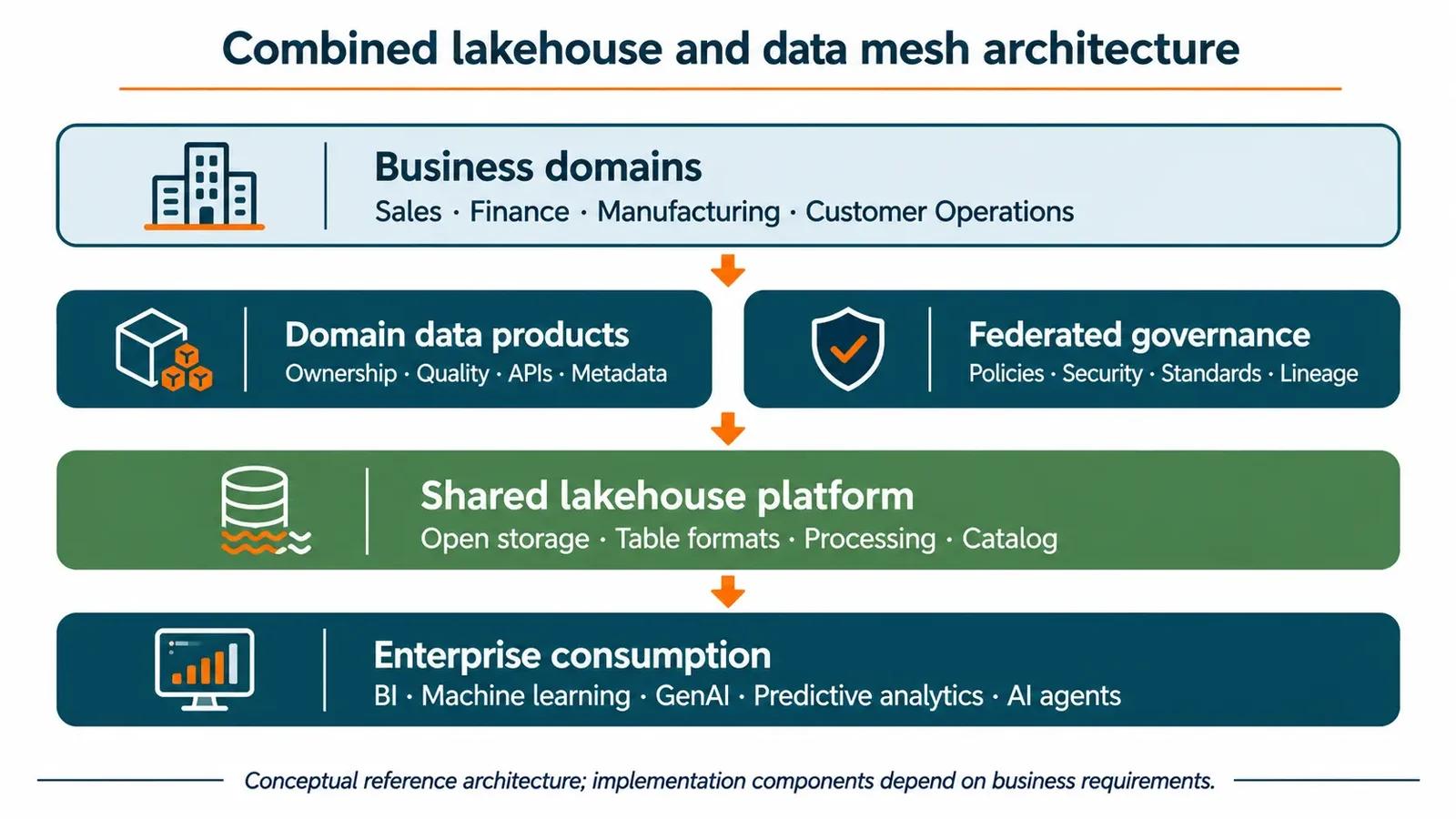
This approach gives organizations a shared technical foundation without forcing every department to surrender ownership of its data.
How Should You Evaluate Databricks vs. Snowflake?
The platform discussion often creates confusion because businesses compare products with architectural approaches.
Databricks is strongly associated with the lakehouse architecture, combining data engineering, analytics, and AI capabilities.
Snowflake is a cloud data platform with a strong data warehousing foundation and capabilities extending into data engineering, data sharing, and AI.
Therefore, the question "Is Snowflake a data warehouse or a data lakehouse?" does not have a simple answer based on the product name alone. Its architecture and workload capabilities have expanded beyond traditional warehousing.
Similarly, Databricks is not simply a data lake. Its lakehouse approach adds transactional table management, governance, and analytical capabilities to data lake storage.
Evaluate both platforms against:
- Compatibility with existing cloud infrastructure.
- Support for open table formats and data portability.
- Batch and streaming processing requirements.
- Machine learning and GenAI integrations.
- Governance, security, and compliance.
- Workload concurrency and query performance.
- Total cost of ownership and engineering skills.
The right platform is the one that meets your actual workload requirements without introducing unnecessary operational complexity.
Which Architecture Is Best for AI and Machine Learning Workloads?
There is no universal winner. However, a lakehouse is often a strong technical foundation when an organization needs to support multiple AI workloads using structured, semi-structured, and unstructured information.
A data warehouse remains useful for structured analytics, while data mesh becomes valuable when distributed teams need independent ownership of data products.
The decision becomes clearer when you examine how AI applications consume information.
How Does a Lakehouse Support AI Workloads?
Consider an enterprise developing a predictive maintenance solution for manufacturing operations.
The AI application needs information from several sources:
- IoT sensors generate continuous machine performance readings.
- ERP systems provide production schedules and inventory information.
- Maintenance applications store equipment service histories.
- Quality systems provide defect and inspection records.
- Computer vision applications generate images and inspection results.
A lakehouse can bring these datasets into a shared environment where engineering teams can process, validate, and prepare them for different AI applications.
However, simply storing the information together is not enough. Teams must establish ingestion pipelines, data contracts, quality checks, access controls, and appropriate processing workflows.
The following capabilities become particularly important.
Batch and streaming data processing: Batch processing handles information collected over a period, while streaming processes incoming events continuously or in small intervals.
Data versioning: Engineers can track which dataset versions were used to train a model, making experiments and model evaluation easier to reproduce.
Metadata and lineage: Teams can identify where information originated, which transformations were applied, and which downstream applications depend on it.
Compute separation: Storage and processing resources can be managed independently, helping organizations allocate compute based on different workloads.
Governed data access: Data scientists, analysts, and AI applications can access approved datasets without creating uncontrolled copies.
How Does Medallion Architecture Prepare Data for AI?
The medallion architecture organizes information into three layers: Bronze, Silver, and Gold.
Each layer progressively improves the quality, structure, and usability of the information.
Databricks' technical documentation on medallion architecture explains how these layers support data processing and analytical workloads.
How Does the Medallion Architecture Work?
Bronze Layer
Raw data
What happens?
Data is ingested from source systems with minimal transformation.
Examples: ERP transactions, IoT readings, logs, documents, and images.
Silver Layer
Validated data
What happens?
Data is cleaned, deduplicated, validated, standardized, and enriched.
Examples: corrected timestamps, standardized product IDs, validated sensor readings, and joined datasets.
Gold Layer
Business-ready data
What happens?
Data is aggregated, enriched, and modeled for specific business applications.
Examples: predictive maintenance datasets, production KPIs, customer segments, and model-ready analytical tables.
The three layers serve different purposes.
An important engineering consideration: Do not assume every AI application should consume only Gold-layer data.
For example, a computer vision model may require original images from Bronze storage, while a predictive model may consume validated Silver datasets. Gold is more appropriate when the model requires business-level aggregates or prepared analytical datasets.
The correct data layer depends on the model's input requirements.
How Do Real-Time Analytics and AI Data Pipelines Work Together?
Traditional batch pipelines may process information every hour or every day. This works for financial reporting and historical analysis, but certain AI applications require fresher information.
Consider a manufacturing environment where an industrial sensor detects abnormal vibration in a machine.
A real-time pipeline can:
- Capture sensor events through a messaging system such as Apache Kafka.
- Process incoming events through a streaming engine.
- Validate readings against expected ranges.
- Enrich the readings with equipment and maintenance information.
- Make the processed data available to a prediction service.
- Trigger an alert when the model identifies a potential failure.
This workflow can reduce the delay between detecting an abnormal condition and responding to it.
However, real-time processing introduces additional engineering requirements.
- Event ordering and late-arriving records.
- Duplicate event handling and idempotent processing.
- Event-time versus processing-time differences.
- Stream processing checkpoints and recovery.
- Data freshness and end-to-end latency monitoring.
- Consistent feature calculations between training and inference.
A common production failure occurs when training data is prepared using one transformation logic, while live inference uses another. This can create training-serving skew, where a model performs well during testing but produces unreliable predictions in production.
The solution requires shared transformation logic, feature validation, version control, and continuous monitoring.
How Do Feature Stores and Training Data Management Improve AI Performance?
A feature is an input variable that a machine learning model uses to make predictions.
For example, a manufacturing model predicting equipment failure might use:
- Average machine temperature.
- Vibration levels over the previous 30 minutes.
- Number of maintenance incidents.
- Equipment operating hours.
- Historical downtime frequency.
A feature store helps teams manage and reuse these prepared variables across machine learning workflows.
It can provide:
- Offline feature storage: Historical features for model training and experimentation.
- Online feature storage: Low-latency feature retrieval for real-time predictions.
- Feature consistency: Shared definitions across training and inference.
- Feature discovery: Documentation and reuse of approved features.
- Point-in-time correctness: Access to feature values that were actually available at the time of a historical prediction.
One frequently overlooked challenge is historical leakage. If a training dataset contains information that would not have been available when the prediction was originally made, model evaluation can become misleading.
For example, a predictive maintenance model must not use a repair record created after the equipment failure to predict that same failure.
This is why time-aware feature engineering and point-in-time joins are important for reliable AI development.
How Do You Choose the Right Data Architecture for Your Business?
Choosing an architecture should begin with business requirements, not vendor comparisons.
A business running financial dashboards has different needs from a manufacturer building computer vision applications or a healthcare organization developing GenAI solutions.
Start by evaluating the following factors.
When Should You Choose a Lakehouse Instead of a Data Warehouse?
Choose a lakehouse when:
- Your AI applications require multiple data formats.
- You need to combine analytics, machine learning, and streaming workloads.
- Data movement between separate systems creates unnecessary complexity.
- You need open storage formats and greater data portability.
- Your data science teams require access to historical and raw datasets.
Retain or prioritize a warehouse when:
- Your primary requirement is structured SQL analytics.
- Existing reporting systems already deliver reliable performance.
- Your datasets have stable schemas and well-defined business metrics.
- You have established reporting and compliance processes.
- Replacing the warehouse would create more disruption than value.
When Should You Adopt Data Mesh?
Data mesh is worth considering when your organization has:
- Multiple business domains generating substantial data.
- Central data teams struggling to manage increasing demand.
- Domain experts who can take responsibility for data quality.
- A need for independently managed data products.
- Sufficient platform engineering and governance maturity.
Avoid introducing data mesh simply because the organization has several departments.
Without domain accountability, shared standards, and platform automation, decentralization can create more silos instead of resolving them.
How Should You Match Architecture to AI Workload Requirements?
The following decision guide connects common AI requirements with suitable architectural approaches.
These are starting recommendations, not fixed rules. A modern warehouse can support some of these workloads, and a lakehouse can support conventional reporting.
The right design depends on workload latency, data formats, integration requirements, security, and existing infrastructure.
How Can Businesses Evaluate the Total Cost of Ownership?
A platform's subscription or infrastructure cost does not represent the entire investment.
Consider five cost categories:
- Storage costs: Historical data, backups, replicas, and retained versions.
- Compute costs: Data transformations, SQL queries, model training, and inference.
- Engineering costs: Pipeline development, integration, testing, and maintenance.
- Governance costs: Security, compliance, cataloging, monitoring, and auditing.
- Operational costs: Platform administration, incident management, and specialist resources.
One common mistake is choosing a platform based on storage costs while ignoring the compute required to process the data.
For example, a company may save money by storing large volumes of information in inexpensive object storage but spend considerably more on repeated transformations, inefficient queries, and unnecessary data movement.
A better evaluation measures the cost per business outcome, such as:
- Cost per trained model.
- Cost per thousand predictions.
- Cost per processed transaction.
- Cost per AI-generated response.
- Cost per data product maintained.
This gives technology and finance teams a common basis for evaluating architecture investments.
How Do You Migrate to a Lakehouse Architecture?
Migrating to a lakehouse should not mean replacing every existing data system at once.
A phased approach allows businesses to modernize their infrastructure while maintaining existing reporting, operational applications, and critical data pipelines.
The migration should begin with a clear understanding of existing workloads and end with measurable improvements in data quality, performance, and AI readiness.
Step 1: How Do You Assess Existing Data Infrastructure?
Start by documenting the current data environment.
Identify:
- Existing databases, warehouses, and data lakes.
- Data sources, formats, and ingestion methods.
- Batch and streaming pipelines.
- Data ownership and access permissions.
- Existing integrations and downstream applications.
- Storage, compute, and maintenance costs.
Next, identify where the current architecture creates bottlenecks.
For example, a business may discover that customer information is duplicated across its CRM, ERP, warehouse, and analytics platforms. Another may find that machine learning teams spend more time preparing data than developing and evaluating models.
These findings should determine migration priorities.
Step 2: How Do You Choose the Right Open Table Formats?
The table format influences how data is stored, updated, accessed, and managed across processing engines.
Consider technologies such as:
- Apache Iceberg: Supports open analytical tables, schema evolution, and partition evolution.
- Delta Lake: Provides ACID transactions, schema enforcement, and integration with the lakehouse ecosystem.
- Apache Hudi: Provides table management capabilities designed for incremental data processing and updates.
The selection should consider:
- Compatibility with existing processing engines.
- Concurrent read and write requirements.
- Schema and partition evolution.
- Streaming and batch processing.
- Time travel and historical data access.
- Catalog integration and governance.
- Long-term data portability.
Do not choose a table format simply because it is popular. Test it against actual data volumes, query patterns, concurrency requirements, and operational constraints.
Step 3: How Do You Plan Data Migration, Governance, and Integration?
Once the foundation is selected, plan how existing information will move into the new environment.
A practical migration sequence includes:
- Identify critical datasets and their dependencies.
- Define target schemas and data contracts.
- Build ingestion pipelines for priority sources.
- Implement data quality and validation rules.
- Establish metadata, lineage, and access controls.
- Integrate downstream analytics and AI applications.
- Test performance and reconcile migrated records.
One important consideration is schema drift.
Schema drift occurs when a source system changes its data structure without corresponding updates to downstream pipelines.
For example, an ERP system may introduce a new field, change a data type, or modify an existing identifier. If the ingestion pipeline does not handle the change correctly, downstream analytics and AI models can receive incomplete or inconsistent information.
Use schema monitoring, compatibility checks, automated validation, and data contracts to reduce these risks.
Step 4: How Do You Validate Performance and AI Readiness?
Before moving critical workloads into production, validate the new architecture against measurable requirements.
Data quality validation
- Completeness and accuracy.
- Duplicate records.
- Schema consistency.
- Data freshness.
- Referential integrity.
Platform performance validation
- Query execution time.
- Pipeline processing latency.
- Concurrent workload performance.
- Storage and compute consumption.
- Recovery and failure handling.
AI readiness validation
- Training dataset consistency.
- Feature availability.
- Data lineage and versioning.
- Training-serving consistency.
- Access permissions for AI applications.
- Model monitoring and data drift detection.
A successful migration is not simply one in which data reaches the new platform. It is one in which the organization can reliably use that data for its intended business and AI workloads.
How Should You Plan a Phased Migration?
A practical implementation roadmap can follow four stages.
- Stage 1: Foundation assessment
Evaluate existing systems, data quality, workload requirements, and migration priorities. - Stage 2: Platform implementation
Set up storage, table formats, catalogs, processing engines, and governance controls. - Stage 3: Workload migration
Move selected pipelines, validate datasets, and connect analytics and AI applications. - Stage 4: Optimization and scaling
Monitor performance, optimize costs, improve data quality, and expand to additional business domains.
The duration of each stage depends on data volume, system complexity, integrations, regulatory requirements, and available engineering resources. Avoid committing to a migration timeline before completing the initial assessment.
FAQs
Can a Data Lakehouse Replace a Data Warehouse?
Yes. A lakehouse can support many traditional data warehouse workloads while also providing storage and processing capabilities for machine learning, GenAI, and unstructured data. However, organizations with established reporting systems may benefit from retaining their warehouse for specific workloads.
Is Snowflake a Data Warehouse or a Data Lakehouse?
Snowflake originated as a cloud data warehouse platform but has expanded into data engineering, data sharing, and AI capabilities. Its modern architecture supports more than conventional SQL reporting. Whether it fits a lakehouse-style implementation depends on the specific storage, table, integration, and processing requirements.
Is Databricks a Data Warehouse or a Lakehouse?
Databricks is strongly associated with the lakehouse architecture. Its platform supports data engineering, SQL analytics, machine learning, and AI workloads using a shared data foundation.
Is Data Mesh Outdated or Dead?
No. Data mesh remains a relevant organizational approach for managing distributed data ownership. However, it is not a standalone storage technology. Its usefulness depends on organizational maturity, domain accountability, platform capabilities, and governance requirements.
Which Data Architecture Is Best for AI and Machine Learning Workloads?
A lakehouse is often a strong choice for organizations requiring diverse data formats, machine learning, streaming, and analytics on a shared platform. A data warehouse can remain appropriate for structured analytical workloads, while data mesh can complement either architecture when distributed domain ownership is required.
Building an AI-Ready Data Architecture for 2027
By 2027, the competitive advantage will not come simply from deploying more AI models. It will come from how effectively businesses connect their data infrastructure with real operational and business requirements.
A data lakehouse can provide a unified technical foundation. A warehouse can continue supporting established reporting requirements. Data mesh can help larger organizations distribute ownership without losing governance.
But choosing the architecture is only the beginning.
Businesses must also address data quality, pipeline reliability, metadata management, access controls, real-time processing, and the engineering capabilities required to operate these systems.
According to Gartner's 2026 research, organizations with successful AI initiatives invest up to four times more in foundational areas such as data quality, governance, and AI-ready talent than those reporting poor outcomes.
That finding raises an important question for technology decision-makers: Are you investing in AI applications while leaving the data infrastructure they depend on underprepared?
As you plan your 2027 technology roadmap, prioritize three outcomes:
- Build reliable data foundations: Connect business systems, establish data quality controls, and make trusted information accessible to AI applications.
- Prepare for enterprise-scale AI: Develop pipelines, governance frameworks, and infrastructure that support machine learning, GenAI, and agentic AI.
- Measure infrastructure value: Track data processing costs, model performance, pipeline reliability, and measurable business outcomes.
AI ML development company and leading data engineering company can work across data engineering, AI/ML development, cloud infrastructure, and enterprise software integration to help businesses address these challenges.
Their approach starts with understanding existing systems, identifying architectural gaps, and developing an implementation roadmap aligned with business priorities.
Before investing in your next AI initiative, examine the foundation it will depend on. Is your current data architecture ready to support the business goals you expect to achieve in 2027?

Written by
Pratik Kantesiya
AI Engineering Lead
Pratik leads AI engineering at Agile Infoways, where he architects production AI systems for enterprises across healthcare, BFSI, and logistics. He writes about practical AI delivery — what works, what does not, and what most teams miss between proof-of-concept and production.