
Quick summary: From agent-powered pipelines and data-driven insights to enhanced flow automation and security improvements, Salesforce’s 2026 updates unlock new efficiencies and competitive advantage. Read the blog now and learn what these changes mean for your enterprise’s strategy and ROI.
2026 is shaping up to be a watershed year for CRM strategy as enterprises increasingly view customer engagement platforms as the backbone of competitive growth. With the global CRM market on pace to surpass $112 billion in 2025 and expand toward roughly $263 billion by 2032, organizations are aiming to hire Salesforce developers, though it is not just about capturing customer data but also about building an intelligent system that drives growth and resilience.
What makes 2026 especially pivotal is the convergence of autonomous AI agents, enterprise-wide automation, and embedded generative intelligence. These capabilities help teams reduce operational drag and surface insights in real time. Against this backdrop, the latest release updates of the Salesforce development company, spanning autonomous AI agents, generative AI across clouds, deeper Flow automation, and strengthened Hyperforce compliance, aren’t incremental updates; they are changing the dynamics of how enterprises buy, operate, and secure CRM at scale.
For enterprises, the latest updates from the Salesforce development company signal a shift from CRM as a supporting tool to CRM as an operating layer for the business. Decisions around architecture, talent, and governance now directly influence speed, compliance, and long-term value across sales, service, and data-driven operations.

What enterprise leaders need to know
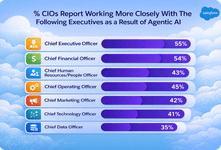
In 2026, enterprise CRM isn’t just about applications anymore; it’s about autonomy, data integrity, and operational intelligence at scale. AI adoption has surged, with full enterprise AI deployments up 282% since 2024, and 96% of CIOs reporting current or planned agentic AI usage in the next two years, signaling broader shifts in enterprise priorities.
- Business impact – AI agents and generative AI are reshaping workflows from frontline support to back-office operations.
- Top risks – Data trust, governance gaps, and skill shortages could slow ROI.
- Immediate priorities – Sharpen your data strategy, build governance frameworks, and upgrade skills to manage autonomous CRM.
What’s new in Salesforce (core 2026 themes)
Salesforce’s 2026 updates signal a clear shift toward autonomous execution, embedded generative intelligence, and stricter cloud compliance. Together, these themes reshape how enterprises automate workflows, manage data, and govern AI at scale, moving CRM from system-of-record to system-of-action for business leaders.
Don’t miss this: 2026 deep-dive – What’s new in Salesforce setup & access?
Agentforce & AI agents
In 2026, the leading Salesforce development company in USA has moved beyond simple AI copilots with a strong push toward Agentforce. These AI agents are designed to complete multi-step tasks on their own, such as researching accounts, drafting customer responses, routing service cases, or preparing follow-ups by coordinating data, logic, and actions across the platform.
Unlike earlier assistants that reacted to prompts, Agentforce supports goal-based execution. For enterprises, this shortens cycle times and reduces manual handoffs between teams. Sales and service leaders can automate entire workflows instead of isolated steps, while IT teams gain more control over how agents operate through defined rules, guardrails, and audit trails.
Flow & hyperautomation enhancements
Salesforce Flow continues to evolve as a core automation engine. Updated Salesforce development services include AI-assisted Flow creation, a modernized Flow Studio interface, and stronger debugging and decision logic.
These improvements allow low-code teams to design more advanced automations without deep development effort. These changes reduce build time and improve reliability. Business teams can iterate faster, while developers focus on complex integrations and custom logic.
Data Cloud, integrations and Hyperforce (compliance & infra)
Data Cloud adoption has accelerated, supported by deeper integrations with platforms like Snowflake and Databricks. These connections allow enterprises to unify customer data without heavy data movement. Alongside this, Hyperforce updates and new regional certifications simplify cloud localization and regulatory alignment.
For regulated industries, this means greater flexibility in meeting data residency and compliance requirements while still running Salesforce at scale.


What this means for enterprise – 5 strategic implications
Salesforce’s 2026 direction changes how leaders should think about CRM investment. AI agents, automation, and data unification push the Salesforce CRM solution into core operations, raising questions around strategy, risk, talent, and cost that demand executive attention now across sales, service, and platform governance decisions enterprise-wide today.
Strategy: reframe CRM as an AI-driven operational platform
CRM in 2026 is no longer just a system of record. With AI agents and Data Cloud working together, the Salesforce development company in USA positions CRM as an execution layer for revenue operations, service delivery, and product insight. Agents can act on signals instead of waiting for user input, while unified data supports real-time decisions. For an enterprise, this requires shifting ownership from departmental tooling to a shared operational platform aligned with business outcomes.
Data & governance – privacy, provenance, and the trust layer
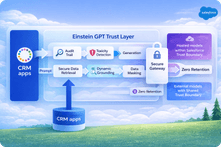
As generative AI becomes embedded in daily workflows, data governance moves from policy to practice. Leaders must define data lineage, usage rights, and access controls across structured and unstructured sources. Salesforce’s Einstein Trust Layer introduces guardrails such as grounding, masking, and auditability to reduce hallucinations and data leakage. The strategic implication is clear: AI scale depends on disciplined data stewardship, clear accountability, and enforceable governance models across business units.

Security & compliance – Hyperforce, local clouds, and certifications
Salesforce’s Hyperforce architecture expands deployment choices through local clouds and regional infrastructure. Enterprises should reassess where workloads run, how data residency is enforced, and which certifications apply to their industry. Updated ISO, SOC, and PCI artifacts support regulated use cases, but responsibility still sits with leadership to map regulatory obligations to deployment models. Security and compliance teams must stay closely involved in CRM roadmaps, or enterprises should hire Salesforce developers.
People & operating model – New skills and governance
AI-driven CRM changes who does what. Automation architects design flows and agent logic, data stewards manage quality and access, and AI-ops roles monitor model behavior and outcomes. DevOps practices tighten as Flow, agents, and integrations become business-critical. Leaders need operating models that balance speed with control, clearly defining ownership across IT, data, and functional teams.
Cost, ROI & vendor lock-in considerations
AI features increase business value, but they also shift cost structures. Usage-based pricing, higher data volumes, and cross-cloud integrations can raise the total cost of ownership. Enterprise leaders must model ROI beyond productivity gains, factoring in consumption, data egress, and long-term dependency risks. Contract negotiations and architectural choices now carry strategic financial weight.

Practical checklist for the next 90 days
This checklist focuses on fast, low-risk actions that improve readiness for AI agents, automation, and compliance, while giving leaders clarity on data, security, and operating model priorities.
Audit core data sources
Map CRM, marketing, service, and external data feeding Salesforce to identify quality gaps and duplication risks.
Classify sensitive data fields
Tag personal, financial, and regulated data to control AI access and reduce exposure during generation and automation.
Activate AI guardrails
Configure Einstein Trust Layer controls in Salesforce for grounding, masking, logging, and output review.
Pilot one Agentforce use case
Select a contained workflow, such as case triage or account research, with clear success metrics and rollback options.
Upskill two admins on Flow Studio
Train admins on AI-assisted Flow creation, debugging, and decision logic to support faster automation cycles.
Review Flow inventory
Document critical Flows, owners, and dependencies to reduce breakage as automation volume increases.
Run Hyperforce region assessment
Evaluate data residency, latency, and regulatory needs before finalizing regional deployment choices.
Conduct security and compliance review
Validate ISO, SOC, and PCI alignment against internal risk policies and audit requirements.
Set a 90-day ROI baseline
Track productivity gains, consumption metrics, and support volume to guide scaling decisions.
Roadmap – pilot → scale → govern
A structured roadmap keeps AI adoption grounded in outcomes rather than experimentation. Over six to twelve months, the enterprise should move deliberately from validation to scale, with governance embedded early. This phased approach reduces risk, controls cost, and builds confidence across business and IT teams.
Discovery
Salesforce development service provider starts by defining priority workflows where AI agents or automation can reduce response time or manual effort. Review data readiness, compliance constraints, and baseline metrics such as time-to-respond, SLA adherence, and cost per interaction.
Pilot
Hire Salesforce developers and run one or two controlled pilots using Agentforce or Flow automations within Salesforce. Limit scope, document assumptions, and track model accuracy, user adoption, and early productivity signals. Maintain manual fallbacks.
Scale
Expand proven use cases across teams and regions. Standardize reusable Flows, agent patterns, and integration templates. Measure SLA improvements, throughput gains, and cost efficiency as usage increases.
Governance & optimization
Establish continuous monitoring for data access, model performance, and spend. Refine guardrails, review accuracy trends, and adjust workflows based on real operating data to keep results predictable and compliant.
Read also: Salesforce development lifecycle: processes, models, and challenges
Risks & mitigations
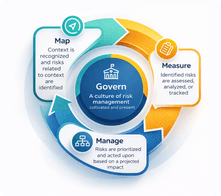
As the Salesforce development company expands AI-driven execution across CRM, leaders must balance speed with control. Clear visibility into risk areas and practical mitigations allows enterprises to scale agents and automation with confidence, while protecting data, operations, and long-term strategic flexibility.

Hallucination risk
AI-generated outputs may include inaccuracies. Use human-in-the-loop reviews, approval steps, and grounding controls within Salesforce to validate responses before execution.
Data privacy exposure
Sensitive data can surface in AI workflows. Apply field-level encryption, strict role-based access, and detailed access logs to maintain auditability.
Automation failure
Complex Flows or agents may behave unexpectedly. Mitigate through staged rollouts, sandbox testing, and real-time monitoring with clear rollback paths.
Vendor dependency
Deep platform reliance can limit flexibility. Maintain hybrid architectures, regular data exports, and documented exit strategies to preserve negotiation leverage.
Short case example – Agentforce in service operations
A mid-sized service organization piloted Agentforce within Salesforce to manage inbound support tickets. AI agents automatically categorized requests, drafted first responses using knowledge articles, and escalated only high-complexity cases to senior agents. Standard issues were resolved without manual routing. During the 60-day pilot, average resolution time dropped by 30%, first-response SLAs improved, and CSAT scores rose due to faster, more consistent replies. Human agents focused on exceptions, reviews, and customer-sensitive scenarios rather than repetitive triage tasks.

Conclusion
Salesforce’s 2026 releases accelerate the shift toward AI-driven CRM execution. For enterprise leaders, the priority is deliberate progress, not reactive adoption or hire Salesforce developers to achieve targeted goals. Start with a tightly scoped, 60-day pilot tied to a high-ROI workflow, measure outcomes, and embed governance early. With clear metrics, data controls, and ownership, Salesforce development company in USA serves as a durable operational platform rather than offering another isolated tool.