
Quick summary: Explore how Salesforce CRM drives 5–8% revenue growth and 15–20% customer satisfaction gains through AI, predictive analytics, automation, and unified cloud architecture. This guide breaks down 15 powerful Salesforce CRM features and strategic insights every executive should evaluate in 2026!
We have come a long way from legacy CRM models centered around segmentation to advancing toward intelligent, real-time personalization across all channels with the Salesforce CRM solution. Now Salesforce CRM helps businesses increase revenue by 5-8% and achieve 15-20% improvements in customer satisfaction within a short period. Mckinsey defines this shift as the next frontier of advanced Customer Relationship Management(CRM) since the shift is from passive data storage to an AI-powered next best experience engine.
Moreover, having sustainable revenue growth in 2026 becomes easy with Salesforce intelligent customer data management and predictive visibility. Salesforce CRM connects sales, service, marketing, and commerce within a unified cloud architecture. Gartner projects worldwide CRM revenue will reach $145.6 billion by 2029, underscoring CRM’s strategic importance for executive leadership.
Why Salesforce CRM still leads in 2026
The Salesforce development company maintains the largest CRM market share, according to IDC’s Worldwide Software Tracker, reinforcing its leadership position. Its multi-tenant cloud infrastructure, metadata-driven architecture, and integrated AI capabilities provide scalability, governance controls, and deep customization. Executives value its ecosystem, Sales Cloud, Service Cloud, Data Cloud, and Einstein AI, for aligning revenue operations with predictive analytics and enterprise-grade security.
What’s driving CRM evolution in 2026
AI acceleration, unified data platforms, and automation-first strategies are reshaping CRM priorities. McKinsey reports that companies leveraging advanced personalization and analytics generate significantly higher revenue growth than peers. Board-level leaders increasingly hire Salesforce developer teams to build API integrations, deploy AI forecasting models, and strengthen governance frameworks that support scalable expansion and operational precision.
Growth-focused organizations now evaluate CRM investments through measurable business impact, operational discipline, and predictive intelligence. Platform capabilities must align with executive strategy, regulatory requirements, and long-term scalability while strengthening revenue visibility, customer lifetime value, and competitive positioning.

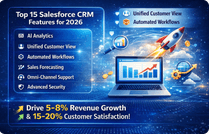
15 best CRM features that benefit businesses
Contact management
Centralizes customer profiles, account hierarchies, communication history, and activity tracking within structured objects, enabling real-time visibility across sales and service teams while maintaining relational data integrity inside the CRM database.
Benefits
- Unified customer visibility
- Faster lead qualification
- Improved personalization
- Reduced duplicate records
- Stronger sales coordination
Single source of truth
Unifies sales, marketing, commerce, and service data within a centralized cloud architecture, synchronizing records in real time to eliminate silos and create consistent reporting across departments and executive dashboards.
Benefits
- Accurate enterprise reporting
- Cross-functional alignment
- Reduced data conflicts
- Reliable forecasting inputs
- Better compliance tracking
Reports, dashboards, and analytics
Delivers configurable dashboards, real-time performance metrics, and AI-driven analytics powered by dynamic reporting engines that convert operational data into strategic insights for revenue, pipeline, and service management decisions.
Benefits
- Data-driven decisions
- Pipeline transparency
- Revenue performance tracking
- Executive-level visibility
- Faster issue identification
Cloud-based and mobile CRM
Operates on secure multi-tenant cloud infrastructure with encrypted mobile access, enabling remote teams to update records, manage pipelines, and respond to customers instantly across devices.
Benefits
- Remote accessibility
- Automatic system updates
- Lower infrastructure costs
- Real-time record updates
- Business continuity support
AI, automation, workflows, and approvals
Uses predictive AI models, rule-based automation, and structured approval processes to reduce manual tasks, optimize lead scoring, and accelerate deal progression across departments.
Benefits
- Reduced manual workload
- Faster sales cycles
- Intelligent prioritization
- Improved accuracy
- Operational efficiency
Collaboration tools
Integrates shared activity feeds, document management, and internal messaging within CRM records to streamline cross-department communication and improve coordination on deals and service cases.
Benefits
- Faster communication
- Improved deal collaboration
- Reduced email dependency
- Centralized knowledge sharing
- Enhanced team productivity
Scalability, flexibility, and customization
Supports custom objects, Apex development, APIs, and low-code tools to adapt workflows, data models, and interfaces as business requirements evolve.
Benefits
- Long-term scalability
- Industry-specific configurations
- Seamless feature expansion
- Process adaptability
- Reduced migration risk
Sales forecasting and opportunity management
Tracks opportunity stages, probability metrics, and historical sales data using AI-powered forecasting models to improve revenue predictability and pipeline visibility.
Benefits
- Accurate revenue projections
- Pipeline risk identification
- Improved quota planning
- Stronger accountability
- Better strategic planning
Product-level quotes and order management
Manages pricing rules, discount approvals, CPQ configurations, and order lifecycle tracking within automated workflows to maintain consistency and reduce manual errors.
Benefits
- Faster quote generation
- Pricing standardization
- Reduced approval delays
- Fewer order errors
- Improved revenue control
Omni-channel support
Connects email, phone, live chat, social media, and messaging channels into a unified service console with intelligent case routing and tracking.
Benefits
- Consistent customer experience
- Faster response times
- Complete interaction history
- Improved satisfaction rates
- Efficient case resolution
Customer self-service
Provides portals, searchable knowledge bases, and AI chatbots that allow customers to resolve issues independently using structured service content.
Benefits
- Lower support costs
- 24/7 availability
- Faster issue resolution
- Reduced agent workload
- Higher customer satisfaction


Field service and campaign management
Coordinates technician scheduling, geolocation tracking, and marketing campaign execution within one platform to align service delivery and demand generation strategies.
Benefits
- Optimized field operations
- Improved campaign ROI
- Better resource allocation
- Real-time service updates
- Increased customer retention
Journey orchestration
Designs multi-step customer journeys using behavioral triggers, segmentation logic, and automated engagement workflows across channels.
Benefits
- Personalized engagement
- Higher conversion rates
- Improved lead nurturing
- Better lifecycle tracking
- Stronger brand consistency
Third-party integration
Enables API-based integration with ERP, finance, and marketing systems through REST and SOAP services; many enterprises hire Salesforce developer teams to build secure, scalable integration frameworks.
Benefits
- Unified technology ecosystem
- Real-time data synchronization
- Reduced manual entry
- Enhanced reporting accuracy
- Streamlined operations
Security
Implements role-based access controls, encryption, audit logs, and compliance frameworks aligned with US regulatory standards, often configured through advanced Salesforce development services for governance management.
Benefits
- Data protection
- Regulatory compliance
- Controlled system access
- Threat monitoring
- Enterprise trust and credibility
Frequently asked questions about the Salesforce CRM system
What makes Salesforce CRM different from other CRM platforms?
The Salesforce development company in USA stands apart through its unified cloud ecosystem, AI-powered analytics, and extensive customization capabilities. For C-suite leaders, it delivers enterprise-grade scalability, deep integration flexibility, and actionable insights that align sales, service, and marketing performance with measurable revenue growth objectives.
Is Salesforce CRM suitable for small and large enterprises?
Salesforce supports both growth-stage companies and global enterprises through modular architecture and industry-specific clouds. Executives benefit from scalable licensing, customizable workflows, and advanced analytics that adapt to organizational complexity while maintaining governance, operational visibility, and long-term strategic alignment.
How secure is Salesforce CRM for enterprise data?
Role-based access controls, field-level security, encryption at rest and in transit, audit trails, and compliance certifications including SOC and ISO standards by the best Salesforce development service provider in USA. Leadership teams gain strong data governance capabilities that support regulatory compliance and enterprise risk management frameworks.
Can Salesforce CRM be customized for industry-specific needs?
When it comes to industry-specific needs, Salesforce offers industry clouds for healthcare, financial services, manufacturing, and public sector organizations. Through configurable objects, APIs, and low-code tools, executives can align CRM architecture with sector regulations, operational models, and performance metrics without rebuilding core infrastructure.
How long does Salesforce CRM implementation take?
Implementation timelines vary based on organizational size, integration complexity, and customization scope. Mid-market deployments may take weeks, while enterprise rollouts can extend several months. Strategic planning, data migration quality, and executive sponsorship significantly influence speed, adoption rates, and measurable outcomes.
What is the cost structure of Salesforce CRM in 2026?
Salesforce pricing follows a subscription-based, per-user model with tiered editions and add-on capabilities such as AI and industry clouds. Executives evaluate total cost of ownership, integration investment, customization scope, and projected ROI when assessing long-term CRM investment strategy.
How to choose the best-fit CRM feature for your business needs
Align CRM capabilities with business objectives
Executive teams must evaluate Salesforce CRM features against strategic priorities such as revenue acceleration, margin improvement, retention targets, and operational efficiency. Map forecasting tools, AI analytics, and automation capabilities directly to board-level KPIs to maintain measurable business impact and accountability.
Identify department-specific requirements
Sales, marketing, service, finance, and operations operate on distinct workflows and compliance frameworks. Leaders should assess reporting structures, approval hierarchies, data visibility levels, and cross-functional dependencies to select CRM capabilities that drive collaboration without compromising governance or performance metrics.
Evaluate scalability & customization needs
A future-ready CRM must support custom objects, API extensibility, role-based permissions, multi-entity structures, and regional deployments. Leadership should assess platform architecture to confirm it accommodates acquisitions, product expansion, regulatory shifts, and increasing data volumes without performance trade-offs.
Consider integration with existing systems
Enterprise value increases when CRM connects seamlessly with ERP, marketing automation, finance, analytics, and data warehouses. Evaluate REST and SOAP APIs, middleware compatibility, event-driven architecture, and synchronization controls to maintain data consistency across interconnected systems.
Assess ROI, adoption, and long-term value
Beyond licensing costs, executives must measure implementation complexity, user adoption strategy, training investment, and integration expenses. Assess measurable outcomes such as forecasting accuracy, reduced sales cycles, customer lifetime value growth, and operational efficiency to justify sustained CRM investment.

Keep up with the latest CRM updates in 2026 and beyond
Why does continuous CRM optimization matter? Well, it matters the most since CRM performance is not static; data models, automation rules, and analytics frameworks require ongoing refinement to remain aligned with evolving revenue strategies. Continuous optimization improves forecasting accuracy, strengthens governance controls, and increases user adoption. Organizations that regularly audit workflows, dashboards, and integrations gain sharper operational visibility and sustained competitive advantage in rapidly shifting markets.
Salesforce consistently introduces AI enhancements, industry-specific capabilities, and platform upgrades that elevate enterprise performance and help you stay competitive with ongoing Salesforce innovations. Organizations that hire Salesforce developers to evaluate and implement these innovations can operationalize predictive analytics, automation enhancements, and integration improvements faster than competitors. Strategic adoption of new releases strengthens scalability, improves customer intelligence, and reinforces executive-level decision-making precision.
Business leaders planning CRM expansion should conduct architecture assessments, define measurable KPIs, and prioritize scalable customization strategies. Partnering with a Salesforce development company enables structured roadmaps, secure integrations, and phased implementation aligned with growth objectives. A disciplined approach to governance, data quality, and user enablement positions organizations for predictable revenue acceleration in 2026 and beyond.