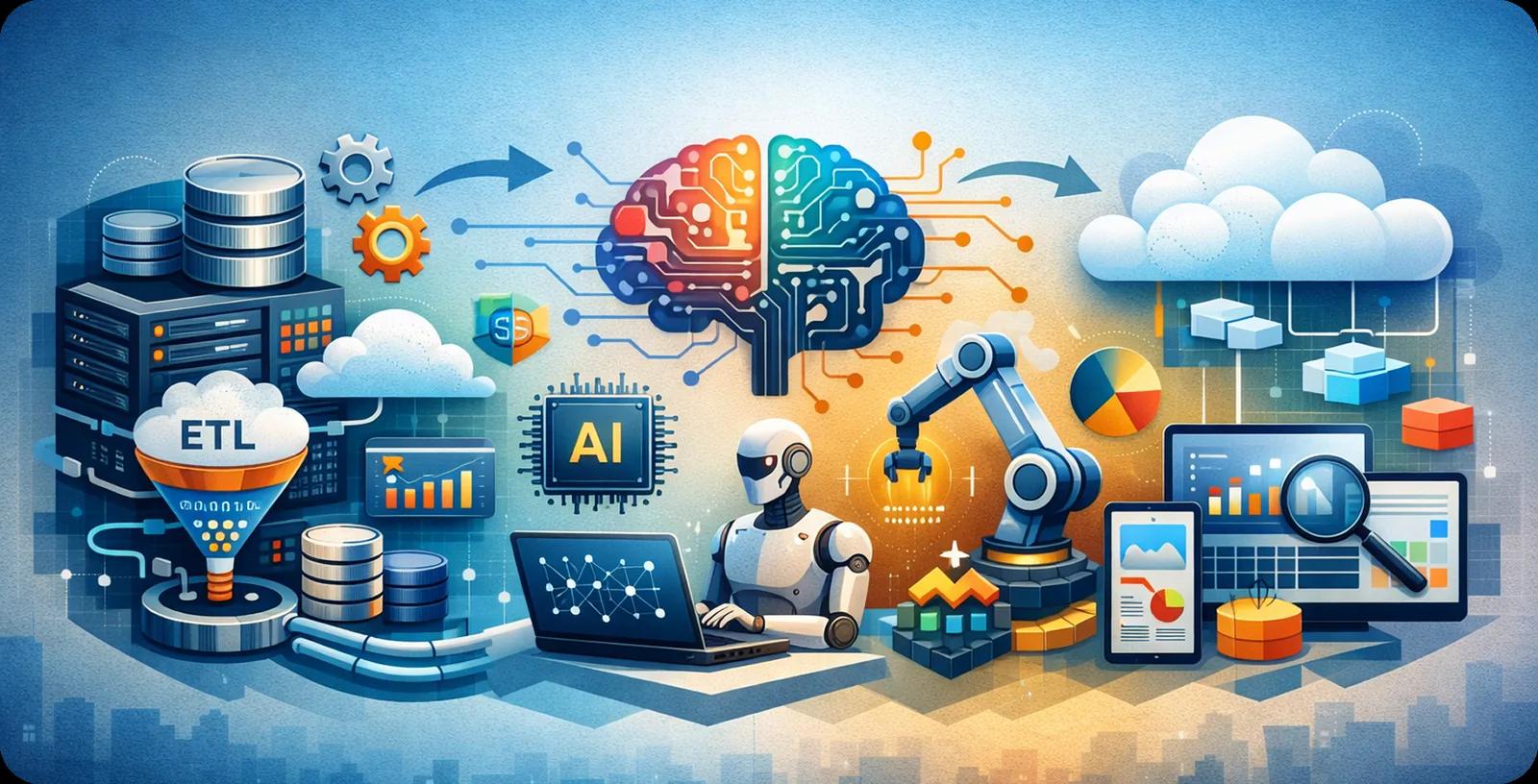
Quick Summary: Wondering how AI transforms data engineering services? In 2026, leading platforms like Snowflake, dbt AI, and Dataiku enable automated ETL, anomaly detection, smart governance, and real-time insights. Businesses can reduce manual effort, enhance data quality, and accelerate decision-making by integrating AI directly into ingestion, transformation, wrangling, and pipeline workflows. Read the blog now and learn more.
Top AI Tools for Data Engineering Services Are Here!
Data engineering services in USA have evolved from a back-end support discipline into the backbone of modern intelligence. What began as routine ETL pipelines and warehouse management has now transformed into an AI-augmented ecosystem, where machine learning models, automation, and predictive algorithms are actively changing how data is captured, cleaned, and delivered. In 2026, data engineering isn't just about moving data; it's about empowering data to move intelligently.
As enterprises scale cloud-native architectures and real-time analytics, traditional data stacks can no longer keep up with the velocity, volume, and variability of today's information flows. This is where AI-driven data engineering services come into play. It uses generative AI, automated data modeling, anomaly detection, and smart governance to remove manual bottlenecks and ensure reliability at scale. Modern tools now interpret transformation logic, optimize queries autonomously, and even recommend schema designs based on usage patterns.
The result? The leading data engineering company in USA are shifting from pipeline maintenance to value creation to building adaptive, self-healing data systems that drive faster insights and sharper decision-making. In this blog, we'll explore the top AI tools for data engineering services in 2026, and how these platforms are setting a new benchmark for efficiency, intelligence, and trust in enterprise data operations.
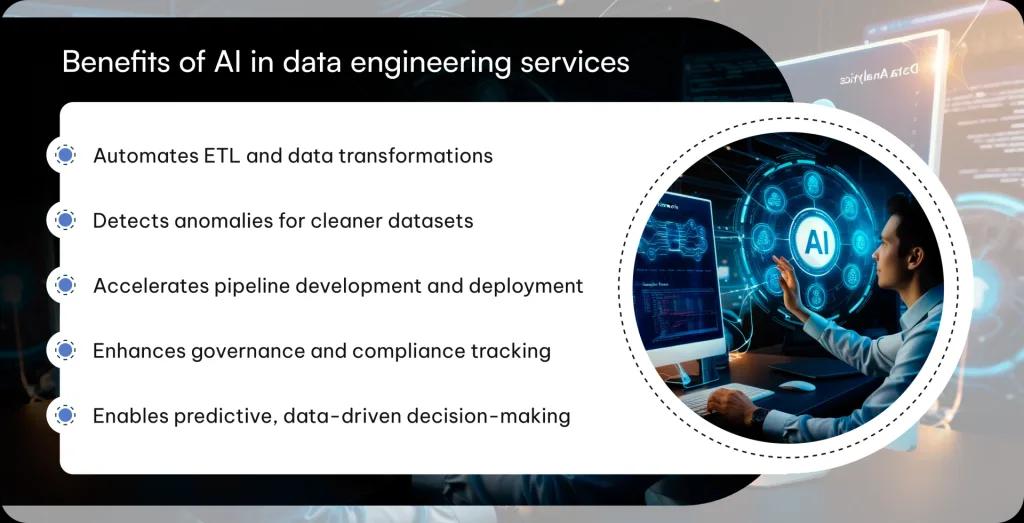
Top AI Tools for Data Engineering Companies in USA
dbt (and "dbt AI"/Semantic AI Enhancements)
- dbt is already a de facto standard for SQL-based transformations in modern data stacks.
- The "AI" add-ons (sometimes called dbt AI) are now including features such as automatic model and documentation suggestions, pipeline debugging, lineage insights, and governance automation.
Why this matters: The shift toward "data engineering with AI support" means that transformation logic, documentation, lineage tracking, and quality checks are increasingly AI-augmented.
Business benefits:
- Faster data transformation and delivery cycles
- Automated documentation improves transparency and trust
- AI-driven quality checks ensure cleaner datasets
- Smarter lineage tracking enhances governance compliance
- Reduced manual effort lowers operational costs
- Improved collaboration across data and business teams
- Predictive insights turn data pipelines into assets
Snowflake Cortex / Snowpark
- Snowflake's data cloud is adding more built-in AI/ML, vector search, and GenAI functions. For example, Snowflake Cortex embeds AI functions directly inside the Snowflake SQL workspace.
- The Snowpark architecture supports data engineering and AI/ML workloads "next to your data" (i.e., you don't have to move data out), which reduces latency and risk.
Why this matters: For a data engineering company, the closer you can keep your transformations, storage, model scoring, and intelligence, the more streamlined your stack becomes.
Business benefits:
- Reduced data movement minimizes latency and risk
- Unified platform simplifies AI and data workflows
- Faster model deployment directly within the data environment
- Lower infrastructure costs through centralized processing
- Enhanced security with in-platform computation control
- Scalable AI integration without complex data pipelines
- Accelerated insights through real-time data intelligence
Amazon SageMaker + AWS Glue
- AWS provides a strong combo: Glue for serverless ETL/ELT, and SageMaker for ML training and deployment. These are increasingly integrated with AI and automated tasks.
- In data engineering services, automated ingestion, transformation, anomaly detection, and metadata enrichment (via AI) are big wins.
Why it matters: Many enterprises use AWS. The ability to use AI within the data engineering stack (not just for "analysis") is a key differentiator.
Business benefits:
- Automated ETL simplifies complex data workflows
- Seamless ML integration enhances data-driven decisions
- Serverless architecture reduces infrastructure management costs
- AI-powered anomaly detection ensures data reliability
- Faster data ingestion accelerates analytics readiness
- Scalable pipeline automation boosts operational efficiency
- Unified ecosystem strengthens end-to-end data strategy
Google Cloud Vertex AI + Google Cloud Dataflow + BigQuery ML
- Google Cloud's stack supports real-time and batch ingestion (Dataflow), big data warehousing (BigQuery), and model development and deployment (Vertex AI).
- The AI-enabled features (e.g., generative AI templates and code assistance) reduce dev overhead for data engineering.
Why this matters: For teams working in or migrating to Google Cloud, having one unified stack that blends data and AI helps reduce friction.
Business benefits:
- Unified platform streamlines data and AI workflows
- Real-time processing enables faster business insights
- Generative AI tools reduce development time
- Integrated ML capabilities enhance predictive accuracy
- Scalable infrastructure supports enterprise data growth
- Automated pipelines minimize engineering overhead
- Seamless collaboration improves cross-team efficiency
lakeFS
- This open source tool provides Git-like version control for data lakes: branching, merging, and isolating dev and test environments.
Why this matters: When data engineering supports AI workflows, data versioning, reproducibility, branching, and governance become critical. lakeFS addresses these.
Good for: Environments where data science and data engineering teams share data lakes and need collaboration and governance.
Business benefits:
- Git-like control improves data version management
- Easier experimentation with isolated data branches
- Enhanced reproducibility ensures consistent AI results
- Streamlined collaboration across engineering and science teams
- Faster rollback reduces risk during data changes
- Improved governance through tracked data lineage
- Accelerated innovation with safer testing environments
Metadata, Governance & Observability Tools
- Tools like Alation and Collibra are using AI to automate cataloging, lineage, and quality alerts.
Why this matters: As pipelines grow in complexity and AI/ML services get embedded, you need transparency, traceability, governance, and data quality.
Example: AI-enhanced metadata tools automate cataloging, detect relationships, and maintain lineage without relying on manual documentation.
Business benefits:
- Automated cataloging improves data discoverability
- AI-driven lineage boosts transparency and trust
- Real-time quality alerts prevent data issues
- Enhanced governance ensures regulatory compliance
- Streamlined documentation reduces manual workloads
- Improved traceability strengthens audit readiness
- Smarter insights enable proactive data management
Airbyte (AI-Enhanced)
- Airbyte incorporates AI-powered features for connector creation, pipeline monitoring, and transformation recommendations, streamlining ETL/ELT workflows.
- The AI capabilities enhance data consistency, automate repetitive tasks, and reduce manual coding for faster pipeline delivery.
Why this matters: Businesses can accelerate data ingestion, ensure reliable transformations, and improve overall engineering efficiency when they hire data engineers.
Business benefits:
- Faster data ingestion with AI-assisted pipelines
- Reduced manual coding saves engineering time
- Smart transformation suggestions improve workflow efficiency
- Enhanced data consistency across multiple sources
- Real-time monitoring detects pipeline issues quickly
- Simplified connector creation accelerates integration
- Supports scalable ETL/ELT for growing datasets
Matillion (AI-Enhanced ETL/ELT Platform)
- Matillion leverages AI to suggest transformation logic, generate code, and detect anomalies in ETL/ELT pipelines, optimizing workflows.
- The AI-powered features reduce manual effort, accelerate pipeline development, and improve data quality across transformations.
Why this matters: Teams can minimize errors, speed up ETL processes, and focus on high-value initiatives.
Business benefits:
- AI suggests transformation logic automatically
- Generates code to reduce manual effort
- Detects anomalies in ETL/ELT pipelines
- Accelerates pipeline development and deployment
- Improves overall data quality and accuracy
- Optimizes workflow efficiency across complex datasets
- Frees teams to focus on high-value tasks
Trifacta (AI-Augmented Data Wrangling)
- Trifacta leverages AI to detect data patterns, automate cleaning, and assist with transformation logic for structured and unstructured datasets.
- The AI-powered features reduce manual effort, accelerate wrangling processes, and ensure high-quality, consistent datasets for downstream use.
Why this matters: You can generate insights faster, maintain data quality, and improve overall engineering efficiency when you hire data engineers.
Business benefits:
- AI detects patterns in structured and unstructured data
- Automates data cleaning for faster workflows
- Assists in the transformation logic to reduce manual effort
- Ensures high-quality, consistent datasets
- Speeds up data wrangling processes
- Improves overall engineering efficiency
- Accelerates insight generation from raw data
Dataiku DSS (AutoPipelines + Governance Features)
- Dataiku provides a low-code platform combining AI, data transformation, and governance features.
- AutoPipelines automate workflows while ensuring traceability, reproducibility, and compliance across production-ready pipelines.
Why this matters: Teams can build reliable data pipelines and ML models with reduced overhead and stronger governance.
Business benefits:
- Automates workflows for faster data processing
- Ensures traceability across all pipelines
- Maintains reproducibility for consistent results
- Supports low-code AI and data transformations
- Strengthens governance and compliance standards
- Reduces engineering overhead and manual effort
- Enables production-ready ML model deployment
Considerations & Trends for 2026
- The data-engineering world is shifting towards unified stacks (ingestion → transformation → model serving/AI) rather than siloed tools.
- Real-time and streaming ingestion (versus pure batch) is becoming increasingly important.
- AI/ML services are being embedded into data-engineering workflows (not just analytics), e.g., pipelines that detect anomalies, suggest transformations, and generate code.
- Governance, versioning, and observability are no longer "nice to have"; they are essential, especially when AI decisions drive business processes.
- Cloud-native and SaaS tools dominate; teams want to move fast and reduce operational overhead.
- The ability to stay close to the data (rather than moving it around) is a competitive advantage.
Data Engineering Services in 2026
As we move into 2026, data engineering services are being redefined by AI-driven automation, advanced governance, and real-time processing capabilities. The top 10 AI tools, from dbt AI's intelligent transformations to Dataiku's AutoPipelines, demonstrate how organizations can streamline ETL/ELT workflows, enhance data quality, and reduce engineering overhead.
Cloud-native platforms like Snowflake, Google Cloud, and AWS integrate AI directly into data pipelines, enabling data engineering companies to offer near-instant insights while minimizing data movement.
Tools like lakeFS, Trifacta, and Airbyte ensure reproducibility, version control, and smart data integration, making collaboration seamless across teams. By embedding AI across ingestion, transformation, wrangling, and governance, businesses can achieve faster, more reliable pipelines, fully prepared to support the next generation of analytics, ML models, and data-driven decision-making.

Written by
Pratik Kantesiya
AI Engineering Lead
Pratik leads AI engineering at Agile Infoways, where he architects production AI systems for enterprises across healthcare, BFSI, and logistics. He writes about practical AI delivery — what works, what does not, and what most teams miss between proof-of-concept and production.