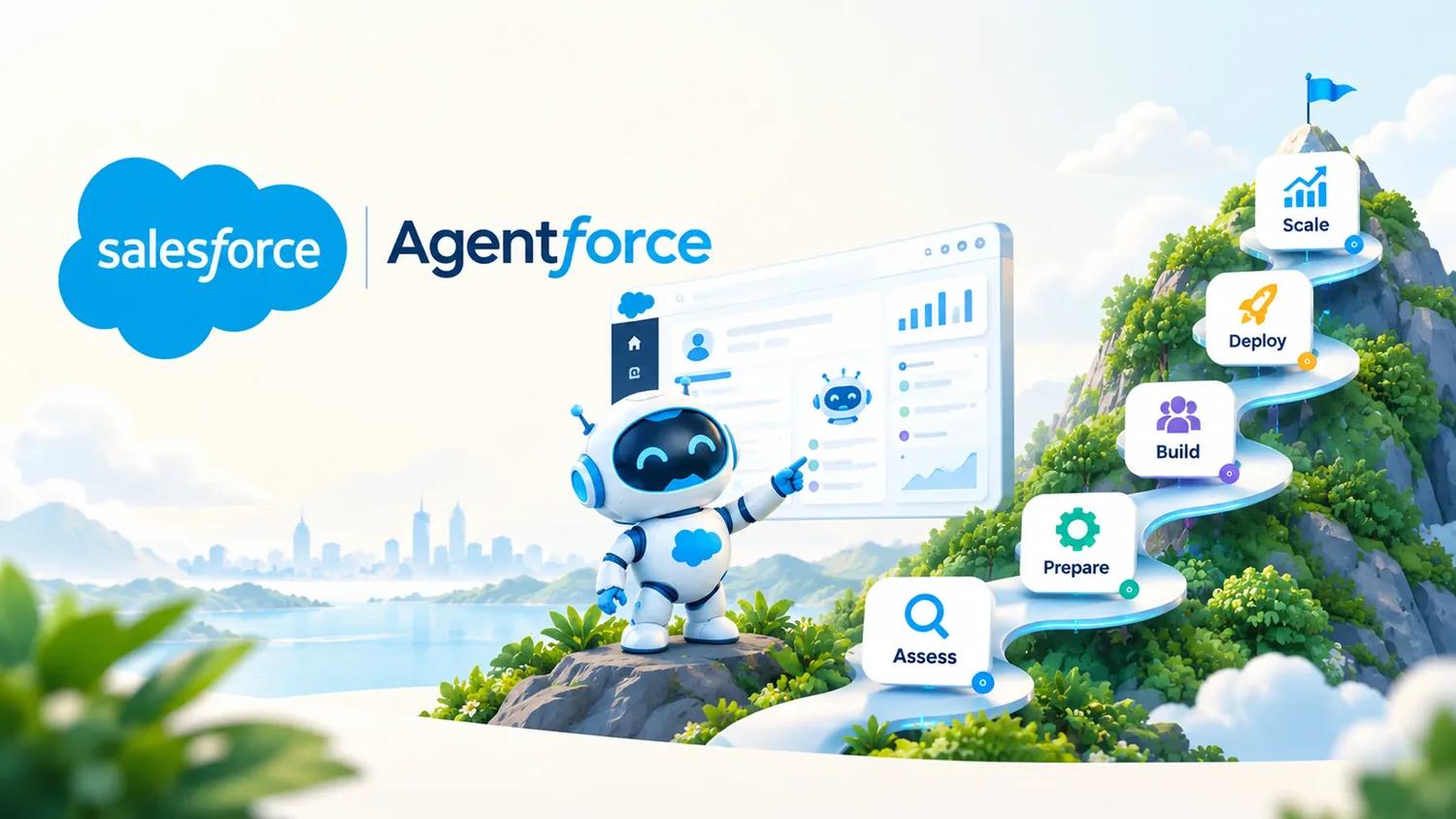
Quick Summary: What separates a dependable AI agent from a risky experiment? Reliable data, controlled permissions, tested integrations, clear escalation rules, and measurable business outcomes. This guide explains how to plan Salesforce Agentforce implementation from readiness assessment to production rollout and long-term optimization.
An AI agent can complete a task in seconds, but if it uses outdated customer data, triggers the wrong action, or exposes information to the wrong user, the consequences can extend far beyond a failed demo. Salesforce Agentforce implementation therefore starts with business readiness, not simply enabling an AI feature. Organizations need reliable CRM data, well-defined workflows, secure integrations, and clear rules for when an agent should act or hand a decision to a person.
The challenge is scaling AI responsibly. In a September 2026 survey, Gartner reported that only 22% of organizations had successfully scaled AI across multiple business units or adopted an AI-first approach. As companies plan for 2027, the real question is how to move from an impressive pilot to an AI agent that delivers measurable, controlled business value.
1. What Is Salesforce Agentforce, and When Is Your Business Ready?
Salesforce Agentforce enables businesses to build AI agents that can understand requests, use business context, and take defined actions through connected systems. Unlike a traditional chatbot that mainly answers questions, an agent can be configured to perform tasks such as summarizing a customer case, retrieving order details, or initiating an approved service workflow.
Readiness depends on whether the business can give the agent the right information, tools, permissions, and boundaries. The technology may be available, but that does not automatically mean every process is suitable for autonomy.
Salesforce's Agentforce architecture guidance describes how agents can access enterprise data and invoke tools to complete tasks. That capability makes workflow design and access control as important as the AI model itself.
How Can You Tell Whether Your Business Is Ready?
Assess five areas before committing to a rollout:
- Business process: Is the workflow documented, repeatable, and owned by a team?
- Data quality: Are customer records, knowledge articles, and operational data accurate and current?
- Integration: Can the agent securely retrieve information and invoke approved actions?
- Governance: Are its permissions, limits, and human-escalation rules defined?
- Measurement: Can you quantify the current cost, time, quality, and service level of the workflow?
A useful starting point is a process that occurs frequently, follows clear rules, and has measurable outcomes. Avoid beginning with a high-stakes process that depends on undocumented judgment or inconsistent records.
The business case should also distinguish between an agent that recommends an action and one that executes it. The second requires stronger controls because mistakes can affect customer records, payments, service commitments, or compliance obligations.
2. Agentforce Readiness: Data Cloud, CRM Data, and Process Gaps
An AI agent can only work with the context it can access and interpret. If Salesforce contains duplicate contacts, outdated account details, inconsistent case statuses, or incomplete knowledge articles, the agent may deliver an answer that sounds convincing but is wrong.
This is not a minor implementation detail. In a 2025 survey, Gartner reported that data availability and quality were among the leading AI implementation challenges, identified by 34% of leaders in low-maturity organizations and 29% in high-maturity organizations.
How Should You Prepare CRM Data?
Start with the information the selected use case needs—not an attempt to clean every record in the company at once.
- Identify source records. Determine which Salesforce objects, fields, knowledge articles, and external systems contain the required information.
- Check quality. Look for missing fields, duplicate records, conflicting values, outdated content, and inconsistent formats.
- Assign ownership. Name the team responsible for maintaining each critical data source.
- Set access rules. Confirm which information the agent may retrieve and which users or customers it can serve.
- Test real scenarios. Check whether the data supports the questions and actions expected in production.
How Do Data Cloud and Retrieval-Augmented Generation Fit In?
Salesforce Data Cloud, now referred to in Salesforce materials as Data 360, can help bring together supported customer and business data for use across Salesforce capabilities. The right design depends on the data sources, access requirements, latency needs, and use case; not every Agentforce project requires the same data architecture.
Retrieval-augmented generation (RAG) is another useful concept. In simple terms, the agent retrieves relevant information from approved sources before generating an answer. For example, a service agent might search product documentation and relevant case history rather than relying only on information learned during model training.
RAG does not automatically make the answer correct. The retrieved content must be relevant, current, and permission-appropriate, and the agent should be able to acknowledge when reliable evidence is missing.
How Do You Identify Process Gaps?
Map the current workflow from request to resolution. Document decision points, exceptions, required approvals, system dependencies, and handoffs to employees. If team members follow different unwritten procedures, standardize the process before automating it.
The objective is not to make every process fully autonomous. It is to provide the agent with a dependable operating environment—and a clear way to stop or escalate when that environment is insufficient.
3. How to Define the Right Agentforce Use Cases and KPIs
The strongest starting use case is not necessarily the most ambitious one. It is the one with a clear business problem, sufficient data, manageable risk, and an outcome that can be measured against the current process.
Capgemini Research Institute's 2025 research on generative and agentic AI reported that 14% of surveyed organizations were implementing AI agents at partial or full scale, while 23% were running pilots. The gap between experimentation and wider implementation reinforces the need for use cases that can demonstrate value beyond a controlled demonstration.
How Should You Compare Potential Use Cases?
Evaluate each candidate using four criteria:
- Business value: Does it reduce handling time, improve service, lower rework, or increase conversion?
- Technical feasibility: Is the required data accessible, and can the connected systems support the actions?
- Risk: What happens if the agent gives an incorrect answer or takes an incorrect action?
- Measurability: Can you establish a baseline and track improvement after deployment?
These are candidate measures, not promised results. The right KPI depends on the workflow and its existing performance.
How Do You Set a Meaningful KPI Baseline?
Record the current process before the agent goes live. For instance, if service representatives spend an average of eight minutes retrieving information and preparing a case response, measure that time across a representative sample. Then compare it with the assisted workflow while tracking answer quality and escalation rates.
Avoid measuring success only through the number of conversations or tasks completed. An agent may process more requests while increasing correction work or creating customer dissatisfaction.
Use a balanced scorecard that includes productivity, quality, risk, adoption, and cost. Assign a business owner to each metric and agree in advance on the minimum performance needed to expand the pilot.
4. Agentforce Architecture: APIs, Permissions, and Guardrails
An agent needs more than a language model. It needs a controlled way to retrieve information, decide which action is permitted, call the relevant tool, and handle the result. Architecture defines how those parts work together—and what happens when something fails.
Salesforce's Agentforce architecture documentation describes patterns for grounding agents in enterprise data and connecting them to tools and services. The appropriate design depends on the workflow, systems involved, and level of autonomy required.
How Should You Structure the Architecture?
A practical design separates the solution into five layers:
- User interaction: Where a customer or employee submits a request.
- Agent instructions and decision logic: The agent's purpose, topics, boundaries, and conditions for selecting an action.
- Data and knowledge access: The CRM records, approved documents, and external data used to ground responses.
- Action and integration layer: The APIs, flows, or services that perform approved operations.
- Monitoring and governance: Logs, access controls, evaluations, usage monitoring, and escalation processes.
This separation helps teams change one part of the solution without losing sight of the full workflow. It also makes troubleshooting easier: when an agent fails, the team can determine whether the problem came from the data, decision logic, API, permission model, or downstream system.
How Do You Control Permissions and Actions?
Apply the principle of least privilege: grant the agent only the access needed for its assigned work. Separate permission to read information from permission to change it, and use stronger approval controls for actions with financial, legal, customer-impacting, or irreversible consequences.
Important safeguards include:
- Restricting access to the required records and fields.
- Validating inputs before sending them to connected systems.
- Requiring confirmation or human approval for sensitive actions.
- Keeping logs of requests, actions, outcomes, and failures.
- Defining timeouts, retries, and recovery procedures for failed API calls.
- Testing whether the agent can be manipulated into ignoring its instructions.
Guardrails should be enforced by the surrounding system wherever possible, not only written into a prompt. A natural-language instruction can guide an agent, but application permissions and server-side validation provide stronger controls over what it can actually do.
5. Salesforce Agentforce Implementation: A Step-by-Step Rollout
A successful rollout moves from a defined business problem to a controlled pilot and then to expansion based on evidence. Building a working agent is one milestone; demonstrating that it performs reliably under real operating conditions is another.
How Can You Organize the Implementation?
Define the Business Outcome
Select one workflow, name its business owner, document the current process, and establish baseline measures. Agree on the tasks the agent may perform and those it must escalate.
Assess Data and Dependencies
Map Salesforce records, knowledge sources, external applications, API dependencies, data-quality gaps, and required permissions. Resolve critical blockers before building the workflow.
Design the Agent's Scope
Define instructions, topics, actions, success conditions, escalation rules, and restrictions. Keep the initial scope narrow enough to evaluate thoroughly.
Build and Connect Systems
Configure the agent and integrate required data and actions. Use secure authentication, scoped access, input validation, and explicit error-handling paths.
Test Before Release
Evaluate routine requests, ambiguous instructions, missing data, unauthorized requests, API failures, and human handoffs. Fix critical defects before the pilot.
Run a Controlled Pilot
Start with a limited group of users, a defined workflow, and clear escalation paths. Compare results with the baseline and collect employee and customer feedback.
Expand Using Evidence
Increase access or workflow scope only after the agent meets agreed quality, risk, adoption, and cost thresholds. Review performance regularly and retest after material changes.
How Do You Decide Whether to Move Beyond the Pilot?
Set the exit criteria before the pilot begins. These may include an acceptable error rate, consistent execution of approved actions, a measurable reduction in handling time, manageable cost per completed task, and reliable human escalation.
Do not expand because a demo looks promising or because users like the conversational interface. Expand when operational evidence shows that the agent improves the workflow without creating unacceptable risk or hidden work for employees.
6. What Are the Hidden Risks in Agentforce Implementation?
The most expensive failures are not always dramatic system outages. They may be incorrect answers that go unnoticed, duplicate transactions after a retry, excessive access to customer data, or a workflow that appears faster but creates more work for employees.
Capgemini Research Institute's 2025 report found that 71% of surveyed organizations said they could not fully trust autonomous AI agents for enterprise use. Trust needs to be supported by evidence, controls, and clear accountability—not by the agent's confidence or fluency.
How Can You Reduce the Main Risks?
Incorrect or unsupported answers. Ground responses in approved sources, measure answer quality, and provide a clear way to abstain or escalate when information is missing.
Excessive permissions. Limit access by role and task. Test whether the agent can retrieve restricted records or trigger actions beyond its intended scope.
Prompt injection and malicious inputs. Treat user messages and retrieved documents as untrusted input. Do not allow instructions inside those sources to override system controls or access rules.
Integration failures. Design for timeouts, partial failures, duplicate requests, and unavailable downstream services. For actions that modify data, use appropriate transaction checks and idempotency controls where supported so retries do not create duplicate changes.
Unclear accountability. Assign owners for the agent, the underlying process, the data sources, and incident response. Define when a human must review or approve an action.
Cost and usage growth. Monitor consumption, retries, tool calls, and human review effort. Set alerts and thresholds so unexpected usage can be investigated before it becomes a sustained operating expense.
How Should You Govern Higher-Risk Actions?
Classify actions by impact. Retrieving an approved knowledge article may require limited controls; issuing a refund, changing a contract, or altering a sensitive record needs stronger validation and may require human approval.
Governance should evolve with the agent. Each new action, data source, user group, or system integration can change the risk profile, so material changes should trigger a review and appropriate retesting.
7. How to Test AI Agents Before Production Deployment
AI agents do not always produce identical responses to identical prompts. Testing must therefore evaluate more than whether a single answer looks correct. Teams need to check whether the agent selects the right topic, invokes the correct action, respects permissions, retrieves relevant information, and handles exceptions safely.
Salesforce provides an Agentforce Testing Center for evaluating agent responses, action execution, and knowledge retrieval. Salesforce also cautions that tests can modify CRM data, which is why testing should be performed in a sandbox rather than against production records.
How Do You Build a Useful Test Suite?
Cover at least five categories:
- Routine scenarios: Common requests the agent should handle correctly.
- Boundary scenarios: Missing details, conflicting data, unusual requests, and ambiguous wording.
- Security scenarios: Attempts to access restricted data or perform unauthorized actions.
- Integration failures: Expired credentials, unavailable APIs, timeouts, and malformed responses.
- Recovery and escalation: Situations where the agent should stop, ask a clarifying question, retry safely, or hand off to a person.
For each scenario, define the expected behavior before running the test. For example, if a customer asks for an order status but provides an identifier that matches multiple records, the correct behavior may be to request clarification—not guess.
How Should You Measure Test Results?
The release conditions should be set by the business and technical owners based on the consequences of failure. A low-risk internal knowledge assistant and an agent that updates customer or financial records should not share identical acceptance criteria.
Testing should continue after launch. Repeat key tests after changing instructions, data sources, permissions, integrations, or models, and monitor real-world performance for new failure patterns.
8. Agentforce Integration With ERP, Odoo, and Legacy Systems
Salesforce may manage customer interactions, while an ERP system manages orders, inventory, finance, or fulfillment. If an agent needs information from both, integration design determines whether it can act on current, authoritative data.
Consider a customer asking whether an order has shipped. Salesforce may contain the support case, but the ERP may own the latest fulfillment status. The agent should retrieve the status from the system responsible for that information rather than assume the CRM copy is current.
How Should You Design Cross-System Workflows?
- Assign a system of record. Decide which application owns each critical data field and transaction.
- Define the integration contract. Specify required inputs, returned fields, authentication, validation, and error responses.
- Choose the interaction pattern. Use a synchronous call when the user needs an immediate response and an asynchronous pattern when processing may take longer.
- Handle failures explicitly. Define what the agent says when a system is unavailable and how the operation can be resumed or investigated.
- Log and reconcile transactions. Track identifiers and outcomes across systems so teams can investigate discrepancies.
Salesforce's Agentic Integration Patterns explain approaches such as sequential actions, parallel actions, asynchronous invocation, and grounding agents in enterprise content. The right pattern depends on whether steps depend on one another, whether a quick response is necessary, and how the downstream system handles failures.
How Can Agentforce Connect With Odoo?
For an Odoo integration, first establish whether Odoo is the authoritative source for the data or operation in question. Then define the approved API operations, field mappings, authentication, access rights, and recovery process.
For example, an agent could retrieve an order status from Odoo and summarize it in a Salesforce service interaction. If the workflow also changes an order, the integration needs stronger validation, authorization, transaction tracking, and a clear way to confirm whether the update succeeded.
Refer to the Odoo external API documentation for the version-specific API approach and access requirements. Confirm compatibility with the actual Odoo deployment and version before selecting an implementation method.
Avoid making Salesforce and Odoo independently authoritative for the same field without a defined reconciliation rule. Conflicting updates can create duplicate records, inconsistent status messages, and avoidable manual work.
9. How to Measure Agentforce ROI, Adoption, and Running Costs
An agent's business value depends on the work it completes correctly—not just the number of interactions it handles. A sound ROI model includes time saved, quality, rework, operating costs, integration maintenance, and human oversight.
How Do You Calculate the Return?
Start with the cost and performance of the existing workflow. Estimate the value of verified improvements, then subtract the full cost of running and maintaining the agent.
A useful framework is:
Net benefit = measurable operational benefits − total implementation and operating costs
ROI = (net benefit ÷ total implementation and operating costs) × 100
Benefits might include reduced handling time, fewer repetitive contacts, faster case resolution, or lower rework. Costs may include implementation, licenses or consumption, API usage, monitoring, evaluation, data maintenance, integration support, and human review.
Use observed pilot results wherever possible. Treat projected savings as estimates until they are validated in actual operations, and avoid counting the same benefit twice—for example, reporting both saved employee hours and the full monetary value of those same hours without explaining how the value is realized.
How Do You Account for Running Costs?
Review the pricing model and terms that apply to your specific Salesforce contract and Agentforce setup. Salesforce's Agentforce pricing page describes available pricing approaches; availability and commercial terms can change, so verify current details before budgeting.
Track the cost drivers that matter to your architecture:
- Agent interactions and applicable consumption units.
- API calls and external service usage.
- Repeated attempts caused by failed or incomplete actions.
- Retrieval, data, and infrastructure costs where applicable.
- Testing, monitoring, and evaluation activity.
- Human review and correction time.
A useful operational measure is cost per successfully completed task. This is more informative than cost per conversation if some conversations end without resolving the request or require substantial employee intervention.
How Should You Measure Adoption?
Track whether employees or customers use the agent, whether they accept its results, how often they request human assistance, and how much correction is required afterward. Low adoption may signal poor workflow fit, unclear communication, unreliable answers, or a process that is harder to use with the agent than without it.
Review financial and operational indicators together. A workflow that saves time but increases error rates may not produce a net benefit; one that costs slightly more per interaction may still be worthwhile if it materially improves accuracy or service quality.
10. Scaling Agentforce in 2027 for Your Next-Stage Roadmap
Scaling should be a sequence of evidence-based decisions, not a commitment to make every workflow autonomous. The goal for 2027 is to build a repeatable way to select, deploy, govern, and improve agents across the business.
How Can You Structure the Next Stage?
Stage 1 - Prepare
Establish Foundations
Choose a high-value workflow, fix critical data gaps, define ownership, document permissions, and establish baseline KPIs. Confirm that the organization can support testing and ongoing monitoring.
Stage 2 - Prove
Validate the Pilot
Test routine and adverse scenarios, measure quality and cost, observe user adoption, and confirm that human escalation works. Address the failures that could affect customers or operations.
Stage 3 - Expand
Reuse Proven Patterns
Extend to related workflows only when the evidence supports it. Reuse secure integration patterns, test templates, monitoring, and governance practices where appropriate.
Stage 4 - Optimize
Manage Performance Over Time
Review accuracy, adoption, exceptions, cost, and business impact. Reassess permissions and risk as new actions, systems, and user groups are added.
How Do You Know When to Scale?
Use a formal review with business, IT, security, data, and operations stakeholders. A workflow should move forward only when it meets agreed standards for:
- Business value against the original baseline.
- Accuracy and consistent execution of permitted actions.
- Data access, security, and compliance requirements.
- Cost per completed task and predictable usage.
- Employee adoption and customer experience.
- Support ownership, monitoring, and incident response.
Not every workflow will pass these criteria and that is useful information. A controlled decision to redesign, narrow, or stop a pilot is better than expanding an unreliable agent across multiple teams.
What to Target for Agentforce in 2027
The key decision is not whether your organization should use AI agents. It is which business processes are ready for them, what authority they should have, and how you will prove that they are producing value.
Start by selecting one workflow with a clear owner and measurable baseline. Check the quality of the data, map the required integrations, define the agent's permitted actions, and agree on the conditions that require human review. Then test the complete workflow—including failures—before giving it broader access.
For 2027, aim to build a repeatable implementation model: one that connects business outcomes to data readiness, secure architecture, disciplined testing, and ongoing measurement. Expand only when results justify it.
Before approving your next Agentforce initiative, ask one question: if the agent makes a mistake tomorrow, will your team know what happened, what it affected, and how to recover? If the answer is unclear, that is the work to address first.

Written by
Pratik Kantesiya
AI Engineering Lead
Pratik leads AI engineering at Agile Infoways, where he architects production AI systems for enterprises across healthcare, BFSI, and logistics. He writes about practical AI delivery — what works, what does not, and what most teams miss between proof-of-concept and production.