Quick Summary: Which AI architecture deserves your 2027 budget? Compare RAG, fine-tuning, and long context using data freshness, accuracy, security, latency, and total cost of ownership. Discover how to benchmark your options and move from pilot to production with confidence.
The most expensive AI decision may not be choosing the wrong model. It may be choosing the wrong way to give that model access to your business knowledge.
As enterprises move from AI experiments to production systems, the choice between RAG vs. fine-tuning, long-context prompting, and hybrid architectures affects more than response quality. It influences operating costs, data security, maintenance, and the reliability of business decisions. According to McKinsey's 2025 State of AI report, 88 percent of surveyed respondents reported AI use in at least one business function, yet most organizations were still working toward enterprise-wide scale.
The question is no longer whether AI can process business information. It is how to make that information accessible, current, and trustworthy without creating unnecessary complexity. This guide provides a practical framework to help enterprises choose the right architecture, measure its value, and prepare for 2027.
1. What Is the Difference Between RAG, Fine-Tuning, and Long Context?
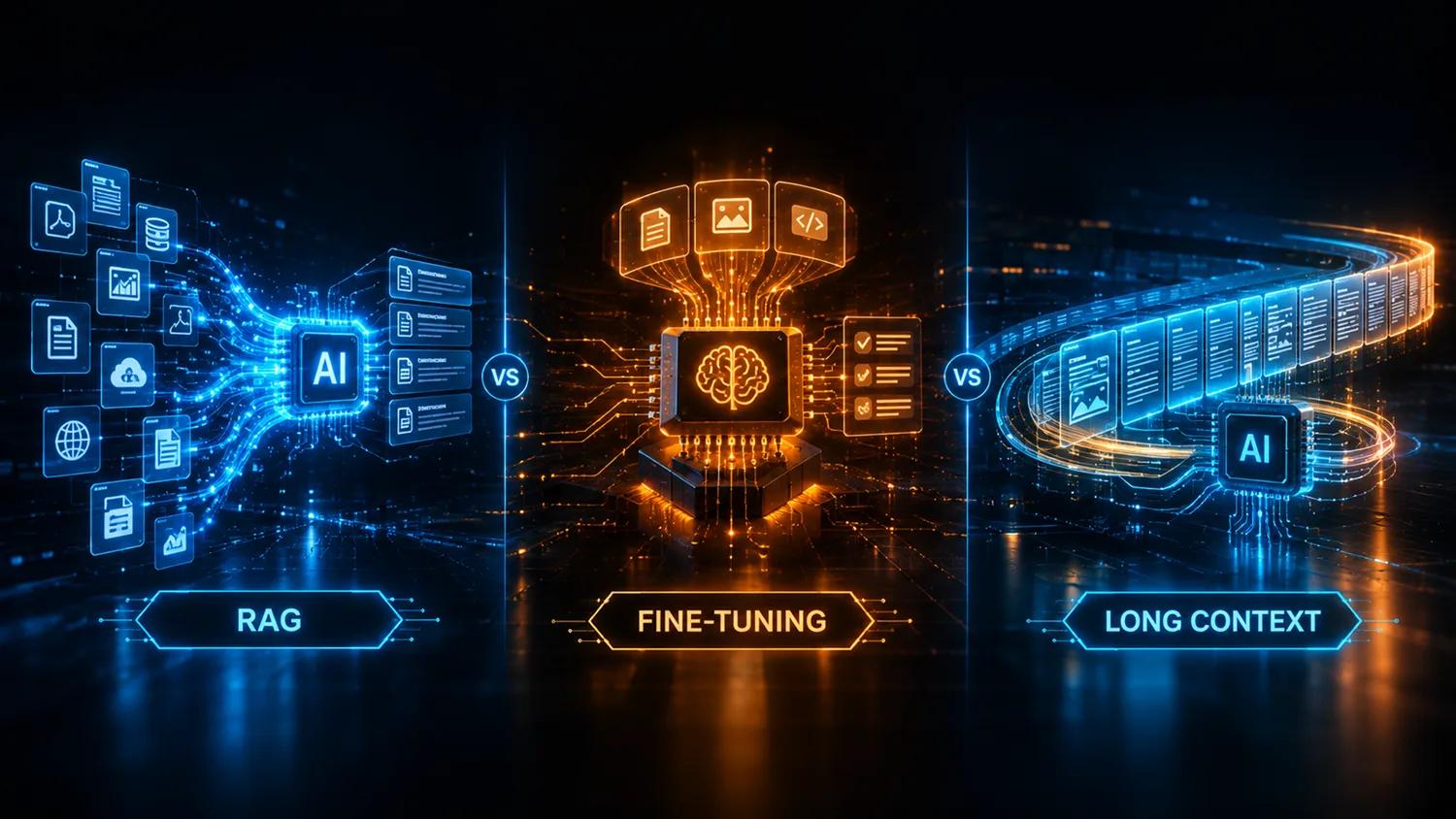
RAG, fine-tuning, and long context solve different problems. RAG retrieves relevant information when a question is asked, fine-tuning adapts a model's behavior through additional training, and long context allows a model to process more information within a single request. Choosing between them starts with understanding what your application actually needs.
How Does Each Approach Work?
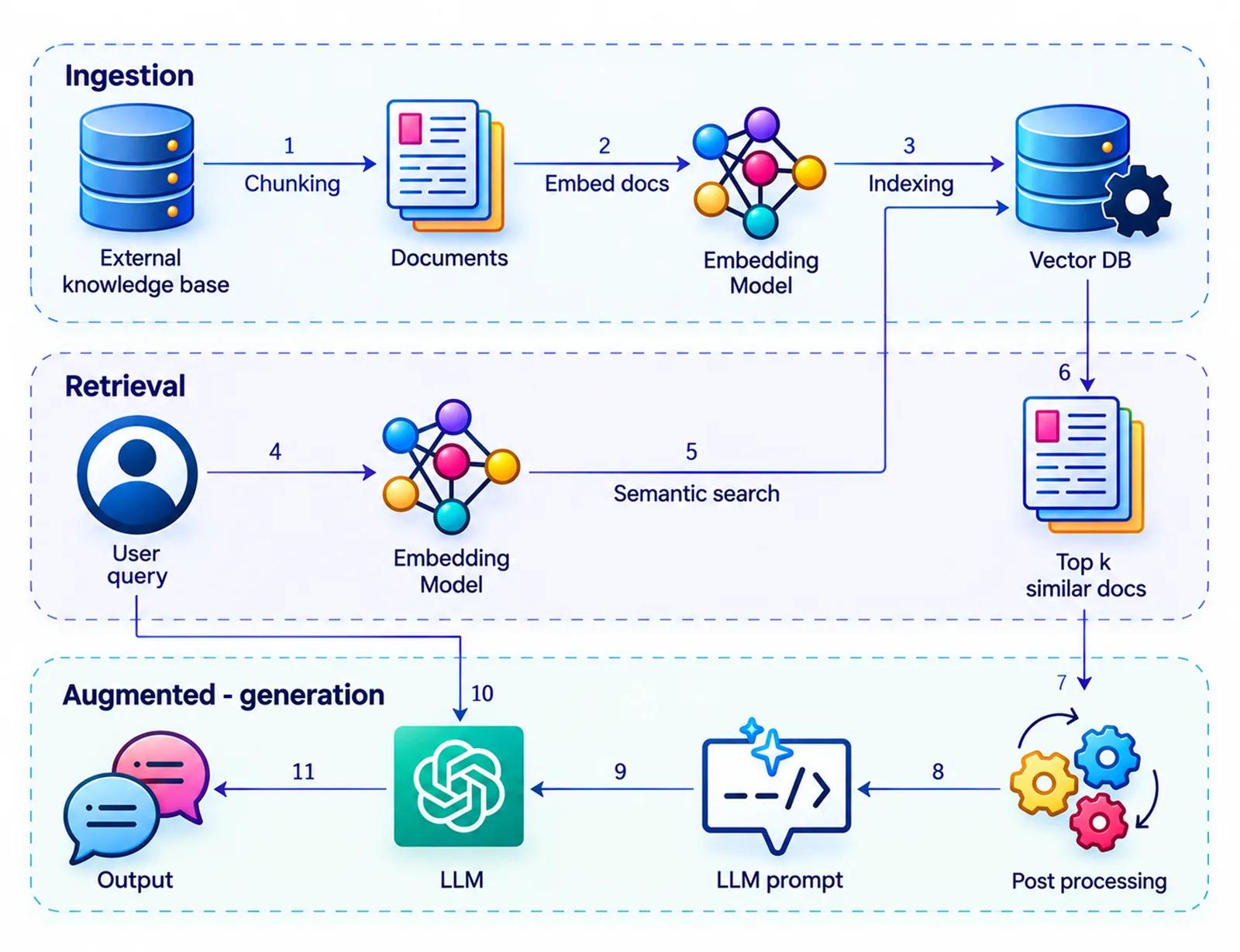
Retrieval-Augmented Generation (RAG)
Retrieves relevant passages from company documents, databases, or knowledge bases and supplies them to the language model to generate an answer. It suits applications where information changes frequently or answers must be grounded in source material.
Fine-Tuning
Trains an existing model further using carefully prepared examples so it learns a desired response pattern, task, or specialized behavior. It is useful when consistent output formats, domain-specific tasks, or instruction-following improvements matter.
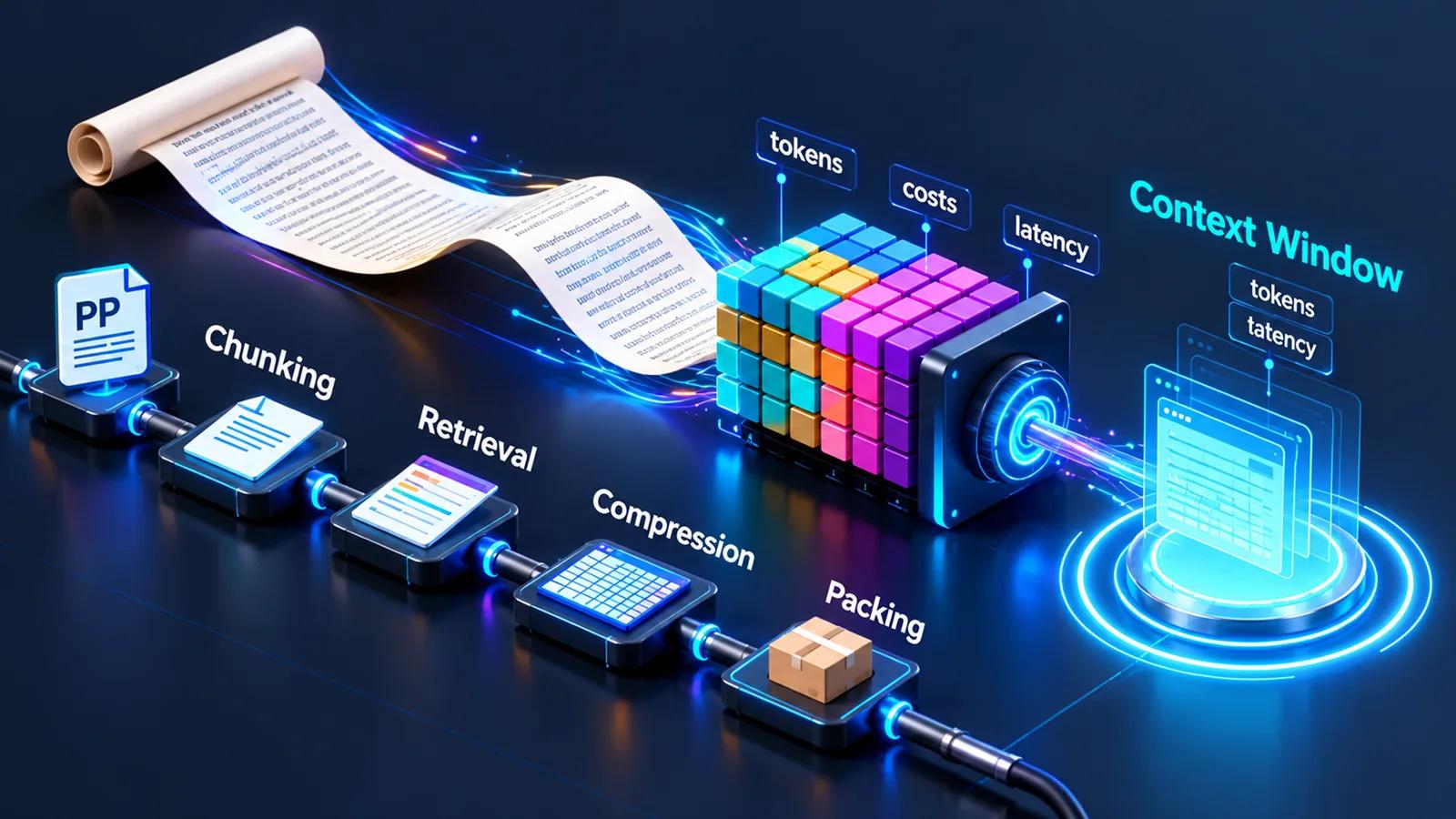
Long Context
Places a large amount of information directly into the model's input. It can help with lengthy contracts, extensive reports, or multi-document analysis when the model can process the material effectively within its context window.
How Do the Three Approaches Compare?
The right choice depends on the task, not the popularity of a technique. AWS Prescriptive Guidance similarly distinguishes retrieving information for question answering from fine-tuning for additional tasks and notes that both approaches can be combined.
2. When Should Enterprises Use RAG, Fine-Tuning, or Long Context?
Enterprises should select an approach according to how their information changes, how the model must behave, and how much information it needs to process per request. The decision becomes clearer when each technique is matched to a specific business problem.
When Should You Use RAG?
Choose RAG when answers depend on information that changes regularly, is distributed across business systems, or must be traceable to approved sources.
Common applications include:
- Healthcare knowledge assistants that retrieve approved clinical guidelines and internal procedures.
- Financial services assistants that search policy documents and compliance guidance.
- Customer support systems that use current product manuals and service records.
- Enterprise knowledge assistants that retrieve information from internal documentation.
- Supply chain applications that answer questions using current inventory and operational records.
For example, a customer support assistant may need to answer questions using the latest warranty policy. RAG allows the system to retrieve the current policy rather than relying on information learned during model training.
However, retrieval is not automatically reliable. If the knowledge base contains conflicting documents, outdated records, or poorly indexed content, the system may retrieve the wrong evidence.
When Should You Use Fine-Tuning?
Fine-tuning is useful when the model needs to perform a task in a more consistent or specialized way.
Consider it when you need to:
- Produce structured outputs that follow a defined format.
- Classify industry-specific requests or documents.
- Apply a consistent communication style across interactions.
- Improve performance on a specialized task using high-quality examples.
- Reduce dependence on lengthy or repetitive instructions, when evaluation confirms the benefit.
For example, an insurance organization might fine-tune a model to classify claims descriptions into predefined categories. The training examples teach the model how to perform the task; current policy rules and customer-specific information can still be retrieved separately.
Methods such as LoRA (Low-Rank Adaptation) can make adaptation more resource-efficient by training a smaller set of additional parameters instead of updating all model parameters. Parameter-efficient fine-tuning (PEFT) is an option when full model training is unnecessary.
A critical distinction: Fine-tuning on company documents does not turn the model into a dependable, continuously updated database. Knowledge can become stale, and the model may still generate unsupported claims.
When Should You Use Long Context?
Long context is worth considering when a task requires the model to examine substantial material together rather than retrieve a few relevant passages.
Examples include:
- Reviewing a lengthy contract alongside its amendments.
- Summarizing a collection of related reports.
- Comparing several technical specifications.
- Analyzing a long conversation or project history.
- Examining a large document where relationships across sections matter.
The trade-off is that accepting more input does not guarantee that the model will use every relevant detail correctly. Performance depends on the model, task, information structure, and how evidence is positioned in the input.
For repeated, predictable workloads, test whether prompt caching can reduce the cost of processing repeated prefixes. Caching may improve efficiency, but it does not eliminate context-window limits or solve poor reasoning.
3. How Do You Choose the Right Approach for Your AI Use Case?
The most effective way to choose an architecture is to score the use case against a consistent set of criteria rather than selecting a technique first and forcing the business problem to fit it.
How Should Knowledge Freshness, Accuracy, and Response Quality Influence Your Decision?
Start with three questions:
- How often does the information change? If policies, prices, inventory, or procedures change frequently, RAG can retrieve updated information without retraining the model.
- How consistent must the output be? If the model must follow a specific classification scheme or output format, test prompt engineering first and fine-tune if measurable gaps remain.
- How much information must be considered together? If the answer depends on relationships across many sections of a document, compare long-context processing with retrieval-based approaches.
The following decision framework translates these questions into an initial recommendation.
These are starting points, not universal rules. Benchmark the approaches on the same representative questions before committing to an architecture.
How Do Data Privacy, Latency, and Inference Costs Change the Decision?
An architecture that produces accurate answers may still be unsuitable if it exposes restricted information, responds too slowly, or costs too much at scale.
Data privacy and access control: Define which documents each user or application can access. RAG systems should enforce permissions during retrieval, not merely instruct the model to avoid restricted information. Long-context inputs must also be filtered before documents are passed to the model. Fine-tuning requires governance over training data, model artifacts, and possible memorization of sensitive information.
Latency: Measure the entire request path. RAG adds retrieval and sometimes reranking steps; long context may require processing more input tokens; fine-tuning can add training and deployment complexity even if it does not add a retrieval step at inference time.
Inference costs: Compare the complete workload rather than the advertised price of a model call. Include input and output tokens, embedding generation, vector database operations, reranking, caching, evaluation, monitoring, and ongoing maintenance.
The Stanford AI Index 2025 reported that the inference cost for a model performing at GPT-3.5's benchmark level fell by more than 280-fold between November 2022 and October 2024. This historical comparison illustrates how quickly the economics of AI can change; it does not guarantee that every enterprise workload will become cheaper.
For that reason, compare current model prices and measured usage when estimating your own total cost of ownership.
4. What Technical Factors Affect Enterprise LLM Performance?
Enterprise LLM performance depends on more than model selection. Retrieval quality, input construction, evaluation, and production monitoring can determine whether a promising demonstration remains reliable when real users and real data enter the picture.
How Do Retrieval Quality, Chunking, and Vector Embeddings Affect RAG?
A RAG pipeline generally follows this sequence:
1. Prepare the Knowledge Base
Clean documents, extract content, preserve metadata
2. Chunk and Embed
Split content into meaningful passages and create vector representations
3. Retrieve and Rerank
Find relevant passages and rank the strongest evidence
4. Generate and Validate
Give the model relevant context and check the response against evidence
Each stage introduces potential failure points.
- Chunking: Splits documents into smaller passages. Chunks that are too small may lose important context, while oversized chunks may include irrelevant information.
- Embeddings: Represent the meaning of text as numerical vectors, allowing semantically related content to be retrieved even when wording differs.
- Vector databases: Store and search those vectors. Metadata filters can narrow retrieval by department, document type, date, or permitted access.
- Reranking: Reorders retrieved passages using a more targeted relevance assessment before sending them to the model.
- Grounding and citations: Connect generated claims to the retrieved evidence so that responses can be checked against source material.
A less obvious challenge is that retrieval quality and answer quality are different measurements. A system may retrieve a relevant passage but still misinterpret it. Alternatively, the model may answer correctly from general knowledge even though the retrieval process failed.
Test both stages independently.
How Do Context-Window Limits and Token Usage Affect Results?
A context window defines how much input and output a model can handle within a request, subject to its specific limits and configuration.
Tokens are pieces of text processed by the model. They are not identical to words: a sentence, code sample, or document may consume different numbers of tokens depending on its content and tokenizer.
A larger context window can accommodate more information, but three constraints remain:
- Cost: More input can increase per-request charges.
- Attention and relevance: Important information can be overlooked when surrounded by large amounts of unrelated material.
- Operational limits: Context size, response-token limits, latency, and model-specific behavior still apply.
The phenomenon commonly called lost in the middle describes how a model may use information less reliably when relevant evidence appears in the middle of a long input than when it appears in more prominent positions. The effect varies by model and task, so it should be measured rather than assumed.
Use a needle-in-a-haystack evaluation: place a known fact at different positions within inputs of increasing length, then test whether the model can retrieve it accurately. For enterprise applications, extend this test to conflicting information, multiple documents, and questions that require combining facts.
How Should Enterprises Evaluate Models, Guardrails, and Monitoring?
Before production, create an evaluation set containing realistic user questions, expected answers, approved source documents, and examples of situations where the model should refuse or acknowledge uncertainty.
Track at least five dimensions:
- Retrieval relevance: Did the system retrieve the evidence needed to answer?
- Answer correctness: Is the response factually accurate?
- Groundedness: Are claims supported by the supplied evidence?
- Security: Can users access only the information they are authorized to see?
- Operational performance: What are the latency, failure rate, and cost per successful task?
Guardrails should also cover sensitive information, unsupported claims, prompt injection, unsafe tool use, and attempts to bypass permissions. Their design must reflect the risks of the specific application.
The NIST Generative AI Profile provides guidance for identifying and managing risks throughout the design, development, evaluation, and use of generative AI systems.
In production, monitor changes in data quality, retrieval behavior, user feedback, response quality, and costs. Re-evaluate after model changes, prompt updates, index refreshes, or significant shifts in user behavior.
5. When Should You Combine RAG, Fine-Tuning, and Long Context?
A hybrid architecture makes sense when one technique cannot meet all the requirements at an acceptable cost and quality level. The key is to assign each technique a distinct responsibility instead of combining them simply because all three are available.
Consider an enterprise assistant that helps employees answer questions about internal policies.
- RAG retrieves the latest approved policy documents.
- Fine-tuning, if evaluation supports it, adapts the model to a specialized classification task or response format.
- Long context helps when a particular question requires reviewing several related documents together.
Not every application needs all three. A well-designed RAG system with a capable base model may be sufficient for a knowledge assistant. A fine-tuned model may add little value if the real problem is poor retrieval. A long-context approach may be preferable for occasional document analysis when indexing and maintaining a retrieval system would add unnecessary overhead.
How Do You Decide Whether a Hybrid Architecture Is Worth the Complexity?
Use this sequence:
- Establish a baseline. Test the base model with clear instructions and representative business inputs.
- Identify the failure. Determine whether errors stem from missing knowledge, inconsistent task behavior, poor retrieval, or insufficient context.
- Add the smallest effective intervention. Improve prompting, retrieval, document preparation, or model adaptation according to the observed gap.
- Retest the same evaluation set. Compare answer quality, security, latency, and cost.
- Add another technique only when the evidence justifies it. Document its expected benefit and ongoing maintenance requirements.
This approach prevents architecture from becoming more complex than the business problem requires.
It also creates a useful separation of responsibilities: retrieve facts from systems designed to manage facts, use training to improve model behavior when justified, and provide longer context when the task genuinely needs it.
6. How Do You Measure ROI Before Moving from Pilot to Production?
A successful pilot proves that a solution can work under selected conditions. Production readiness requires evidence that it can deliver repeatable business value across realistic workloads, users, data, and failure scenarios.
How Should Enterprises Calculate the Business Case?
Start with a measurable business outcome rather than an AI-specific target.
For example, a customer support assistant should be assessed on whether it reduces resolution time without increasing incorrect answers, escalations, or customer complaints. An internal knowledge assistant should be measured on whether employees find accurate information faster, not simply how many questions it answers.
Use the following framework.
How Can You Estimate Return on Investment?
A practical starting point is:
Net benefit = Quantified benefits − Total costs
ROI (%) = (Net benefit ÷ Total costs) × 100
Total costs should include engineering, model usage, infrastructure, data preparation, integrations, security controls, testing, monitoring, support, and maintenance. Benefits should reflect verified savings or incremental value rather than assumed productivity gains.
For example, suppose an AI assistant saves 10 minutes per task across 2,000 tasks per month. That represents approximately 333 hours of capacity released monthly. It is not automatically equivalent to 333 hours of cash savings: the financial benefit depends on whether that capacity is productively redeployed, overtime is reduced, or additional output is delivered.
How Do You Decide Whether to Scale?
Before moving to production, agree on measurable acceptance criteria for accuracy, security, latency, operating cost, and business value.
Run the system on representative data, including difficult queries and failure cases. Compare the baseline with each proposed architecture using the same evaluation set. Include human review where the consequences of incorrect answers are material.
Scale in stages: begin with a controlled user group, review performance and incidents, address weaknesses, and expand only when the agreed criteria are met.
McKinsey's 2025 State of AI research found that many organizations were still in experimentation or pilot stages, despite widespread AI use. The practical lesson is that adoption alone does not establish enterprise value. Workflow integration, operational discipline, and measurable outcomes matter just as much as model capability.
7. What Should Enterprises Prioritize for AI in 2027?
Enterprises preparing for 2027 should prioritize reliable data, measurable outcomes, controlled deployment, and architectures that can evolve with changing business needs. The objective is not to adopt the newest AI technique; it is to build systems that remain useful, secure, and economically viable as usage grows.
How Should You Prepare Your AI Architecture for 2027?
Focus on five priorities.
- Build a reliable data foundation. Clean up duplicate, outdated, and conflicting information. Establish ownership, metadata standards, access controls, and refresh schedules before connecting enterprise knowledge to an LLM. A strong AI data engineering practice makes this foundation repeatable.
- Make evaluation part of development. Maintain representative evaluation sets and test changes to models, prompts, retrieval, and data. Establish quality thresholds before allowing applications to handle higher-risk tasks.
- Design for security from the beginning. Apply least-privilege access, audit trails, appropriate data retention, and controls against prompt injection. Review the entire flow of information, including retrieved documents, model inputs, outputs, and connected tools.
- Optimize for total cost of ownership. Measure actual usage, token consumption, caching effectiveness, retrieval costs, and ongoing maintenance. Reassess model and architecture choices as prices and capabilities change.
- Plan for production, not just pilots. Establish monitoring, incident response, version control, fallback behavior, and clear ownership. Determine how the system will be maintained when documents, processes, and business requirements change.
How Should Enterprises Phase Their Implementation Roadmap?
Phase 1: Assess and Prioritize
Identify high-value use cases, assess data readiness, define risks, and document the baseline metrics.
Phase 2: Test and Compare
Benchmark prompting, RAG, fine-tuning, and long context where relevant using the same representative evaluation set.
Phase 3: Validate Production Readiness
Test security, permissions, failure handling, latency, monitoring, and cost against agreed thresholds.
Phase 4: Scale and Optimize
Expand by business value, review production metrics, and refine the architecture as evidence accumulates.
This roadmap gives organizations a way to move from experimentation to controlled deployment without locking themselves into an unnecessarily complex architecture too early.
8. Build an Enterprise AI Strategy for 2027
The architecture you choose today will influence your AI costs, data governance, and ability to scale in 2027. But the bigger risk is investing in a solution before identifying the actual reason your current approach falls short.
Start with one business problem. Define the information the model needs, the behavior it must demonstrate, the risks it must avoid, and the outcomes the business expects. Test RAG when current, traceable knowledge is essential; fine-tuning when measurable improvements in specialized behavior justify additional training; and long context when a task benefits from examining substantial information together. Combine them only when testing demonstrates a meaningful advantage.
Agile Infoways helps organizations assess AI use cases, engineer custom AI applications, develop RAG knowledge systems, and integrate AI into enterprise workflows. The focus is on matching architecture to business requirements and validating results through measurable performance, security, and cost criteria.
Before committing your 2027 AI budget, ask one question: Can your team demonstrate why its chosen architecture is the right fit—and prove that it delivers the intended business value?
If the answer is not yet clear, make that the next milestone. An evidence-based architecture decision today can help prevent avoidable rework and make future AI investments easier to justify.

Written by
Pratik Kantesiya
AI Engineering Lead
Pratik leads AI engineering at Agile Infoways, where he architects production AI systems for enterprises across healthcare, BFSI, and logistics. He writes about practical AI delivery — what works, what does not, and what most teams miss between proof-of-concept and production.