
Quick summary - Businesses are shifting from app-based systems to agentic AI. Discover how hiring AI ML developers helps leaders deploy intelligent automation, reduce operational delays, and create faster, decision-driven workflows across finance, operations, and support. Read the blog now and learn more.
AI adoption in enterprises has accelerated quickly, and so has the rate to hire AI ML developers. Nearly eight in ten companies have deployed GenAI in some form. But here's the catch: almost the same number say it hasn't moved revenue, margins, or operational efficiency. This is the GenAI paradox: a lot of deployment, not a lot of impact.
The core issue is where companies applied AI. Most invested in horizontal tools, such as copilots, chat interfaces, writing assistants, and chatbots. These are helpful, but they don't actually change how work gets done. They make work nicer, not faster.
Meaningful value comes from vertical, workflow-specific use cases, the ones buried deep inside operations, finance, support, and supply chain. These require systems that don't just assist users but act on their behalf. This is where agentic AI systems replace traditional app-driven workflows. Instead of humans pushing buttons and routing tasks, AI agents observe data, decide next steps, and execute them inside business systems.
This shift matters because enterprises can't scale headcount at the same pace as work volume. And the truth is, most organizations are still stuck in pilot mode, never pushing into real production workflows. This is exactly why businesses are now choosing to hire AI/ML developers to build systems that do the work, not just support it.
What AI Agents in Business Actually Do (Beyond Chatbots)
Most people still think of AI in terms of chatbots, tools that answer questions or generate text. But AI agents in business are fundamentally different. They don't just talk, they do. AI agents observe → decide → act → escalate, just like a trained employee would -
- They observe real-time data, system states, and workflow conditions.
- They interpret business rules, policies, and intent—not just text.
- They decide what should happen next using learned patterns and prior outcomes.
- They execute actions directly inside enterprise systems (CRM, ERP, ticketing, billing).
- And if something falls outside the expected logic, they escalate to a human for review.
This is what we refer to as agentic AI workflows. Unlike traditional automation, which follows rigid scripts and breaks when exceptions appear, AI-driven workflow automation adapts in real business environments. It can handle the messy middle, the part of work where judgment, variation, and context matter.
This is why more enterprises are evaluating AI agents as the execution layer, not just another tool. Instead of employees clicking through screens to complete routine steps, agents progress work automatically, and humans step in only where judgment is required. It's autonomy. Not chat, that drives operational efficiency.
Reasons Businesses Are Choosing to Hire AI/ML Developers for Agentic Systems
When enterprises across industries decide to move from traditional apps to agentic systems, the first realization hits quickly: this is not just "plug in an AI model" and call it a day. Businesses that turned early AI experiments into agentic systems are now seeing measurable results. Considering their win and strategic insights, businesses are leaning towards implementing AI Agents. To build workflows where AI actually does the work, they need to hire AI developers who understand execution logic, system integration, and real-world process constraints. This is where AI ML Development Services and experienced AI engineers come in.
Traditional apps rely on people to click, route, and interpret. But AI agents need:
- Memory modeling so they understand context over time
- Tool-calling logic so they can take action in CRMs, ERPs, and support platforms
- Workflow orchestration to know when and how to move work forward
This requires you to hire AI architects to design reasoning and memory layers, while machine learning development teams build the orchestration and exception-handling logic. A strong AI ML Development Company doesn't just connect APIs, they design how work actually flows when humans aren't the ones pushing every button.
The shift isn't about removing software systems. It's about moving execution away from user interfaces and into autonomous workflow layers where AI agents handle routine work and humans handle judgment.
Core Architecture of Autonomous Workflows (Intelligent Process Automation)
To move beyond basic automation and into workflows that actually run on their own, organizations are shifting toward intelligent process automation. This new model doesn't replace systems like Odoo ERP or Salesforce CRM; it changes how workflows flow through them. And this shift requires thoughtful AI development, not just plugging in an LLM.
Agentic workflows are built on a layered architecture designed for decision-making, context awareness, and direct system execution. This is where a seasoned AI software development services partner or an experienced Artificial Intelligence development company plays a crucial role.
Model Layer (Reasoning)
This layer uses large language models or specialized domain models to interpret context and decide what should happen next. It's responsible for logic, classification, prioritization, and workflow direction.
Memory Layer (Context + Vector Databases)
Agents need history to act intelligently. The AI solution stores internal SOPs, past resolutions, business rules, exceptions, logs, and common edge cases in a vector knowledge base. This is what prevents "hallucinated" decisions.
Tool-Calling Layer (System Permissions + API Integrations)
Instead of waiting for human clicks, the agent interacts directly with enterprise systems, updating CRM records, triggering ERP workflows, routing tickets, issuing approvals, generating schedules, or adjusting configurations. This is where autonomy replaces manual navigation.
Orchestration Layer (Decision Routing)
This layer defines how tasks progress: sequence, dependencies, branching, rollback steps, and escalation triggers. It ensures workflows execute logically, reliably, and consistently.
Human Override Layer (Exception Handling)
Humans remain in the loop, but only where nuance, negotiation, or judgment is needed. Routine work becomes machine-handled; edge cases become human-reviewed. This architecture lets organizations scale workflow output without scaling headcount, which is exactly why the shift toward agentic systems is accelerating.
Where Agentic Workflows Are Already Replacing Traditional Apps
Enterprise AI automation is no longer a lab experiment; it's already in motion across multiple industries. Businesses are realizing that traditional apps, which depend on users to drive every click and approval, can't keep up with the pace of modern operations. Agentic workflows flip that model on its head. Instead of employees chasing status updates or moving data between systems, AI agents manage end-to-end workflows, stepping in proactively when conditions change.
These systems observe, decide, act, and escalate in real time, cutting through bottlenecks that were once considered "just part of the process." The impact is especially visible in sectors where tasks are repetitive, time-sensitive, and rule-heavy. Finance, supply chain, HR, and even healthcare operations are now leveraging agentic AI to automate decisions instead of just tasks.
Below are real-world examples of how enterprise AI automation is changing the dynamics of day-to-day work across industries -
Agentic workflow impact across industries-
These agentic systems don't just "assist" teams; now they handle execution. The result? Faster decisions, fewer errors, and teams that can focus on strategy instead of spreadsheet gymnastics. That's the real promise of enterprise AI automation, not replacing people, but replacing lag with intelligence.
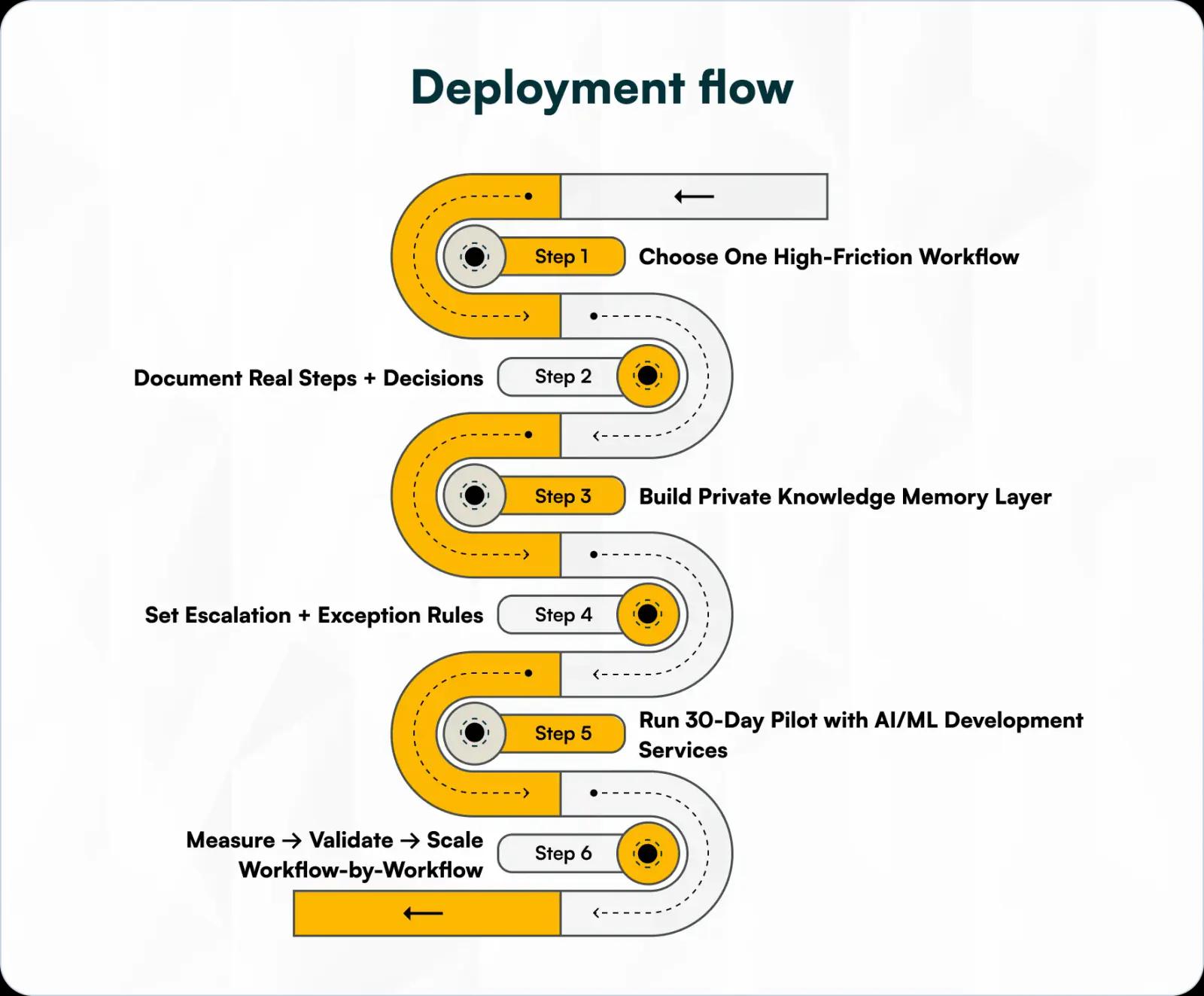
How to Start (6 Steps Leader's Playbook)
Most organizations overcomplicate AI deployment. You don't need a 12-month roadmap or a giant strategy binder. You need one workflow where manual effort is slowing things down—and a focused pilot that proves real operational value.
Here's the step-by-step approach used by teams successfully deploying agentic systems -
Step 1: Identify One Workflow With Recurring Delays
Look for tasks that are repetitive, rules-driven, and high volume, invoice approvals, support triage, purchase routing, scheduling, or reconciliation are common starting points.
Step 2: Document the Real Workflow
Not the "perfect SOP." The real sequence humans actually follow under pressure—including shortcuts and decisions made on the fly.
Step 3: Build a Private Knowledge Memory Layer
This is where your business logic lives:
- Policies
- Past resolutions
- Exceptions
- Decision patterns
This enables consistent, reliable AI decision-making.
Step 4: Define Escalation Boundaries
The agent should:
- Act automatically when conditions are clear
- Escalate to a human when something looks unusual, sensitive, or high-risk
This maintains trust and audit control.
Step 5: Run a 30-Day Pilot
Deploy the workflow with AI/ML development services in USA and measure:
- Cycle-time reduction
- Queue/volume throughput
- Error reduction
- Human workload shift
Step 6: Scale Workflow by Workflow
If the pilot works, repeat the pattern for one workflow at a time.
The Advantage Goes to Companies That Move First
The shift from traditional app-driven workflows to agentic execution is already underway. It's not about eliminating jobs or replacing core systems; it's about removing operational drag. When AI agents handle the repetitive, rules-based steps, teams spend more time on judgment, strategy, and customer impact. Organizations that adopt now will run faster, operate with fewer delays, and scale without scaling headcount.
The window is open, but it won't stay open for long!
Those who start small and learn early gain a lasting advantage!
Those who wait will adopt later, only under pressure and at a higher cost.

Written by
Hiral Bhatt
Content Writer
Hiral Bhatt is a technical content writer with a management background and a deep interest in emerging technologies. She blends analytical thinking with a passion for writing to create clear, insightful content that helps readers understand complex digital concepts effectively in every industry she writes for.