
Quick summary: Agentic AI in 2026 is no longer experimental. This blog explains what has changed, what works at scale, and how enterprises can adopt agentic systems safely without increasing risk across operations, data, and governance.
2026 has just begun, and using agentic AI as an add-on or background assistant is no longer enough. It now operates as a full architecture layer across sales, service, operations, finance, and other business functions.
We have moved from rule-based automation to systems that plan, act, validate, and learn with intent. For enterprises, this shift changes the stakes of AI adoption.
Every enterprise therefore needs a capable AI/ML development company that brings responsibility, control, and clarity to implementation. What organizations deploy today may run critical parts of tomorrow’s business at global scale.
The global agentic AI market is booming, projected to grow from roughly $7.3 billion in 2025 to over $88 billion by 2032 at around a 43% CAGR, reflecting businesses embedding agentic systems deeply into core workflows rather than treating them as experiments. Besides that, research from PwC indicates that 88% of leaders plan to increase AI budgets due to agentic AI, with over a quarter increasing budgets by 26% or more to support scaling and governance.
This creates pressure to separate real progress from overstated claims. Not every agent is ready for production, and not every promise holds up under operational pressure.
Understanding what has genuinely changed, what works today, and how to move forward without increasing risk is now a leadership priority.
Agentic AI in 2026: A Quick Reality Check
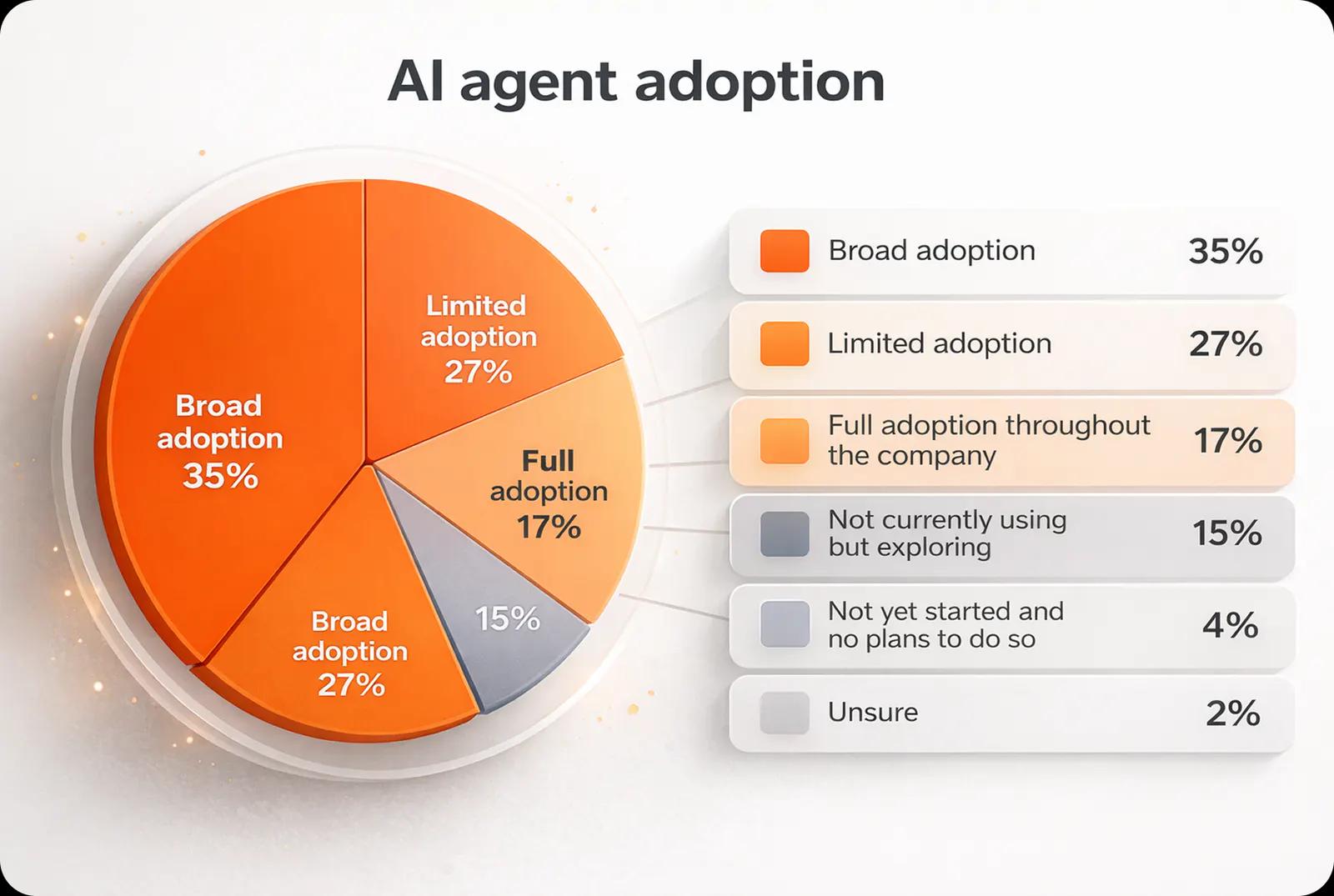
In 2026, agentic AI has moved beyond isolated experiments and proofs of concept.
Enterprises are now running coordinated agents that execute tasks across systems. This shift requires clarity about what agentic AI can handle reliably and where human oversight remains essential.
The focus is no longer novelty. It is stability, accountability, and measurable outcomes.
From Copilots to Autonomous Workflows
Early AI copilots assisted users with suggestions, summaries, and generated content.
Agentic AI systems go further. They can:
- Plan a sequence of steps
- Invoke approved tools
- Retrieve relevant context
- Perform actions across systems
- Validate results
- Adapt when inputs change
- Escalate when a decision exceeds their authority
These systems can manage end-to-end workflows such as case resolution, order processing, internal approvals, and service operations.
Delivering this capability requires mature AI/ML services and teams that know how to design agents with clear goals, boundaries, validation rules, and fallback paths.
Why Enterprises Are Paying Attention Now
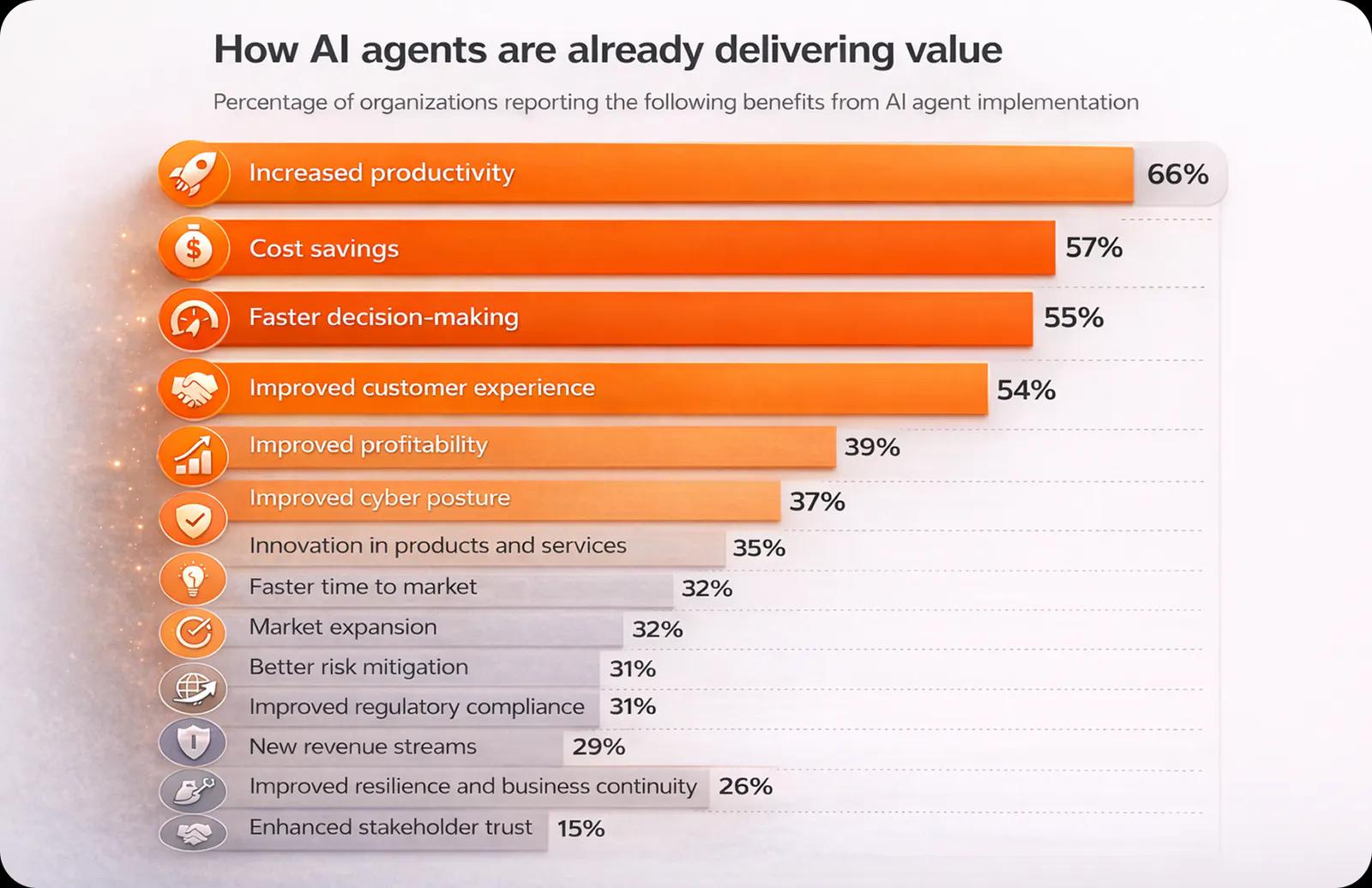
Enterprises are paying attention because agentic AI directly affects cost, speed, and operational consistency.
When designed correctly, agents reduce manual handoffs and decision delays across departments. However, greater autonomy also raises the stakes around control, reliability, privacy, and auditability.
Many organizations therefore choose to hire AI/ML developers who understand enterprise systems, data-access policies, integration requirements, and governance.
Don’t miss this: Agentic AI Deployment: 10 Lessons from a Year in Production
What Actually Changed Since Early Agentic AI
Early agentic AI focused on experimentation and narrow tasks.
In 2026, the change is structural. Agents increasingly operate as coordinated systems rather than isolated logic units. Enterprises deploy them with defined goals, controls, ownership, and accountability.
This maturity has pushed AI/ML development companies to focus less on novelty and more on reliability, orchestration, security, and long-term operational fit.
Improved Reasoning, Memory, and Planning
Modern agents work across multi-step objectives instead of responding to one prompt at a time.
They retain short- and long-term context, evaluate alternatives, and adjust plans when conditions change. This enables agents to manage workflows such as approvals or issue resolution without repeated human prompting.
To build this capability, organizations hire AI/ML developers experienced in:
- Reasoning models
- Context and memory management
- Retrieval-augmented generation
- Decision validation
- Planning frameworks
- Exception handling
Better Tool Use and System Integration
Agentic AI now interacts directly with enterprise systems such as:
- CRMs
- ERPs
- Ticketing platforms
- Internal APIs
- Knowledge bases
- Data warehouses
- Communication tools
- Workflow engines
Agents can retrieve data, trigger actions, and verify outcomes across systems in sequence.
This level of integration depends on well-structured AI/ML services that manage permissions, error handling, identity, audit logs, and data boundaries.
Shift from Demos to Production Use
Earlier agentic AI initiatives were often demos designed for visibility rather than durability.
In 2026, enterprises are deploying agents into live environments with uptime requirements, security expectations, audit needs, and measurable service levels.
This shift requires:
- Production engineering
- Observability
- Fallback logic
- Evaluation frameworks
- Security controls
- Cost monitoring
- Incident response
- Human escalation
Organizations increasingly hire developers who understand production systems, not only experimental models.
What's Real vs. What's Still Hype
Agentic AI in 2026 sits at a clear dividing line between proven capability and overstatement.
Some agents consistently deliver value in controlled environments. Others remain experimental.
For enterprises, the challenge is not adopting as quickly as possible. It is choosing which use cases justify investment today and which require more maturity from AI models, platforms, data, and development practices.
Capabilities That Work Reliably Today
Today’s agentic systems can reliably manage structured, repeatable workflows such as:
- Ticket triage
- Data validation
- Report generation
- Cross-system record updates
- Document classification
- Knowledge retrieval
- Routine approval routing
- Incident categorization
- Standard customer-service requests
They perform best when objectives are well defined, actions are constrained, and data access is controlled.
Limitations Enterprises Still Face
Agentic AI still struggles with:
- Ambiguous goals
- Incomplete or conflicting data
- Situations requiring nuanced judgment
- Long-running tasks without supervision
- Context loss across systems
- Unclear ownership
- Unpredictable external dependencies
- High-impact actions without validation
These limitations explain why AI/ML services must include monitoring, constraints, escalation logic, and approval mechanisms that prevent agents from operating beyond their intended scope.
Common Misconceptions to Avoid
A common misconception is that agentic AI can replace entire teams or operate safely without oversight.
Another is that model intelligence alone guarantees reliability.
In reality, outcomes depend heavily on:
- System design
- Data quality
- Tool integration
- Governance
- Testing
- Observability
- Human accountability
Enterprises that hire production-experienced AI/ML developers are more likely to avoid these traps.
Where Agentic AI Delivers Real Enterprise Value
Agentic AI creates value when applied to processes that require speed, consistency, and coordination across systems.
Enterprises are increasingly targeting functions where agents can own clearly defined outcomes.
Success depends on process boundaries, measurable objectives, and teams that align agent behavior with operational controls.
Customer Support and Service Operations
In customer support, agentic AI can manage:
- Case intake
- Prioritization
- Knowledge lookup
- Recommended resolutions
- CRM updates
- Follow-up communication
- Escalation
- Routine case closure
An experienced AI/ML development company ensures that agents follow service policies, protect customer data, and maintain traceability across every action.
Sales, Marketing, and Revenue Workflows
Agentic AI supports sales and marketing by:
- Qualifying leads
- Enriching prospect records
- Updating pipelines
- Generating proposals
- Coordinating follow-ups
- Summarizing account activity
- Identifying stalled opportunities
- Triggering next-best actions
These agents work best when goals are measurable, such as response time, conversion, or deal progression.
IT Operations and Internal Automation
In IT operations, agents can handle:
- Incident triage
- System health checks
- Access provisioning
- Workflow routing
- Alert analysis
- Approved remediation
- Documentation
- Status updates
Strong engineering ensures that agents operate within permission limits, preserve logs, and support compliance across internal systems.
Enterprise Risks You Cannot Ignore
As agentic AI takes on decision-making and execution, enterprise risk expands beyond model accuracy.
Agents now interact with systems, data, and workflows that affect customers, revenue, and operations. Small design gaps can scale into significant failures.
Autonomy Without Governance
When agents act independently without defined boundaries, they may trigger actions that exceed business intent.
This can include:
- Launching incorrect workflows
- Repeating flawed decisions
- Modifying records improperly
- Sending inappropriate communications
- Bypassing approval requirements
Governance defines approved goals, escalation rules, permissions, and checkpoints.
Enterprises must decide who sets limits, who reviews outcomes, and when human intervention is mandatory.
Data Access and Security Exposure
Agentic AI often requires access to multiple systems.
Without strict permission controls, agents may retrieve or modify sensitive data unintentionally. This can expose customer information, financial records, health data, or internal intellectual property.
Key controls include:
- Scoped permissions
- Identity management
- Least-privilege access
- Data masking
- Secret management
- Activity logging
- Environment separation
Reliability, Auditability, and Trust
Enterprises must trust that agents behave consistently under real operating conditions.
Failures become more costly when actions cannot be traced or explained. Auditability requires every decision, tool call, input, and result to be recorded.
Reliable monitoring and reporting build confidence that agentic AI supports operations predictably rather than creating hidden risk.
How to Adopt Agentic AI Without Increasing Risk
Successful adoption depends more on discipline than speed.
Enterprises that scale safely treat agents as controlled systems, not unlimited automation.
Clear objectives, oversight, and recovery planning determine whether agentic AI becomes an operational asset or a source of instability.
Start with Bounded, Goal-Driven Agents
Begin with agents designed around narrow, measurable goals.
Clear success criteria limit unexpected behavior and simplify evaluation. Bounded agents operate within predefined:
- Actions
- Data sources
- Tools
- Decision paths
- Time limits
- Permission levels
This approach allows teams to validate performance before expanding scope or increasing autonomy.
Human-in-the-Loop and Escalation Design
Human oversight remains essential for complex or high-impact decisions.
Agents should know when to:
- Pause
- Request approval
- Ask for missing information
- Escalate an exception
- Transfer ownership
- Stop execution
Escalation rules based on confidence scores, exceptions, financial thresholds, or policy conflicts reduce risk while allowing agents to automate routine work.
Monitoring, Guardrails, and Rollback Plans
Continuous monitoring tracks agent behavior, results, costs, and anomalies in real time.
Guardrails restrict actions outside approved parameters. Rollback plans allow teams to reverse unintended changes quickly.
Together, these controls ensure agentic systems can be corrected without causing lasting operational impact.
Architecture and Governance Essentials
As agentic AI becomes embedded across enterprise functions, architecture and governance define whether it succeeds.
Strong foundations ensure that agents act safely, consistently, and in alignment with business intent.
Agent Orchestration and Control Layers
Orchestration layers coordinate how multiple agents:
- Interact
- Sequence tasks
- Share context
- Resolve dependencies
- Handle failures
- Transfer work
Control layers define execution limits, approval flows, and exception handling.
Together, they prevent agents from acting independently in conflicting ways and allow enterprises to manage scale without redesigning every agent.
Data, Identity, and Permission Management
Each agent should have a defined identity, role, and scope.
Identity management ensures agents retrieve or modify only the information they are authorized to use.
This improves security, simplifies monitoring, and aligns agent actions with enterprise policies.
Compliance and Audit Readiness
Compliance depends on visibility.
Enterprises must log:
- Decisions
- Tool usage
- Data access
- Inputs and outputs
- Approvals
- Escalations
- Errors
- Final outcomes
Audit-ready systems allow teams to trace results back to source data and governing policies.
A Practical 90-Day Adoption Roadmap
A structured 90-day roadmap helps enterprises move from intent to execution without overexposure. Rather than a broad rollout, this approach emphasizes controlled pilots, clear ownership, and measurable outcomes. The goal is to validate value, identify risks early, and build confidence before expanding agentic AI across additional business functions.
Pilot Selection and Success Metrics
Effective pilots focus on processes with clear inputs, outputs, and performance gaps. Success metrics should be defined upfront, such as cycle-time reduction, error rates, or manual effort saved. Narrow pilots make results easier to evaluate and help teams understand where agentic AI performs reliably under real operational conditions.
Team Roles and Operating Model
Agentic AI adoption requires defined roles across business, engineering, and governance teams. Business owners set objectives, technical teams manage agent behavior, and reviewers oversee outcomes. A clear operating model ensures decisions, updates, and escalations follow structured paths, reducing dependency on individuals and improving long-term sustainability.
Scaling Beyond the First Use Case
Scaling should only occur once performance, controls, and monitoring prove stable. Reusable agent patterns, shared orchestration, and standardized governance accelerate expansion. This disciplined approach allows enterprises to add new use cases without increasing risk or complexity as agentic AI becomes part of daily operations.
What Enterprise Leaders Should Do Next
Gartner predicts that over 40% of agentic AI projects may be canceled by 2027 due to unclear value or risks. It is therefore about time to partner with the leading AI/ML development company and treat agentic AI adoption as a long-term operating shift that affects risk, cost, and execution. The focus should be on informed action, moving forward with clarity while ensuring accountability, visibility, and control remain firmly in place.
Leaders must decide where agentic AI fits into core operations, which processes are suitable for autonomy, and what level of oversight is required, and hire AI architects accordingly. Choices around data access, governance, ownership, and integration depth will shape outcomes. These decisions should align with business priorities, not vendor capabilities alone.
Readiness comes from disciplined preparation rather than aggressive rollout. Enterprises should invest in skills, governance frameworks, and monitoring systems before expanding scope. By validating performance through limited deployments, leaders can build internal confidence and operational maturity without locking the organization into high-risk commitments.

Written by
Pratik Kantesiya
AI Engineering Lead
Pratik leads AI engineering at Agile Infoways, where he architects production AI systems for enterprises across healthcare, BFSI, and logistics. He writes about practical AI delivery — what works, what does not, and what most teams miss between proof-of-concept and production.