Quick Summary: What does the path from manual deployments to managed cloud operations really look like? This practical framework breaks the journey into five maturity stages and explains how to improve automation, cloud infrastructure, observability, security, reliability, and measurement, then connects these capabilities to platform engineering, SRE, AI-assisted operations, and the strategic priorities businesses face in 2026–27.
DevOps maturity is no longer just an engineering concern. For CXOs, it directly affects release speed, cloud costs, operational resilience, security, and the ability to scale digital products. Yet many organizations still move between manual deployments, disconnected tools, and reactive incident management. DevOps consulting services can help organizations identify these gaps and build a structured path toward automation and managed cloud operations. The objective is not to adopt every new tool. It is to create an operating model in which software can move from code to production safely, infrastructure can scale predictably, and teams can respond to problems before they become business disruptions.
How Do You Assess Your Organization's DevOps Maturity?
Assess DevOps maturity as an operating capability, not simply by counting how many tools an organization uses.
A company may have Git repositories, containers, Kubernetes, CI/CD tools, and cloud infrastructure while still operating at a relatively low maturity level if releases require manual intervention or production incidents depend on a few individuals.
A practical assessment should examine five areas:
- Development: How consistently is code reviewed, tested, and integrated?
- Deployment: How much of the release process is automated?
- Infrastructure: Can environments be created consistently through code?
- Operations: How quickly can teams detect, diagnose, and recover from incidents?
- Governance: Are security, access, compliance, and cost controls built into workflows?
The goal is to establish a baseline before deciding what to automate next.
How to Identify Your Current DevOps Maturity Stage
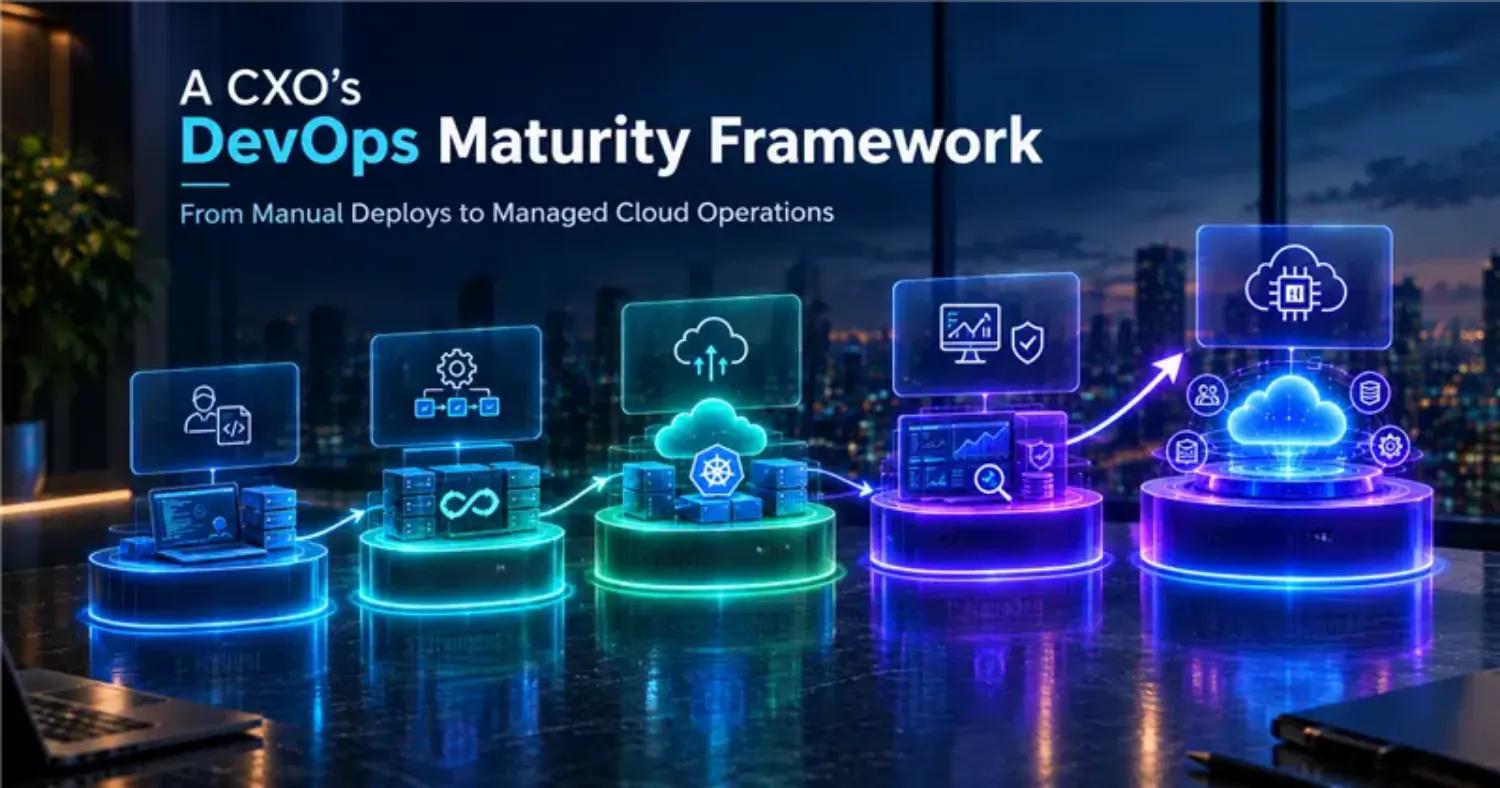
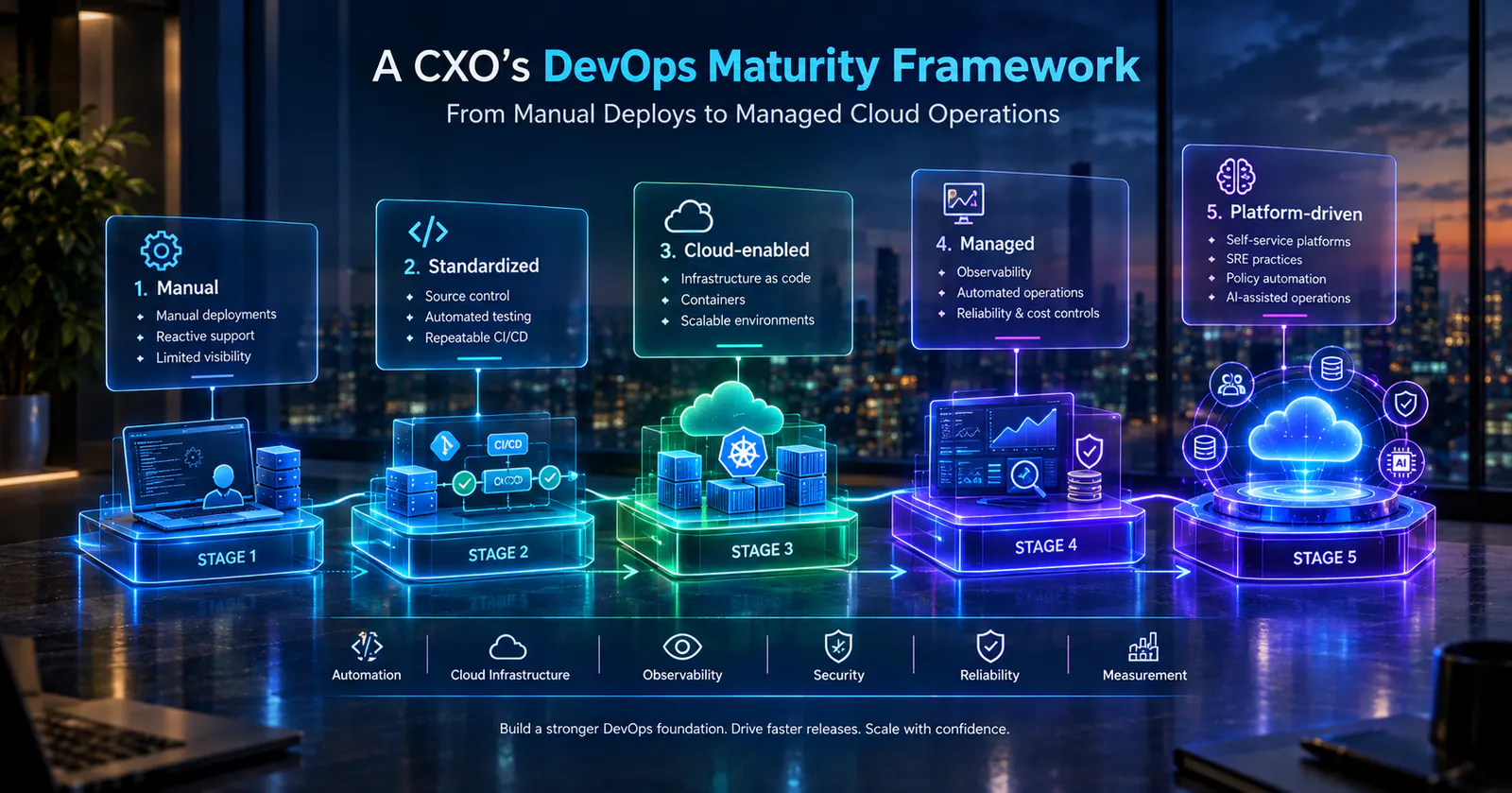
A useful maturity model can be viewed as five progressive stages:
The important point is that organizations do not need to reach Stage 5 everywhere. A regulated financial application may require a different operating model from an internal business application.
Maturity should therefore be measured against business requirements, application criticality, regulatory obligations, and growth plans.
How to Find Gaps in People, Processes, and Technology
Start by mapping the journey of a typical production change:
Developer commits code → code review → build → automated tests → security scan → artifact creation → deployment → monitoring → incident response
Now ask where humans must intervene.
If a release requires someone to manually copy files, change configuration, approve infrastructure commands, or verify deployments through spreadsheets, those points represent potential automation opportunities.
The same exercise should be performed for infrastructure provisioning and incident management.
This prevents a common mistake: buying another DevOps tool before understanding the operational problem it needs to solve.
How to Conduct a DevOps Maturity Assessment
A practical assessment can score each capability against four questions:
- Is the process documented?
- Is it repeatable?
- Is it automated?
- Can its outcome be measured?
For example, if infrastructure provisioning is documented but still performed manually, it may be standardized but not automated.
If infrastructure is provisioned through Terraform or another infrastructure-as-code system, changes are reviewed through Git, and deployments are integrated into CI/CD, the capability has reached a higher level of maturity.
The assessment should result in a prioritized roadmap rather than a long list of technical recommendations.
How Do You Move From Manual Deployments to Standardized DevOps?
The first major step is to make the software delivery process repeatable.
Manual deployment processes often create hidden dependencies. One person may know which server needs to be updated, which environment variable needs to change, or which command needs to run before production is ready.
That creates operational risk and makes scaling difficult.
How to Replace Manual Releases With Repeatable Workflows
Begin by moving deployment instructions into version-controlled configuration.
A basic workflow might look like:
Code commit → pull request → automated build → automated tests → security checks → deployment to staging → approval → production deployment
Each stage should produce a visible result.
For example:
- Tests return pass/fail results.
- Security scans identify vulnerabilities.
- Builds generate versioned artifacts.
- Deployment tools record which version was released.
- Monitoring confirms whether the application remains healthy.
This creates an auditable delivery chain.
How to Standardize Environments and Configuration
A common source of deployment failures is the difference between development, staging, and production environments.
Infrastructure as code (IaC) can reduce this inconsistency by defining infrastructure in machine-readable configuration.
Instead of manually creating a database, network, load balancer, or virtual machine, teams can define the desired state in code.
Tools such as Terraform, AWS CloudFormation, and Azure Resource Manager can then provision infrastructure consistently.
Configuration should also be separated from application code where appropriate. Secrets should never be stored directly in source repositories; they should be managed through systems such as AWS Secrets Manager, Azure Key Vault, or comparable secret-management platforms.
How to Reduce Deployment Errors and Release Risk
Automation should not mean removing every human decision.
For high-risk production changes, organizations can retain approval gates while automating the technical execution.
A mature deployment process can also support:
- Blue-green deployments
- Canary releases
- Automated rollback
- Feature flags
- Database migration checks
- Health checks
- Deployment validation
The objective is controlled change, not simply faster change.
How Do You Build a Reliable CI/CD Pipeline?
A mature CI/CD pipeline creates a consistent path from source code to production.
How to Automate Code Builds and Testing
Every meaningful code change should trigger automated validation.
A typical pipeline may include:
- Source checkout
- Dependency installation
- Static code analysis
- Unit testing
- Integration testing
- Security scanning
- Application build
- Container image creation
- Artifact storage
For containerized applications, the resulting image can be stored in a registry and promoted through environments rather than rebuilt differently for each environment.
This creates a traceable relationship between the code that was tested and the code that reaches production.
How to Introduce Continuous Integration and Continuous Deployment
Continuous integration focuses on frequently merging and validating changes.
Continuous deployment takes automation further by allowing validated changes to reach production with minimal manual intervention.
However, not every organization should immediately implement fully automatic production deployment.
A sensible progression is:
Automated testing → automated staging deployment → controlled production deployment → automated production deployment where risk permits
This allows teams to improve delivery speed without ignoring application criticality or regulatory requirements.
How to Automate Releases, Rollbacks, and Approvals
A production pipeline should define what happens when a deployment succeeds and what happens when it fails.
For example:
Deploy → health check → traffic shift → monitor → confirm
If health checks fail, the pipeline can stop the rollout or return traffic to the previous version.
For database changes, rollback planning becomes more complex because schema changes may not be reversible. Teams may therefore use backward-compatible database migrations and phased releases.
This is where good CI/CD design becomes an operational discipline rather than simply a collection of automation scripts.
How Do You Scale DevOps Across Cloud Environments?
Cloud adoption becomes significantly more valuable when infrastructure can be managed consistently.
Simply moving servers from a data center to AWS or Azure does not create DevOps maturity.
How to Move From Manual Infrastructure to Infrastructure as Code
Infrastructure as code treats infrastructure definitions as software.
A simplified workflow is:
Infrastructure code → pull request → review → validation → plan → approval → deployment
Terraform, CloudFormation, and similar tools allow teams to define networks, compute resources, databases, permissions, and other cloud components through configuration.
This creates several benefits:
- Repeatable environments
- Version-controlled infrastructure
- Easier disaster recovery
- Faster environment creation
- Reduced configuration drift
- Better auditability
Infrastructure changes can also follow the same review practices as application changes.
How to Standardize Development, Staging, and Production
The objective is not necessarily to make every environment identical.
Instead, environments should follow the same architectural patterns while using appropriate capacity.
For example, production may use multiple availability zones and larger database instances, while development uses smaller resources.
Infrastructure code can define these differences through variables or environment-specific configuration.
This allows teams to scale without creating completely separate operational processes.
How AWS and Azure DevOps Consulting Can Support Cloud Adoption
Cloud DevOps implementations often require decisions around networking, identity, compute, storage, containers, monitoring, CI/CD, security, and cost management — the kind of cross-cutting work cloud infrastructure specialists are brought in to help design and execute.
AWS environments may use services such as:
- Amazon EKS
- Amazon ECS
- AWS CodePipeline
- AWS CodeBuild
- Amazon CloudWatch
- AWS IAM
Azure environments may use:
- Azure Kubernetes Service
- Azure DevOps
- Azure Monitor
- Microsoft Entra ID
- Azure Policy
- Azure Container Registry
The objective should be to create a coherent operating model rather than simply adopt equivalent services across cloud providers.
How Do You Move From DevOps Automation to Managed Cloud Operations?
Automation becomes strategically important when an organization must operate more applications without continuously increasing operational overhead.
How to Introduce Monitoring and Observability
Monitoring tells teams that something is wrong.
Observability helps them understand why.
A mature observability model typically combines:
- Metrics
- Logs
- Distributed traces
- Application performance monitoring
- Infrastructure telemetry
- User-facing service indicators
For example, a sudden increase in application latency may appear as a metric. Distributed tracing can then help identify whether the delay originates in the application, database, API dependency, or network.
This reduces the time required to diagnose production issues.
How to Automate Incident Detection and Response
A mature operations model should define what happens when an alert is generated.
A typical flow is:
Detection → alert → classification → automated remediation where possible → escalation → recovery → post-incident review
Not every alert should wake an engineer.
Low-risk issues can sometimes be handled automatically — for example, restarting an unhealthy container or scaling a service when predefined thresholds are reached.
More serious incidents should trigger escalation based on severity and business impact.
How to Control Cloud Performance, Reliability, and Costs
Cloud operations require more than uptime monitoring.
CXOs should also understand:
- Which applications consume the most resources?
- Which workloads are over-provisioned?
- Which resources are idle?
- How quickly can capacity scale?
- What is the cost of a transaction or workload?
- Are non-production resources automatically shut down?
Cost controls can be integrated into infrastructure code and deployment workflows.
This becomes increasingly important as AI workloads add new compute and infrastructure requirements. Gartner's September 2026 forecast puts worldwide AI spending at approximately $2.7 trillion in 2026, with AI infrastructure accounting for about $1.48 trillion. Gartner forecasts AI infrastructure spending to reach nearly $1.98 trillion in 2027.
When DevOps Managed Services Make Sense
Managed DevOps services can be useful when an organization needs mature cloud operations but does not want every operational capability to be built internally.
They can cover areas such as:
- CI/CD management
- Cloud infrastructure
- Monitoring and observability
- Security automation
- Incident response
- Infrastructure optimization
- Reliability engineering
The right model depends on application criticality, internal skills, operating hours, compliance requirements, and the organization's long-term technology strategy.
How Do You Know When to Adopt Platform Engineering or SRE?
As organizations grow, DevOps practices often evolve into more specialized operating models.
How Do DevOps and Platform Engineering Differ?
DevOps is primarily an operating philosophy and set of practices that bring development and operations closer together.
Platform engineering focuses on creating internal platforms that make common engineering tasks easier.
An internal developer platform might provide standardized templates for:
- Creating a new application
- Provisioning infrastructure
- Creating CI/CD pipelines
- Configuring monitoring
- Managing secrets
- Deploying applications
Developers consume these capabilities through self-service workflows rather than repeatedly configuring the underlying infrastructure.
How Do Platform Engineering and SRE Differ?
Site Reliability Engineering focuses heavily on reliability, availability, performance, incident management, and measurable service objectives.
SRE teams may use:
- Service-level indicators
- Service-level objectives
- Error budgets
- Automated remediation
- Capacity planning
- Incident response
Platform engineering and SRE can complement one another.
A platform can provide standardized deployment and infrastructure capabilities, while SRE practices help ensure the services running on that platform remain reliable.
For organizations considering the transition, the Google SRE resources provide a useful reference for understanding reliability engineering practices and operating principles.
How to Measure DevOps Maturity With DORA Metrics
DevOps maturity should ultimately be measured by outcomes rather than the number of tools deployed.
What Are DORA Metrics?
DORA's framework provides five software delivery performance metrics:
Throughput
- Change lead time
- Deployment frequency
- Failed deployment recovery time
Instability
- Change fail rate
- Deployment rework rate
The distinction matters because a team may deploy frequently while also generating excessive rework.
The DORA metrics guide recommends looking at these measures as indicators of software delivery performance rather than treating them as a simplistic score.
How to Track Deployment Frequency, Lead Time, Change Failure Rate, and Recovery Time
Consider a simplified example.
If a team moves from deploying once every two weeks to several times per week, deployment frequency has improved.
But if failed deployments also increase significantly, the organization has not necessarily improved its overall delivery performance.
This is why CXOs should examine throughput and stability together.
A practical executive dashboard can include:
How Do You Measure DevOps Success?
A CXO dashboard should connect engineering metrics to business outcomes.
For example:
Engineering metric: deployment frequency Business question: Can product teams respond faster to market requirements?
Engineering metric: failed deployment recovery time Business question: How quickly can the organization restore customer-facing services?
Engineering metric: cloud utilization Business question: Are infrastructure investments aligned with actual demand?
This creates a stronger connection between technology operations and business performance.
How Do You Build Security Into a Mature DevOps Model?
Security should become part of the delivery process rather than a final checkpoint before release.
How Do You Integrate Security Into DevOps?
DevSecOps introduces security controls throughout the software lifecycle.
A pipeline may include:
Code → SAST → dependency scanning → container scanning → infrastructure scanning → deployment → runtime monitoring
SAST tools analyze source code for vulnerabilities.
Dependency scanners identify risks in third-party libraries.
Container scanning examines application images for known vulnerabilities.
Infrastructure scanning evaluates cloud configuration against security policies.
This approach allows vulnerabilities to be identified earlier, when they are generally easier to address.
Organizations can use established frameworks such as the NIST Secure Software Development Framework (SSDF) to structure secure software development practices.
How Does PAM Improve DevOps Security?
Privileged access management controls who can access sensitive systems and what they can do.
Instead of providing engineers with permanent administrative access, organizations can use:
- Role-based access
- Temporary credentials
- Just-in-time access
- Multi-factor authentication
- Session logging
- Approval workflows
This reduces the risk associated with compromised credentials or unnecessary administrative privileges.
PAM becomes especially important as infrastructure becomes increasingly automated because CI/CD systems themselves may have significant production access.
How to Build Security and Compliance Into Cloud Operations
Security policies can increasingly be represented as code.
For example, an organization can establish policies requiring:
- Encryption for storage
- Approved geographic regions
- Mandatory tagging
- Restricted network exposure
- Logging for privileged actions
- Approved container images
Automated policy checks can prevent non-compliant infrastructure from being deployed.
This changes security from a periodic audit exercise into a continuous control mechanism.
How to Build a DevOps Maturity Roadmap
A maturity roadmap should define what changes first, what changes next, and how progress will be measured.
How to Prioritize Automation, Cloud, Security, and Reliability
Do not automate everything simultaneously.
Prioritize capabilities according to business impact.
A useful sequence may be:
1. Stabilize → 2. Standardize → 3. Automate → 4. Measure → 5. Optimize
For example, automating an unstable deployment process can simply make failures happen faster.
First standardize the process. Then automate it.
Likewise, moving an inconsistent application to Kubernetes may increase operational complexity rather than reduce it.
The right architecture depends on the workload.
How to Set Maturity Milestones and Measurable Goals
Each maturity stage should have measurable outcomes.
For example:
Stage 1 goal: document the release process Stage 2 goal: automate testing and deployment Stage 3 goal: provision infrastructure through code Stage 4 goal: establish measurable reliability and cloud operations Stage 5 goal: provide self-service engineering capabilities
Each milestone should have an owner, target date, dependency list, and measurable outcome.
How to Decide Between In-House, Outsourced, and Hybrid DevOps
There is no universal delivery model.
An organization with a large engineering organization may build core DevOps and SRE capabilities internally.
A growing company may use a hybrid model in which internal teams own architecture and product decisions while an external team supports cloud engineering, automation, monitoring, or specialized infrastructure.
DevOps outsourcing can also be appropriate for specific capabilities where maintaining an internal 24/7 operation would be disproportionate to business needs.
The decision should consider:
- Internal expertise
- Application criticality
- Compliance requirements
- Operational coverage
- Total cost
- Vendor dependency
- Knowledge transfer requirements
When Can DevOps Consulting Services Accelerate the Journey?
External expertise can be useful when an organization knows its operational model needs to change but has difficulty determining where to begin.
How DevOps Consulting Services and Solutions Can Support the Journey
A consulting engagement can begin with an assessment of:
- Application architecture
- CI/CD pipelines
- Cloud infrastructure
- Security controls
- Monitoring
- Incident management
- Engineering workflows
- Cloud costs
The output should be a prioritized improvement roadmap.
The value is not simply implementing tools. It is helping the organization connect technical changes to measurable outcomes.
How DevOps Consulting and Managed DevOps Services Work Together
Consulting and managed services solve different problems.
Consulting is often focused on designing and improving the operating model.
Managed services are focused on running and continuously optimizing defined capabilities.
An organization might therefore use consulting to redesign its CI/CD and cloud architecture, then use managed DevOps services to support monitoring, infrastructure operations, and ongoing optimization.
This model can also evolve as internal capabilities grow.
How to Choose the Right DevOps Consulting Partner
CXOs should look beyond certifications and tool expertise.
Important questions include:
- Can the partner assess the current operating model?
- Can it connect engineering metrics to business outcomes?
- Does it understand cloud security and governance?
- Can it work across CI/CD, infrastructure, observability, and reliability?
- Can it support modernization without forcing unnecessary technology changes?
- Is knowledge transfer part of the engagement?
- Can success be measured after implementation?
The right engagement should leave the organization with clearer processes, stronger automation, better visibility, and a sustainable operating model — not simply another collection of tools.
How Should Businesses Prepare for DevOps in 2026–27?
The next phase of DevOps will be shaped by a combination of cloud scale, platform engineering, AI-assisted operations, security automation, and increasing pressure to demonstrate measurable technology value.
According to Gartner's September 2026 AI spending forecast, worldwide AI spending is forecast to reach $2.67 trillion in 2026, representing 49.5% year-over-year growth. Gartner forecasts total AI spending to reach approximately $3.64 trillion in 2027, with AI infrastructure alone reaching nearly $1.98 trillion.
That has direct implications for DevOps and cloud operations.
How to Move From Deployment Automation Toward AI-Assisted Cloud Operations
The next evolution will involve systems that can help teams detect anomalies, correlate operational signals, recommend remediation, optimize resource utilization, and automate selected operational tasks — a shift that depends heavily on the underlying AI infrastructure an organization has in place.
Gartner's August 2026 AI-optimized IaaS forecast projects AI-optimized IaaS spending to reach approximately $42.3 billion in 2026 and $66.1 billion in 2027. Gartner also forecasts inference spending to surpass training spending in 2026, with inference accounting for 55% of AI-optimized IaaS spending in 2026 and 59% in 2027.
For DevOps teams, that means infrastructure management will increasingly need to account for workloads that are not simply conventional web applications.
An AI-assisted operations platform, for example, could correlate:
High latency + database saturation + increased traffic → identify likely bottleneck → recommend scaling → evaluate policy → execute approved remediation
Human oversight remains important, particularly for production systems with significant financial, regulatory, or customer impact.
AI should therefore be introduced within clearly defined permissions, observability, auditability, and rollback mechanisms.
How Platform Engineering, SRE, and AI-Assisted Operations Could Shape DevOps
Platform engineering can reduce repetitive infrastructure work by giving developers standardized self-service capabilities.
SRE can provide the reliability discipline needed to operate those services at scale.
AI-assisted operations can add another layer by helping teams interpret large volumes of operational data and automate selected responses.
These capabilities are complementary rather than interchangeable.
A mature organization may therefore evolve toward:
DevOps practices → platform engineering → SRE → AI-assisted operations
But the progression should be driven by actual organizational needs.
For CXOs, the important consideration is not whether AI should be added to every DevOps workflow. It is whether the organization has the underlying observability, automation, security controls, and data quality required to use AI safely and effectively.
How to Build a DevOps Roadmap That Supports Scale, Resilience, Security, and Cost Control
For 2026–27, CXOs should treat DevOps maturity as an ongoing business capability rather than a one-time technology program.
A practical roadmap can focus on five priorities:
1. Standardize Create repeatable engineering and infrastructure processes.
2. Automate Remove unnecessary manual work from delivery and operations.
3. Measure Use DORA and business-relevant metrics to understand performance.
4. Govern Embed security, access, compliance, and cost controls into workflows.
5. Adapt Prepare the platform and operating model for AI workloads, new architectures, and changing business requirements.
The destination is not simply "fully automated DevOps." It is an operating environment in which teams can deliver software faster without sacrificing reliability, security, or financial discipline.
For businesses entering 2027, that distinction will matter. Gartner's 2026 IT spending outlook forecasts worldwide IT spending at $6.31 trillion in 2026, with IT services including implementation, managed services, infrastructure services, and IaaS exceeding $1.87 trillion.
The opportunity for businesses is therefore not simply to automate deployment. It is to build an operating model that can absorb greater cloud complexity, support AI-driven workloads, improve engineering productivity, maintain security and reliability, and keep infrastructure spending aligned with business value.
Organizations that establish a measurable maturity baseline today can make technology investments based on capability gaps rather than trends and build a DevOps model that can evolve as their business and technology requirements change.

Written by
Pratik Kantesiya
AI Engineering Lead
Pratik leads AI engineering at Agile Infoways, where he architects production AI systems for enterprises across healthcare, BFSI, and logistics. He writes about practical AI delivery — what works, what does not, and what most teams miss between proof-of-concept and production.