
Quick summary: Is your current ERP forcing complexity instead of flexibility? This guide explains how Odoo's composable ERP model—built on modular apps, rapid configuration tools, and seamless integrations—gives enterprises the freedom to scale, adapt, and optimize operations without the burdens of monolithic systems.
Enterprises are moving away from rigid, all-in-one systems and adopting a composable ERP approach that lets them build capabilities at their own pace. Unlike older platforms delivered as fixed suites, modern architectures use modular components that fit together like building blocks.
This shift reflects the need for greater agility, faster deployment, and the ability to integrate new digital tools without depending on a tightly coupled core. As ERP systems evolve, organizations want solutions that support rapid changes in processes, data flows, and customer expectations.
An experienced Odoo development company can deliver that flexibility without forcing the business to replace everything at once.
Why composable ERP is overtaking monolithic suites
Conventional large-scale ERP suites often struggle to match the pace at which enterprises now operate. High upgrade costs, long customization cycles, and limited adaptability are pushing businesses toward modular systems that evolve alongside their operations.
The difference between modular and monolithic ERP becomes clear when the business needs to introduce a new process or integration. A composable platform allows teams to add or refine a capability independently, improving business agility without launching a long redevelopment program.
The shift toward modular, API-driven business systems
Modern enterprises depend on connected ecosystems. An API-driven ERP architecture simplifies integrations across CRM, HR, finance, ecommerce, analytics, and supply chain platforms.
Through Odoo ERP integration services, businesses can eliminate data silos, automate processes, and create unified operational flows. Standards-based APIs and event-driven connections allow systems to exchange data smoothly, reducing departmental friction and giving leaders a clearer operational view.
Understanding composable ERP
A composable ERP approach gives enterprises the flexibility to build systems from independent, plug-in modules instead of relying on one massive suite. Businesses can adopt functionality when it becomes necessary, reducing implementation complexity and aligning the platform with changing operational needs.
What composable really means for enterprises
For business leaders, composability is about choice and control. Each department can activate the tools it needs instead of adopting an unnecessary bundle. This improves cost efficiency, limits custom code, shortens upgrade cycles, and simplifies maintenance.
The result is an ERP stack that grows with the business instead of forcing teams into predefined workflows.
Core principles: Modularity, extensibility, and interoperability
Composable design is based on three principles:
-
Modularity: Capabilities can be deployed and managed independently.
-
Extensibility: New functions can be added without rebuilding the core platform.
-
Interoperability: ERP modules exchange information with external systems through consistent interfaces.
Together, these principles allow Odoo to adapt quickly while retaining structural consistency across applications.
How Odoo fits the composable architecture model
Odoo's architecture supports modular growth, seamless integrations, and rapid adaptation. Its ecosystem offers configurable applications that connect across finance, sales, inventory, HR, manufacturing, projects, and other functions.
Enterprises can deploy workflows progressively and scale the platform as demand changes. Odoo combines the agility of modular systems with the breadth expected from a full ERP suite.
Limitations of monolithic ERP systems
Organizations looking for alternatives to monolithic ERP platforms often share the same frustration: traditional systems are too rigid for today's pace of business. They were designed for stability, but accumulated customizations, manual workarounds, and forced upgrade cycles can make modernization difficult and expensive.
Forced bundles and slow customization cycles
Monolithic ERPs commonly bundle features that organizations may never use but must still license and maintain. Changes can require long vendor timelines, major version upgrades, or complete module overhauls.
Composable systems support low-code customization and independently configurable workflows, allowing teams to respond faster as business processes evolve.
High ownership costs and vendor lock-in
Traditional vendors may tie customers to proprietary integrations, long contracts, and mandatory upgrade paths. Licensing, maintenance, specialized resources, and integration overhead increase the total cost of ownership.
Odoo offers a pay-as-you-grow model in which cost can scale with actual usage rather than a fixed bundle.
Integration challenges across business units
Monolithic systems can struggle when departments need specialized applications. Integrations may require custom code and high IT involvement. Odoo uses APIs, connectors, middleware, and webhooks to support real-time communication and cleaner data flows across departments.
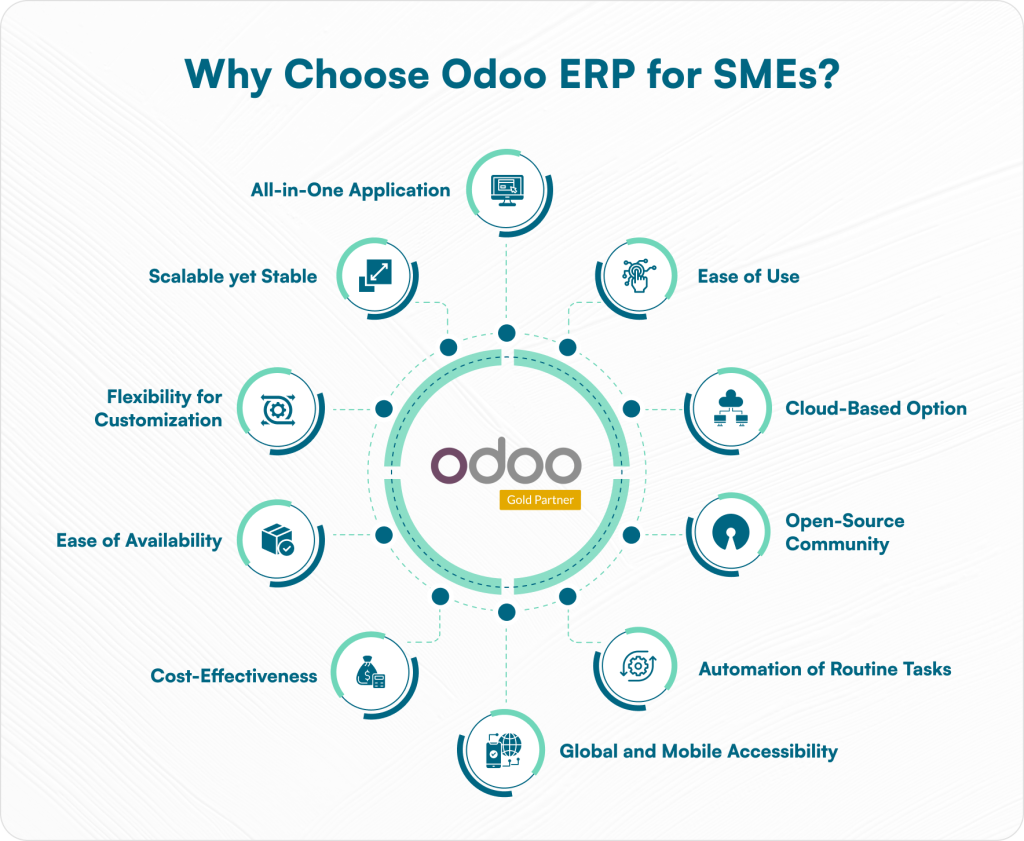 Why choose Odoo ERP for SMEs
How an Odoo development company enables true composable ERP
Odoo delivers a modular approach in which organizations activate only the components needed at each growth stage. Every module can operate independently while sharing data and workflows with the rest of the platform.
Specialized implementation services help businesses sequence modules at their own pace while keeping the wider system cohesive and scalable.
Modular apps activated only when needed
Organizations do not need to commit to a complete suite upfront. They can begin with accounting or CRM and introduce inventory, HR, manufacturing, projects, or other applications as operations expand.
This approach aligns costs with usage and avoids a disruptive rearchitecture each time the business adds a capability.
Low-code and no-code customization
Odoo Studio provides visual tools for creating fields and forms, adjusting interfaces, and automating workflow steps. Business teams can implement routine changes without deep engineering work, while developers remain available for complex rules and integrations.
This balance reduces dependency on lengthy development cycles and gives departments more control over their processes.
API-first integrations with external systems
Odoo APIs support connections with CRMs, business intelligence tools, ecommerce platforms, payment systems, and specialized applications. Integration teams can automate end-to-end workflows, synchronize records, and maintain consistency across systems.
Scalability from SMBs to enterprises
Odoo can support an emerging organization as well as a multi-company enterprise. Its modular architecture allows both to operate on a unified platform without sacrificing flexibility. Capacity, modules, users, and integrations can expand as the organization grows.
Technical foundation of Odoo's composable design
Odoo's architecture supports modular growth without creating unnecessary system bottlenecks. Its Python-based framework and extensible data model allow teams to build systems that evolve as business requirements change.
Modern backend architecture with Python and PostgreSQL
Python enables readable, maintainable development and rapid iteration. PostgreSQL provides mature transaction handling, indexing, data integrity, and performance features. Together, they support large transaction volumes, real-time updates, and stable operations as datasets grow.
Reusable business components and reconfigurable modules
Odoo applications provide reusable components that can be configured for different departmental needs. Modules work together but remain independently deployable, so teams can extend functionality without disrupting unrelated business units.
Event-driven workflows and automated triggers
Actions can be triggered when conditions are met, such as receiving a payment, confirming an order, changing a case status, or reaching a stock threshold. Event-driven workflows reduce manual intervention and execute processes consistently across the system.
Odoo Studio for rapid configuration
Odoo Studio lets teams adjust fields, forms, views, and automation through a visual interface. This low-code capability helps organizations respond to operational changes without waiting for a full development cycle.
AI, automation, and composable workflows in Odoo
Odoo development teams can combine intelligent automation with modular AI components to build systems that react to changing business conditions. Rules-based workflows handle predictable actions, while machine intelligence supports context-aware decisions.
Built-in AI capabilities
Odoo includes intelligent search, document processing, and recommendation or prediction capabilities across supported applications. Optical character recognition can extract data from invoices, receipts, and PDFs, reducing manual entry.
Predictive capabilities can also support demand planning, customer analysis, and financial forecasting.
Automated business rules and smart flows
Automated sequences can run in response to transactions, statuses, thresholds, and user actions. These workflows reduce repetitive approvals, notifications, record updates, and inventory adjustments while maintaining operational accuracy.
Extending Odoo with external AI agents
Odoo's interfaces allow external AI agents and custom models to support fraud detection, churn prediction, risk scoring, lead qualification, and other specialized use cases. This extends the platform beyond built-in AI while preserving a consistent operational system.
Context-aware operations
AI enables modules to react to real-time factors such as customer priority, item availability, deadlines, or operational constraints. Automation becomes dynamic rather than limited to fixed paths, allowing processes to adjust without constant manual intervention.
Integration ecosystem and extensibility
Odoo supports broad connectivity through APIs, connectors, webhooks, middleware, and extensible modules. This flexible ecosystem lets the platform adapt as the enterprise technology landscape expands.
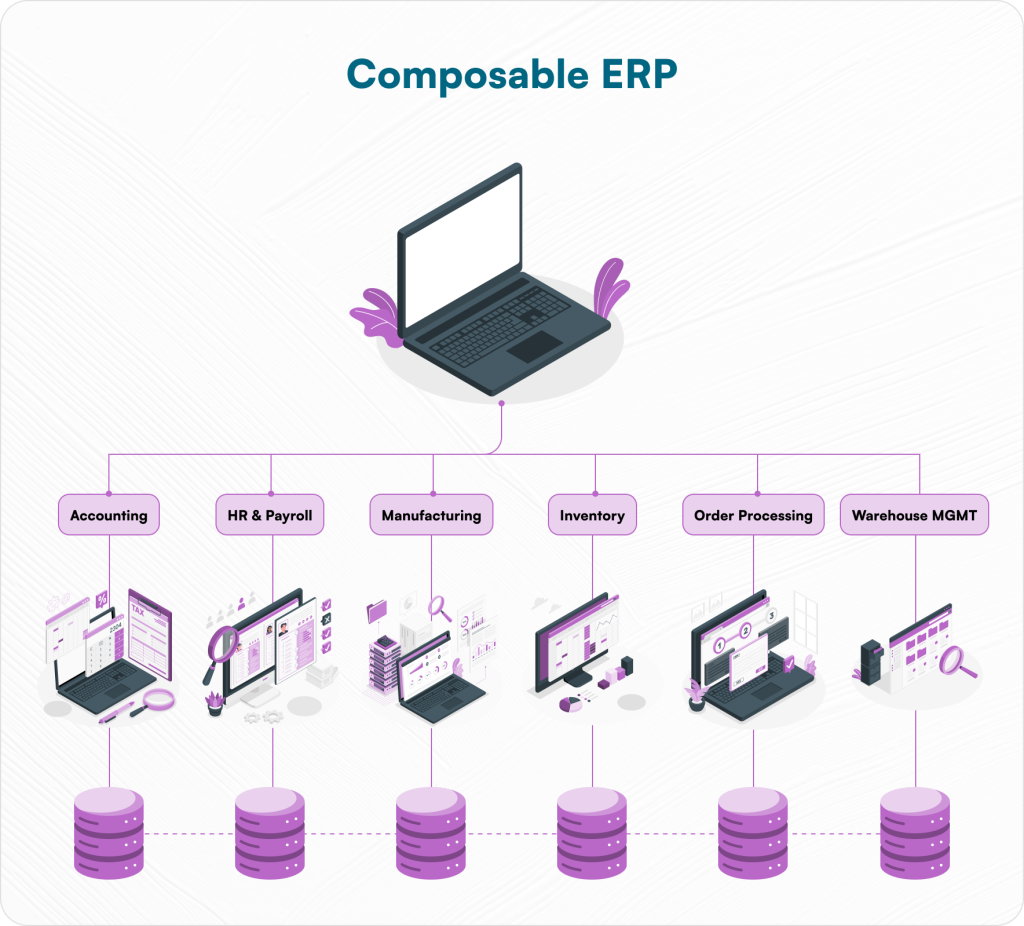 Composable ERP architecture
Plug-and-play marketplace modules
Odoo's marketplace includes modules for accounting, CRM, HR, projects, supply chain, ecommerce, and other functions. Ready-made modules can accelerate adoption, provided teams evaluate security, support, compatibility, and upgrade readiness before deployment.
APIs, webhooks, and middleware integration
APIs connect external platforms, while webhooks publish real-time events such as order confirmations and inventory changes. Middleware can manage transformations, retries, monitoring, and orchestration where integrations become more complex.
Multi-system orchestration
Connector frameworks coordinate data and processes between Odoo and CRM, logistics, finance, analytics, or industry-specific platforms. This supports end-to-end workflows without relying on manual handoffs or fragile point-to-point connections.
Security, compliance, and governance
A composable environment still requires consistent governance. Odoo provides access controls, audit capabilities, and configurable security rules that help protect sensitive business information and support regulatory requirements.
Role-based access and field-level controls
Permissions tied to job responsibilities control which records, operations, and fields a user can access. These rules reduce internal risk while audit trails document important system activity.
Data governance in modular ERP environments
Shared data standards, validation rules, ownership, and controlled update processes maintain consistency across modules. Governance prevents modularity from creating fragmented definitions or unreliable reporting.
Compliance-ready architecture
Privacy controls, logging, access policies, and audit workflows can support GDPR, SOC 2, ISO, and regional compliance programs. The final control design should reflect the organization's data, risks, and regulatory obligations.
Real-world use cases of composable Odoo ERP
Retail: Fast feature additions without disruption
Retailers can add point-of-sale updates, loyalty features, discount rules, inventory processes, or new sales channels without halting operations. This supports seasonal scaling and omnichannel coordination.
Manufacturing: Modular MRP and IoT applications
Manufacturers can combine material requirements planning, shop-floor controls, quality workflows, maintenance, and IoT data. Real-time machine and production insights help reduce downtime and improve traceability.
Finance: Composable accounting workflows
Accounting capabilities such as invoicing, reconciliation, reporting, and multi-entity processes can be configured independently. The modular structure helps finance teams adapt to new revenue models and compliance requirements.
Services: Scalable project and subscription operations
Service organizations can manage projects, resources, recurring contracts, usage-based billing, and renewals while keeping client, delivery, and revenue data aligned.
Cost-efficiency and ROI advantages
Odoo's modular structure reduces forced bundles and lets organizations align investment with real operational demand. Reusable components, configuration tools, and shorter rollout cycles can improve time to value and reduce long-term maintenance.
Pay only for what you use
Organizations can introduce modules gradually rather than purchasing an oversized suite. This is useful for seasonal businesses, rapidly expanding organizations, and multi-branch rollouts.
Reduced custom-development costs
Prebuilt components and standard applications reduce the need to build common functions from scratch. Careful use of standard features also limits technical debt and upgrade complexity.
Faster deployment than monolithic ERP
Configuration-driven setup and modular sequencing shorten deployment cycles. Businesses can realize value from priority workflows while later phases continue in parallel.
Comparing Odoo with monolithic ERP platforms
SAP vs. Odoo: The flexibility gap
Odoo's modular architecture can support faster configuration, lightweight module onboarding, and fewer dependency chains. This can make it attractive to organizations that prioritize rapid adaptation.
Oracle vs. Odoo: Cost and customization
Odoo may offer a leaner licensing and maintenance footprint for organizations that do not require the full complexity of a large enterprise suite. The right choice still depends on scale, compliance, functionality, and existing architecture.
Microsoft Dynamics vs. Odoo: Integration flexibility
Odoo's open interfaces and extensible framework can simplify connector development and multi-system orchestration. Organizations should compare the platforms using their actual integration landscape and operating model.
Migration strategy: Moving from monolithic ERP to Odoo
A structured migration reduces complexity and downtime. The roadmap should cover assessment, module sequencing, data preparation, integration mapping, testing, training, and adoption.
Assessment and module prioritization
Teams should identify which legacy capabilities must be retained, improved, or retired. The goal is not to reproduce every old process but to prioritize modules that provide immediate value.
Phased rollout for lower risk
Foundational applications can be introduced first, followed by additional modules after teams validate workflows and performance. This keeps change manageable and creates feedback for later phases.
Data migration and API mapping
Historical and operational data must be profiled, cleansed, mapped, and validated before import. In parallel, teams define APIs and integration responsibilities to maintain consistency during and after the transition.
Why composable ERP is the future and how Odoo leads the shift
Composable ERP is becoming the preferred model for organizations that need scalable, modular operations. Odoo's configurable applications, integration capabilities, and extensible architecture make it a strong option for enterprises seeking adaptability without the overhead of a tightly coupled suite.
Partnering with the right Odoo development company enables businesses to tailor workflows, unify data, and modernize processes in manageable phases. The strategic question is no longer only whether to adopt a composable platform, but how to use Odoo's modular foundation to build an ERP environment that can keep evolving with the business.

Written by
Pratik Kantesiya
AI Engineering Lead
Pratik leads AI engineering at Agile Infoways, where he architects production AI systems for enterprises across healthcare, BFSI, and logistics. He writes about practical AI delivery — what works, what does not, and what most teams miss between proof-of-concept and production.