Quick summary: Struggling with revenue blind spots and operational uncertainty? This guide explains how Salesforce CRM centralizes data, supports AI-driven forecasting, automates workflows, and strengthens compliance so enterprise leaders gain measurable control and more predictable performance.
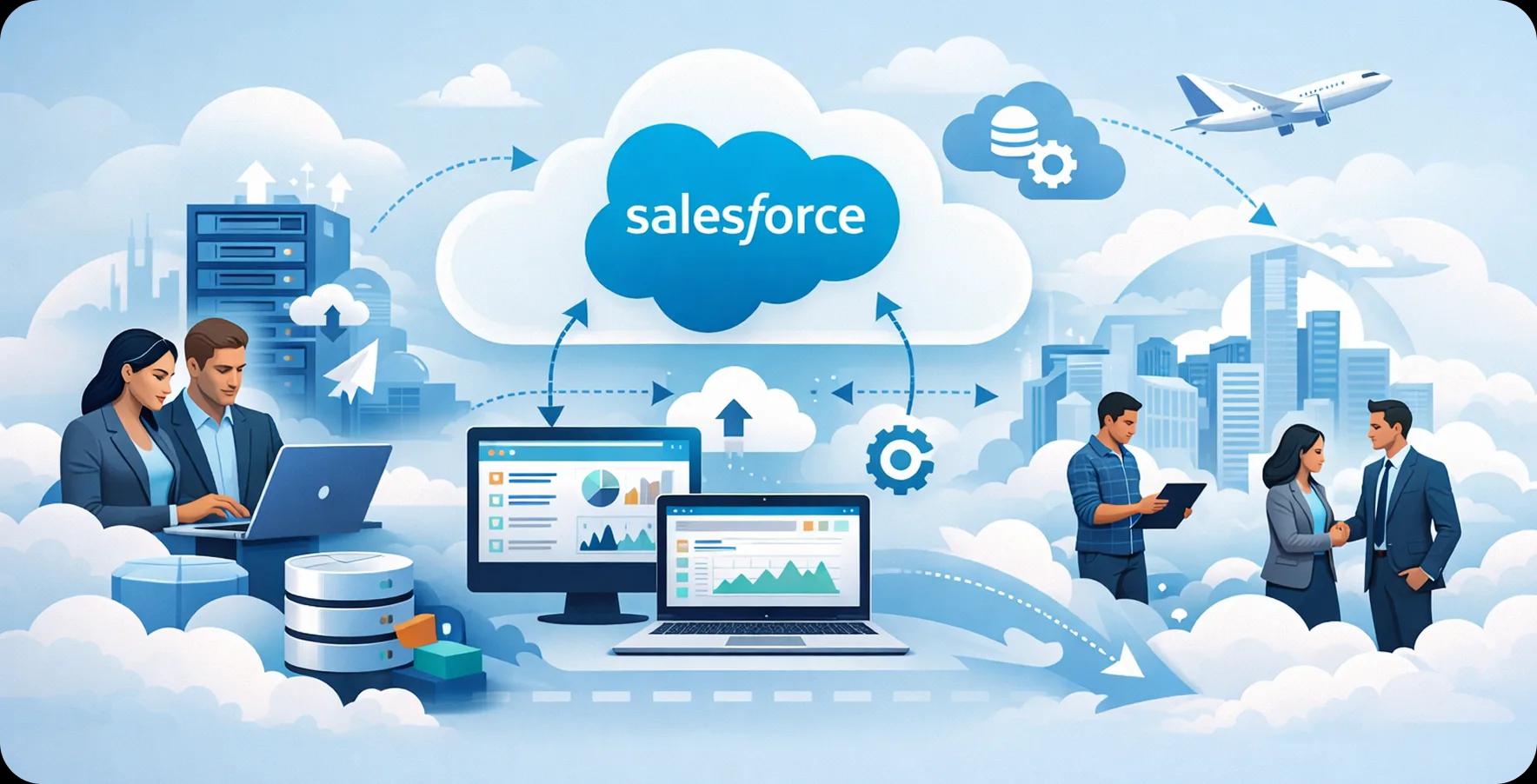
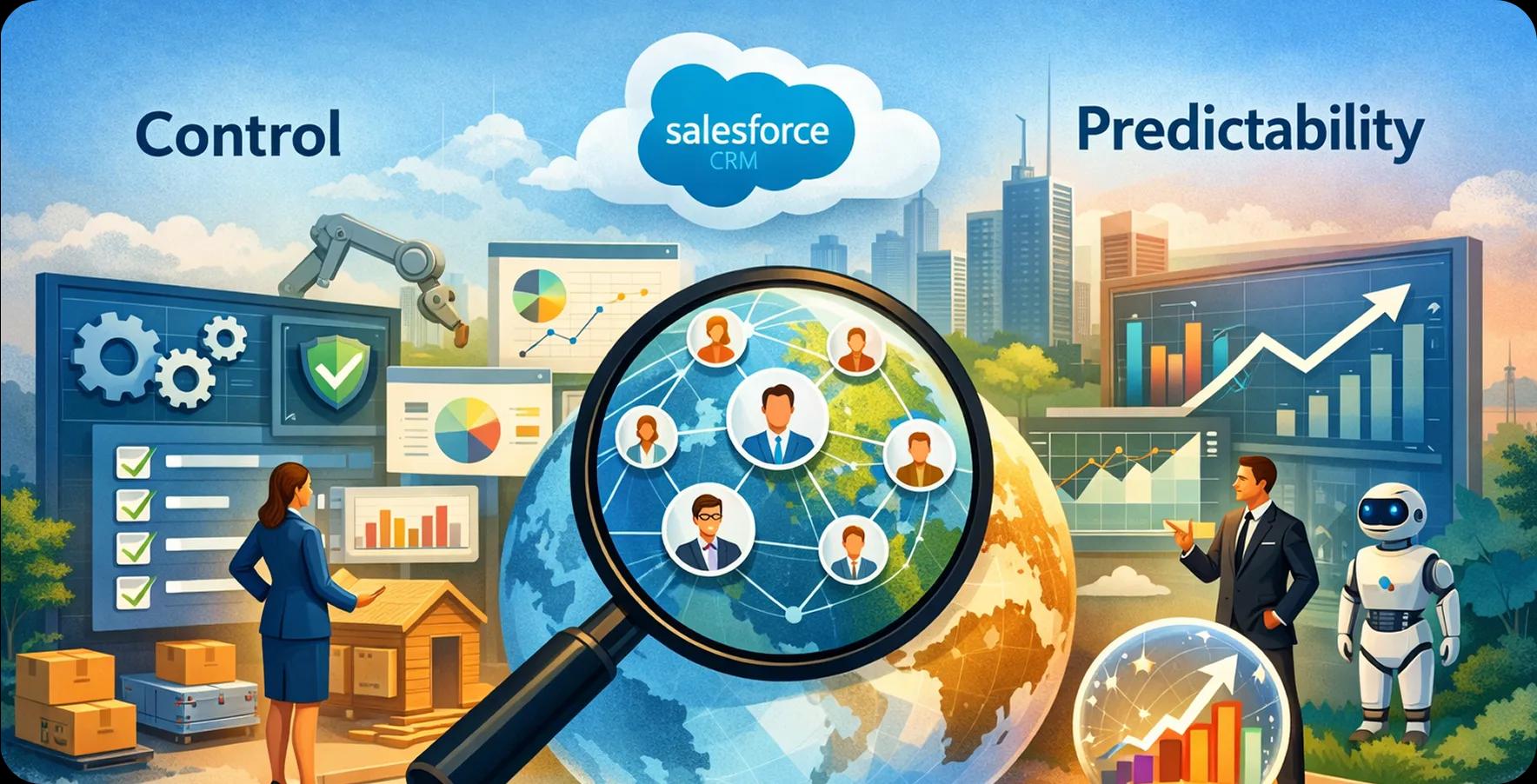
Enterprise leaders know that delivering control, visibility, and predictability is essential for scaling operations and hitting strategic goals. Salesforce CRM delivers this through a unified data architecture, AI-driven analytics, API-based integrations, automated workflows, and role-based dashboards that connect sales, marketing, service, commerce, and IT on a single platform. Companies using Salesforce CRM tools report enhanced process efficiency, and results speak in measurable numbers:
-
Sales: Over 30% revenue growth, 87% win rate, 85% faster deal closure
-
Marketing: 32% increase in ROI, 33% higher customer lifetime value, 89% improved ability to act on data
-
Customer Service: 31% ROI growth, 33% rise in satisfaction, 32% first-interaction case resolution
-
Digital Commerce: 29% year-over-year digital revenue, 31% higher conversion rate, 74% repeat customers
-
IT & Technology: 30% lower IT cost, 32% fewer threats or breaches, 32% reduction in unique IT systems
A strategic Salesforce development company can design a secure and scalable architecture aligned with governance goals. Organizations that hire Salesforce developers can strengthen data control, compliance visibility, and predictive accuracy across enterprise operations.
Consistent metrics, centralized governance, and AI-assisted forecasts create executive confidence. Leaders gain clearer pipeline visibility, stronger risk oversight, and structured accountability that support sustainable growth across business functions.
Why Enterprise Leaders Demand Operational Control
Fragmented systems create blind spots that affect revenue accuracy and risk exposure. A centralized CRM architecture with unified data models, real-time dashboards, and forecasting capabilities provides consistent KPIs and more reliable projections.
Automated workflows reduce manual dependency, while APIs connect ERP, marketing automation, service, and finance platforms. Role-based access, audit trails, and encryption strengthen governance and help executives make data-backed decisions across complex environments.
Enterprise leaders require operational control for:
-
End-to-end revenue pipeline transparency
-
Centralized and governed enterprise data
-
AI-assisted forecasting and scenario planning
-
Standardized cross-functional workflows
-
Risk monitoring and compliance enforcement
-
Integrated access and cybersecurity management
-
Scalable cloud infrastructure with API connectivity
The Executive Visibility Gap: Where Revenue and Risk Hide
Revenue leakage and operational risk rarely appear clearly in board summaries. They hide in disconnected systems, delayed reports, inconsistent definitions, and manual handoffs. When CRM, ERP, marketing, finance, and service platforms operate in silos, leaders lack a trustworthy view of performance.
Incomplete pipeline data, unmanaged access, and spreadsheet-based forecasting create blind spots that distort revenue projections and compliance posture. Without real-time dashboards, anomaly detection, and governed data architecture, executives operate with partial visibility.
Revenue and risk commonly hide in:
-
Unvalidated pipeline stages and inflated opportunity values
-
Shadow IT systems outside governance controls
-
Manual spreadsheet forecasting
-
Inconsistent customer information across platforms
-
Delayed financial reconciliation between CRM and ERP
-
Weak role-based access and audit monitoring
-
Disconnected marketing attribution and revenue reporting
Salesforce CRM as a Unified System of Record
Salesforce acts as a unified system of record by consolidating sales, marketing, service, commerce, and customer data within a governed architecture. Standard and custom objects, API integrations, and validation rules improve consistency across departments.
Role-based dashboards and analytics provide forecasting and performance tracking. Structured data models and secure access controls help enterprises reduce duplication, resolve reporting conflicts, and establish a reliable foundation for operational decisions.
Real-Time Dashboards for Board-Level Decisions
Real-time dashboards convert enterprise data into executive intelligence by bringing CRM objects, revenue metrics, service KPIs, and marketing performance into a single visual layer. Live data pipelines and automated refresh cycles reduce reporting delays and manual consolidation.
Board members gain visibility into pipeline health, margin trends, risk exposure, and operational efficiency. Structured permissions and drill-down capabilities protect sensitive information while enabling deeper analysis.
Real-time dashboards support board-level decisions through:
-
Immediate visibility into revenue and forecasting accuracy
-
Earlier identification of operational risks and compliance gaps
-
Faster strategic adjustments based on current metrics
-
Improved accountability through transparent KPI tracking
-
Reduced dependency on manually prepared reports
Standardizing Processes Across Sales, Service, and Operations
Standardized processes create a controlled execution framework built on defined workflows, approval hierarchies, and automated triggers. Structured CRM objects, validation rules, Flow, and rule-based routing reduce the inconsistencies that slow performance.
Unified lifecycle management ensures opportunities, cases, orders, and customer requests follow agreed stages with measurable checkpoints. This discipline reduces manual intervention, strengthens auditability, and aligns teams around shared KPIs.
Benefits of process standardization
-
Improved forecasting accuracy and revenue predictability
-
Fewer operational bottlenecks and manual errors
-
Stronger compliance through auditable workflows
-
Faster case resolution and deal progression
-
Clear accountability across departments
-
Consistent customer experiences
-
Better coordination between CRM, ERP, and enterprise systems
Data Governance, Compliance, and Enterprise Security
Data governance and security form the backbone of operational control. A structured CRM architecture uses role-based access, field-level security, encryption, multifactor authentication, audit trails, event monitoring, and automated compliance workflows.
Centralized data classification and validation rules improve accuracy while reducing exposure to unauthorized access. This framework protects sensitive customer and financial information while supporting transparent, policy-driven operations.
Benefits of strong CRM governance
-
Reduced risk of data breaches and internal misuse
-
Better regulatory compliance and audit readiness
-
Controlled user access through role hierarchies
-
Improved data accuracy and integrity
-
Visibility into system activity and changes
-
Lower legal and financial risk exposure
-
Increased confidence in enterprise data
AI-Driven Forecasting and Revenue Predictability
AI-assisted forecasting applies models to historical CRM data, pipeline velocity, win rates, seasonality, and customer behavior. Predictive capabilities can score opportunities, detect anomalies, and produce scenario-based projections.
Automated data ingestion and regular recalibration help forecasts adjust as business conditions change. Executives gain data-supported revenue estimates rather than relying entirely on subjective assumptions, enabling better planning, budgeting, and risk management.
Benefits of AI-assisted forecasts
-
Improved forecast accuracy
-
Early detection of revenue shortfalls and pipeline risk
-
Objective opportunity scoring and prioritization
-
Scenario planning for strategic decisions
-
Less dependency on spreadsheet forecasting
-
Faster executive reporting
-
Greater confidence in resource allocation
Automation That Reduces Operational Friction and Cost
Automation replaces repetitive tasks with rule-based workflows, intelligent triggers, and API-driven processes. Salesforce can automate lead routing, approvals, case escalation, account updates, customer notifications, and compliance checks.
Background jobs, event-based notifications, and synchronization between CRM and ERP reduce duplication and errors. A Salesforce development team can design scalable automation aligned with governance policies and human approval requirements.
Benefits of enterprise CRM automation
-
Lower costs through reduced manual effort
-
Faster deal progression and service resolution
-
Fewer data-entry errors and inconsistencies
-
Improved cross-system synchronization
-
Stronger compliance through automated audit trails
-
Increased employee productivity
-
Workflows that scale with enterprise growth
Integrating ERP, Marketing, and Finance for Transparency
Integrating ERP, marketing, finance, service, and CRM systems creates end-to-end transparency by synchronizing customer, revenue, inventory, and financial information. API-led connectivity, middleware orchestration, and event-driven synchronization reduce reconciliation delays and reporting conflicts.
Structured mappings maintain consistent relationships across platforms. AI-powered ERP and CRM integration can support automated financial updates and closed-loop reporting that aligns pipeline performance with billing, cash flow, and profitability.
Benefits of connected enterprise systems
-
More accurate revenue recognition and financial alignment
-
Real-time visibility into cash flow and sales performance
-
Reduced manual reconciliation
-
Marketing attribution connected to closed revenue
-
Synchronized records for compliance and audit
-
Fewer reporting inconsistencies and silos
-
Better strategic planning using unified data
Measuring What Matters: KPIs, Performance, and Accountability
Effective performance management requires clearly defined KPIs embedded in CRM objects, dashboards, and automated reports. Revenue growth, pipeline velocity, customer acquisition cost, case resolution time, retention, forecast accuracy, and margin should connect to governed data sources.
Role-based scorecards help departments measure performance against standardized benchmarks. Automated alerts flag deviations, while drill-down reports connect executive summaries to supporting transactions.
Building an Enterprise Operating Model on Salesforce
An enterprise operating model on Salesforce aligns revenue processes, service workflows, compliance controls, and connected financial data. Standardized objects, integrations, automation, and analytics create measurable execution discipline.
Role hierarchies and governance frameworks support secure collaboration across teams and regions. A trusted Salesforce partner can design environments that support multiple entities, complex reporting structures, and predictable performance.
Benefits of an enterprise Salesforce operating model
-
A unified operating framework across departments
-
Improved revenue predictability
-
Centralized governance and compliance oversight
-
Reduced system redundancy and IT complexity
-
Faster decisions based on current analytics
-
Scalable architecture for multi-region growth
-
Stronger KPI-driven accountability
Turning CRM into a Strategic Control Tower for the C-Suite
Turning CRM into a strategic control tower requires more than software implementation. It requires structured governance, trustworthy integrations, real-time executive dashboards, well-designed automation, and forecasting grounded in high-quality data.
When CRM becomes the intelligence layer connecting revenue, service, finance, and operations, the C-suite gains measurable control and predictive clarity. Automated workflows, audit trails, and unified analytics convert operational data into board-level insight.
Enterprises that combine the platform with skilled Salesforce developers can position CRM as a command center for disciplined leadership and sustained growth.

Written by
Pratik Kantesiya
AI Engineering Lead
Pratik leads AI engineering at Agile Infoways, where he architects production AI systems for enterprises across healthcare, BFSI, and logistics. He writes about practical AI delivery — what works, what does not, and what most teams miss between proof-of-concept and production.