Quick summary: The convergence of Generative AI and mobile app development has sparked impressive innovations in creativity, customization, and user engagement. Given user instructions, Generative AI models use artificial intelligence, machine learning, deep learning, and neural networks to produce content such as audio, video, text, and images. This blog explains the core concepts of Generative AI, its rise in the market, its evolution in mobile app development, and its benefits, industry use cases, and emerging trends.
Generative AI has garnered considerable attention in recent years for compelling reasons. This impactful technology has the potential to reshape diverse fields, including mobile app development. Generative AI development is a form of artificial intelligence capable of crafting unique content such as images, text, music, and entire videos. Unlike AI systems focused solely on recognition or prediction, it can generate original and novel content.
Generative AI uses complex algorithms to understand patterns within existing datasets and produce original content from those patterns. It can process structured and unstructured data and generate detailed information and insights.
As the technology advances, its impact on mobile app development is set to become even more significant. AI-powered tools will become increasingly prevalent across the development landscape, allowing teams to create more intelligent and customized apps. Applications can also adapt and learn in real time, anticipate user needs, and improve experiences in ways that were previously difficult to imagine.
This blog evaluates the major types of Generative AI, provides statistics on how Generative AI services are growing in the competitive market, and explains how their integration will modernize the mobile app development industry.
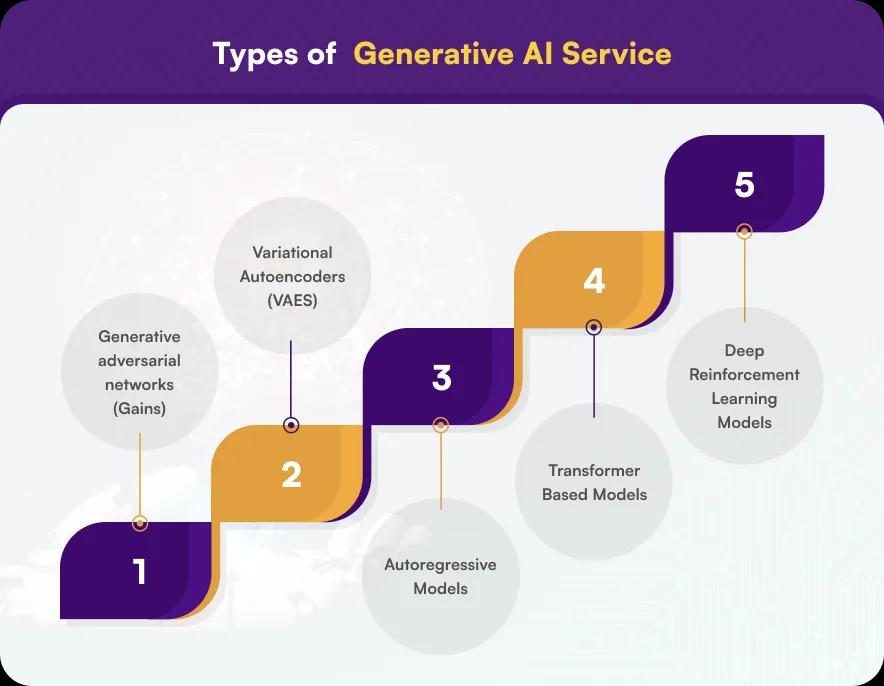 Types of Generative AI services
Types of Generative AI
Generative Adversarial Networks (GANs)
Generative Adversarial Networks consist of two neural networks—the discriminator and the generator—that compete against each other in a gamified environment. The discriminator differentiates between synthetic and real data, while the generator creates content such as images, text, and sound from random noise.
The generator focuses on producing realistic data while the discriminator improves its ability to distinguish between real and generated results. This competitive process enables the system to create increasingly realistic content.
Variational Autoencoders (VAEs)
Variational Autoencoders are Generative AI models that encode data into a latent space and then decode it to reconstruct the original information. They learn how to represent data in a way that enables the model to produce new samples from the inferred distribution. VAEs are commonly used to generate images, audio, and text.
Autoregressive models
Autoregressive models create data one element at a time based on previously generated elements. These models use the context of earlier components to predict the probability distribution of the next element and generate new data by sampling from that distribution. GPT is a well-known example capable of creating coherent, contextual text.
Transformer-based models
Transformers such as GPT have become increasingly popular in natural language processing and generative tasks. They use attention mechanisms to model relationships between elements in a sequence. Because they can manage long sequences and run computations in parallel, transformers are effective at creating unified and relevant content.
Deep reinforcement learning models
Deep reinforcement learning models combine reinforcement learning with neural networks to develop robust, responsive behavior. They use trial and error, with rewards and penalties, to optimize their actions. These models are used in robotics, game development, and autonomous systems.
Statistical facts on Generative AI
The Generative AI market was expected to grow significantly between 2023 and 2030. At the end of 2023, it was valued at just under USD 45 billion, nearly twice its 2022 size. Forecasts anticipated that strong annual growth would continue through the end of the decade.
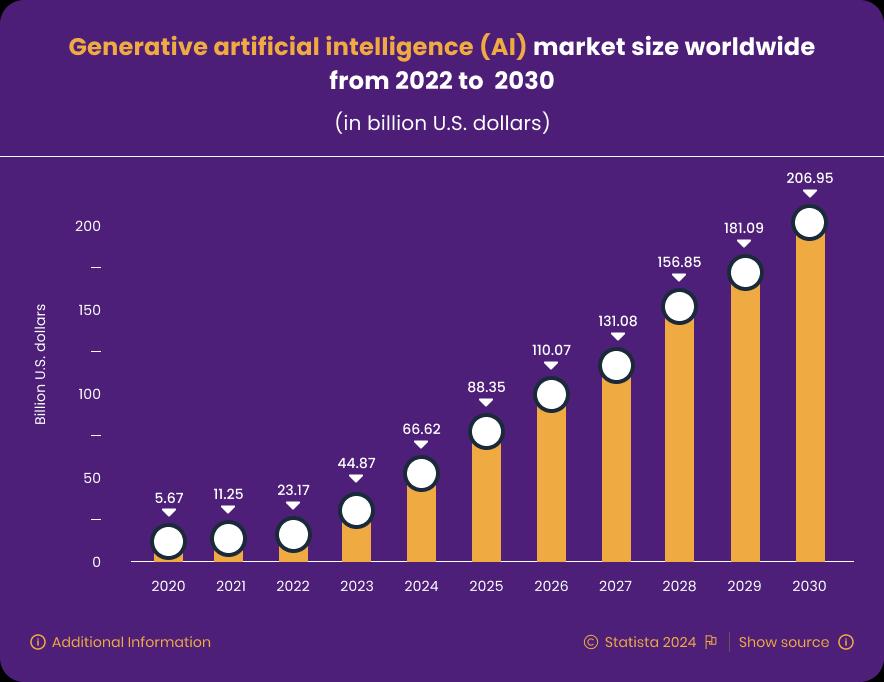 Generative AI market growth from 2020 to 2030
A Google Cloud survey also found that 64% of surveyed businesses wanted to adopt Generative AI.
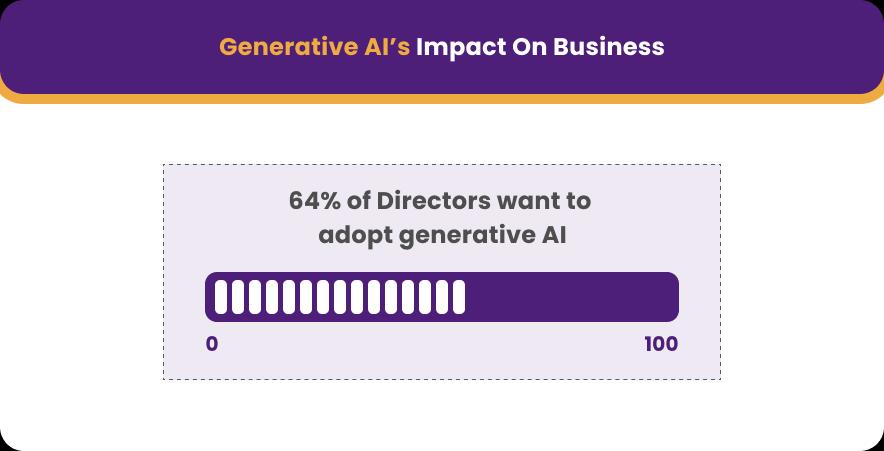 Generative AI impact on business
In a global comparison, the United States represented the largest national market, valued at approximately USD 5.6 billion in 2023.
Generative AI: a pivotal innovation for mobile app development
The potential of Generative AI in mobile app development is immense, offering meaningful benefits for developers and users alike.
Autonomous design
Generative AI solutions can automate parts of the design process by creating layouts, wireframes, and graphic elements for mobile apps. This helps developers and designers save time and focus on other important aspects of the application development process.
Embracing innovation
AI can foster innovation and recommend ideas that teams may not have considered. An AI-powered creative tool might suggest unconventional designs, layouts, content recommendations, or entirely new app concepts based on user behavior and market trends.
Customized user experience
Generative AI solutions can create customized mobile app experiences. By evaluating user data and preferences, GenAI can help generate layouts, themes, colors, animations, and recommendations tailored to individual needs.
Increased productivity and speed
AI can automate routine work such as generating boilerplate code and crafting basic UI designs. This allows developers to focus on complex features, creative product improvements, and challenging engineering problems.
Progressive testing and debugging
AI algorithms can analyze code for probable errors and suggest fixes, streamlining testing and debugging. This helps developers recognize and resolve issues earlier, resulting in a more robust app experience for users.
Advanced security
Generative AI services can strengthen mobile app security by generating encryption keys, identifying potential cyber threats, and supporting secure customer authentication methods.
Superior performance
GenAI can enhance mobile app performance by helping optimize code, reduce memory usage, and improve the user experience. By harnessing these capabilities, developers can build more efficient and responsive applications.
Intelligent search with image and speech recognition
AI makes search engines more intelligent by presenting content based on user preferences and choices. AI and machine learning also allow people to search using voice or images inside mobile applications. For example, a user can submit an image to find its origin or use a spoken query to retrieve relevant information.
Industry use cases of Generative AI in mobile app development
Generative AI has substantial potential to enhance mobile app experiences across different domains. The following are some of its most important applications.
Generative AI ideas for intuitive app design
GenAI facilitates the creation of innovative designs and illustrations for iPhone, Android, and web applications. UI designers can use generative algorithms to create custom graphics, logos, and visual elements, enabling teams to develop more intuitive interfaces.
Generative AI for content creation
GenAI can automatically create images, text, and videos for content marketing, social media, and customized recommendations. When integrated into mobile app development, it can generate unique and engaging content personalized to user preferences.
Generative AI in gaming app development
GenAI transforms mobile gaming experiences through procedurally generated content, interactive storytelling, and dynamic gameplay. Game developers can use it to create virtual characters, environments, and narratives that evolve based on player actions and preferences.
Generative AI for creating realistic effects
AI-generated imagery has become increasingly common. Generative AI applications allow mobile development teams to integrate advanced photo-editing capabilities into apps. Users can apply filters, remove imperfections, and create realistic effects with less effort, improving image quality and usability.
Generative AI for behavioral analysis and customization
Generative AI solutions in mobile apps help businesses analyze user behavior, preferences, and historical data. These insights enable personalized suggestions, product recommendations, and tailored content. By understanding user preferences, mobile applications can deliver experiences that resonate with individuals.
Emerging trends in Generative AI mobile app development
As Generative AI evolves, emerging trends will shape mobile app development and influence many industries.
Customized AI models
Developers can modify pre-trained models to fit specific use cases. Highly specialized AI models will increasingly provide content and capabilities tailored to particular industries and enterprises.
Multimodal AI
Future Generative AI services will not rely on text alone; they will also use images, audio, video, and other modalities. Developers will build apps that understand and produce information in multiple formats, creating more productive and engaging user experiences.
AI-powered innovation
People across many professions will use GenAI as a tool for innovation. Authors, artists, designers, and other specialists can use AI-powered applications to explore new concepts, artwork, and materials, treating models as creative collaborators.
Augmented and virtual reality
AR and VR were projected to grow at an annual rate of 8.97% from 2024 to 2029, reaching a market volume of approximately USD 62 billion by 2029. Mobile AR and VR applications rely on AI for data collection, analysis, and use. AI can process these workloads accurately and faster than conventional manual approaches.
Generative AI in healthcare
Using AI in healthcare mobile applications is already transforming the sector. Mobile app development companies build healthcare applications that simplify health administration, maintain records, assist with early disease detection, support robotic surgery, and monitor patient health. Generative AI can extend these capabilities through more natural interactions, personalized information, and intelligent automation.
Generative AI: defying expectations
The groundbreaking Generative AI landscape is already shaping the future. From advanced models such as ChatGPT to its influence across industries, GenAI has defied expectations and offered a glimpse into the opportunities ahead.
In mobile app development, the integration of Generative AI marks a major shift toward a new era of innovation, customization, and productivity. By understanding the available models, widespread adaptability, benefits, and future trends, companies can begin using GenAI effectively in mobile applications.
As technology evolves, Generative AI demonstrates both the power of human creativity and the expanding capabilities of artificial intelligence. Organizations that integrate AI thoughtfully can build more intelligent apps while keeping user needs, quality, privacy, and responsible implementation at the center of development.

Written by
Pratik Kantesiya
AI Engineering Lead
Pratik leads AI engineering at Agile Infoways, where he architects production AI systems for enterprises across healthcare, BFSI, and logistics. He writes about practical AI delivery — what works, what does not, and what most teams miss between proof-of-concept and production.