Quick summary: Our latest 2025 CIO guide explains how to integrate AI into software development services. It explores how CIOs can reduce time-to-market, improve decision-making, address security challenges, automate testing, detect issues early, and accelerate software delivery with greater precision and cost efficiency.
Hardly a day goes by without news of businesses adopting AI for software development services. This momentum is well deserved because CIOs have a critical role in capturing value from technologies such as AI and machine learning and moving initiatives beyond pilot projects into scalable production environments.
For CIOs, the AI services boom presents an opportunity to apply lessons from early experiments and convert the promise of AI into sustainable business value.
However, moving past the pilot stage remains difficult. Based on conversations with technology leaders and analysis of AI initiatives across more than 30 organizations, several actions have emerged for creating value, orchestrating technology and data, scaling software solutions, and managing the risks of AI in software development.
Overview of AI in software development services
AI and machine learning services are improving the complete software development lifecycle. From increasing productivity and automating repetitive tasks to improving code quality, software development companies are making significant progress with AI-enabled engineering.
With more developers using AI tools, machine learning algorithms are increasingly applied to code generation, debugging, testing, documentation, and optimization.
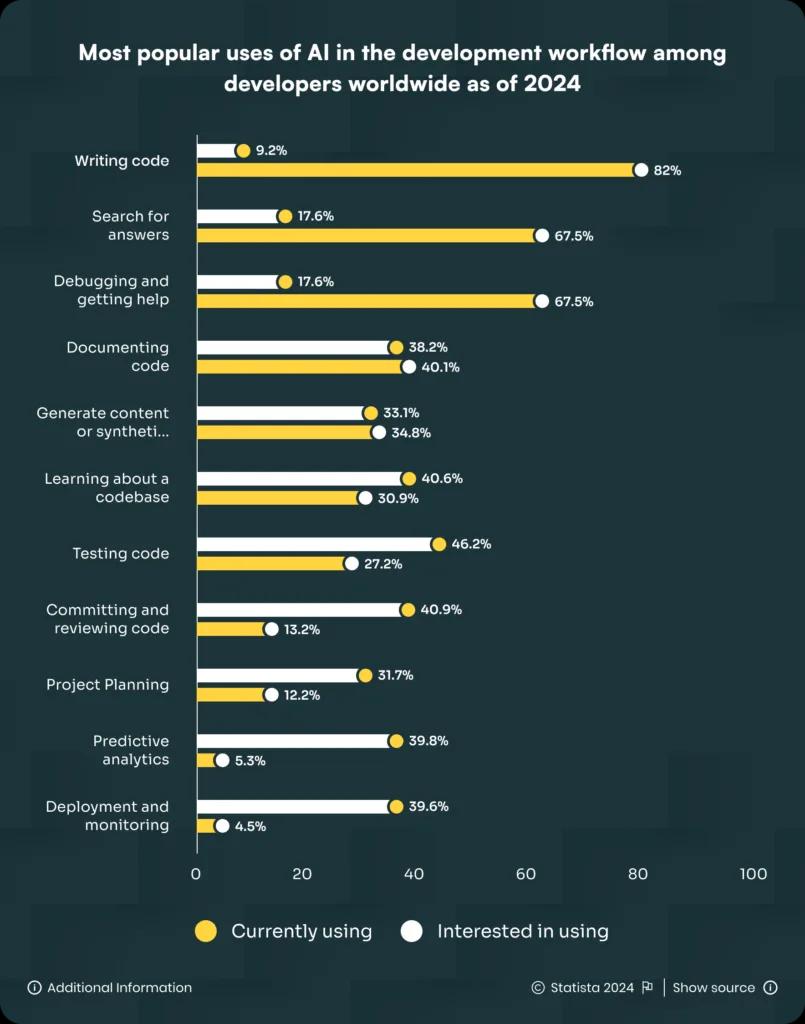 Most popular uses of AI in software development
Off-the-shelf coding assistants and AI-enabled engineering tools can improve software development productivity substantially. These gains can generate cost savings that organizations can reinvest in digital transformation and product innovation.
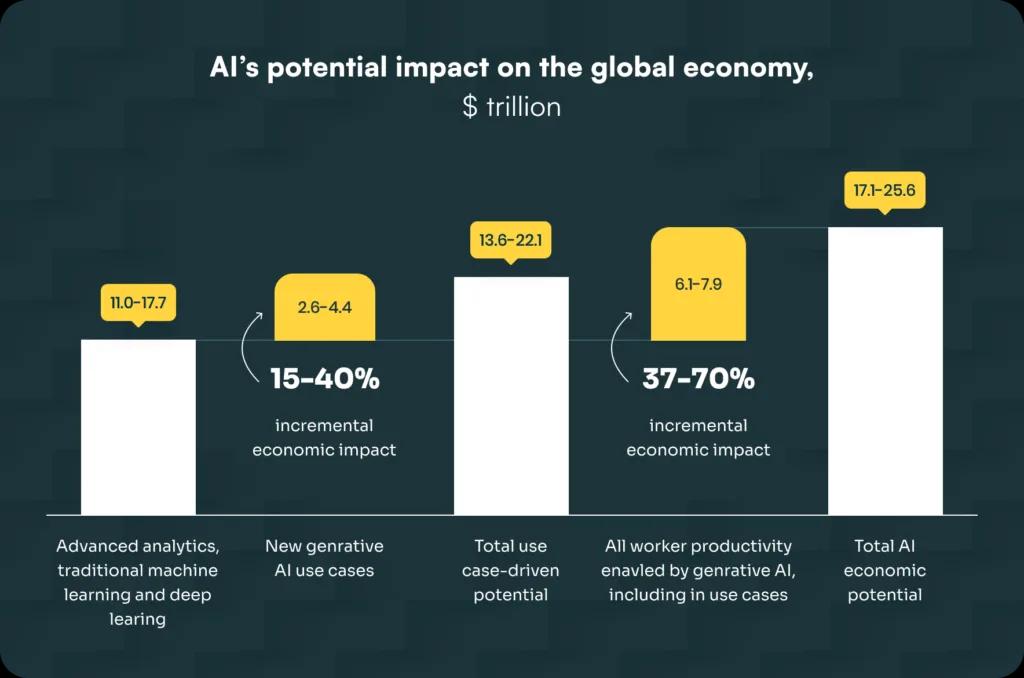 AI potential impact on the global economy
AI also has the potential to create trillions of dollars in annual economic value. As a result, organizations worldwide are accelerating AI adoption across software development lifecycles to streamline delivery, improve security, and strengthen their competitive position.
Significance of AI technologies in software development
Machine Learning and Deep Learning for code optimization
Machine Learning and Deep Learning help optimize code by identifying inefficiencies and recommending improvements. These algorithms can analyze large codebases, detect patterns, and suggest performance-enhancing changes.
For CIOs, adopting ML and DL can improve software efficiency, system performance, scalability, and code-review speed while reducing human error.
Natural Language Processing for improved developer productivity
Natural Language Processing tools allow developers to interact with code through natural language. They can automate documentation, generate code comments, support code creation, and reduce the cognitive load on engineering teams.
CIOs can use NLP-powered tools to improve productivity, strengthen code quality, and shorten development timelines.
Computer Vision and AI in visualizing code
Computer vision can support automatic code visualization, structural pattern detection, and analysis of code flow. These capabilities help development teams identify issues earlier and improve collaboration around complex software systems.
AI-powered visualization tools also support better decision-making and help teams maintain cleaner, more understandable codebases.
Reinforcement Learning in automated testing
Reinforcement Learning can automate software testing by learning from previous test results, identifying effective testing strategies, and predicting outcomes.
RL-powered testing improves test coverage and defect detection while reducing manual effort and accelerating release cycles.
Deep Learning for code generation and refactoring
Deep Learning can automate code generation and refactoring by learning from large datasets of existing source code. It enables developers to generate and restructure complex code with less manual input.
This can lead to faster development cycles, fewer defects, better consistency, and more maintainable applications.
AI in DevOps
AI improves DevOps automation by using machine learning models to manage deployment pipelines, predict failures, optimize workflows, and adjust resources dynamically.
When combined with tools such as Jenkins, GitLab, and Kubernetes, AI can reduce manual intervention, accelerate releases, and minimize production downtime.
Predictive deployment
AI-powered predictive capabilities allow teams to forecast application performance and deployment risks in real time. By analyzing historical data, AI models can predict load spikes, system failures, and other issues before they occur.
This gives teams time to apply preventive measures and maintain smoother software operations.
AI-driven CI/CD pipelines
AI improves Continuous Integration and Continuous Deployment pipelines by automating code integration, quality analysis, testing, and deployment decisions.
Machine learning models can detect anomalies, assess code quality, and trigger automated tests before a release moves forward. This reduces bottlenecks and improves reliability.
Self-healing infrastructure
AI supports self-healing cloud infrastructure by enabling systems to detect anomalies, reconfigure resources, and recover from failures automatically.
For example, Kubernetes environments can use intelligent automation to scale resources, replace failed containers, and maintain service availability with minimal human intervention.
Enhancing software quality with AI-driven testing
AI-driven testing uses advanced algorithms to identify patterns in code and detect possible issues faster. It can automate test creation, execution, and analysis while reducing manual intervention.
This helps development teams improve software quality and shorten time-to-market without sacrificing reliability.
Test case generation with machine learning algorithms
Machine learning algorithms can generate test cases by learning from historical data and identifying scenarios that are likely to expose hidden defects.
They can analyze code coverage, identify edge cases, and recommend effective test cases, reducing manual effort and improving testing productivity.
Predicting software defects and enhancing test coverage
AI can identify high-risk areas early by analyzing historical defects, user behavior, code changes, and development patterns.
It can also recommend test cases for paths that have not yet been covered, improving validation and reducing the risk of production issues.
Automating regression and load testing
AI models can automate regression testing by assessing the effects of code changes and verifying that existing functionality remains stable.
They can also simulate realistic usage patterns during load testing, helping teams identify performance bottlenecks and validate scalability.
AI and software security
AI is becoming an important part of secure software development. Machine learning models can assess code for vulnerabilities, detect suspicious behavior, and provide real-time threat intelligence.
By automating routine security tasks, development teams can focus more on product innovation while maintaining stronger protection and compliance.
Secure coding and vulnerability detection
AI can detect coding patterns associated with vulnerabilities such as SQL injection, buffer overflows, insecure dependencies, and unsafe input handling.
By analyzing static and dynamic code, AI tools help teams identify weaknesses earlier in the development lifecycle.
Proactive threat detection
Machine learning models can continuously monitor network traffic, logs, and application behavior to identify anomalies and possible threats.
These systems learn from historical attack patterns and adapt to evolving techniques, improving protection against increasingly sophisticated attacks.
AI-powered security audits and compliance automation
AI can streamline audits and compliance by automating data collection, risk assessment, monitoring, and reporting.
Organizations can use AI-driven tools to maintain alignment with standards and regulations while reducing human error and improving audit readiness.
AI-driven insights for business and technical decision-making
AI can analyze large datasets and provide actionable recommendations for project priorities, risk mitigation, feature planning, and technical strategy.
This allows business and engineering leaders to align decisions more closely with measurable outcomes.
Predictive analytics in software projects
AI-powered predictive analytics can estimate timelines, resource requirements, delivery risks, and possible delays by analyzing historical project data and team performance.
This improves planning accuracy and helps leaders intervene before problems affect delivery.
AI-powered risk assessment
AI tools can evaluate code quality, progress, dependencies, and historical project patterns to identify risks such as scope creep, quality issues, or resource constraints.
This allows project managers to act earlier and improve execution.
Resource allocation and timeline predictions
Machine learning models can recommend how to allocate people, infrastructure, and time based on project dependencies, workload, and historical productivity.
This can improve efficiency, shorten delivery timelines, and reduce avoidable delays.
AI integration in cloud-native software development
AI plays a central role in cloud-native engineering by optimizing infrastructure, automating deployment pipelines, managing microservices, and predicting system demand.
It enables cloud applications to adjust resources dynamically, improve availability, and reduce infrastructure waste.
AI in cloud-native architectures and microservices
AI improves microservice orchestration through real-time monitoring, anomaly detection, predictive scaling, and analysis of inter-service communication.
These capabilities help teams identify failures earlier and improve the resilience of distributed systems.
Optimizing cloud infrastructure
AI can predict traffic spikes and automatically scale infrastructure based on actual demand. This prevents over-provisioning while maintaining performance.
Smarter resource usage can reduce cloud costs and improve operational efficiency.
AI for serverless computing and edge development
AI can predict workloads and optimize where applications and functions should run across serverless and edge environments.
It supports intelligent load balancing, lower latency, more efficient processing, and faster insights closer to the point where data is generated.
The impact of AI on developer roles and skillsets
AI is changing developer responsibilities by automating repetitive tasks such as code generation, testing, documentation, and debugging.
Developers are increasingly expected to focus on higher-value activities such as architecture, model design, data interpretation, security, and algorithm optimization.
Changing skill demands for developers
As AI becomes more deeply integrated into software engineering, developers need knowledge of machine learning, data science, AI frameworks, cloud platforms, and Natural Language Processing.
Tools such as TensorFlow and PyTorch are becoming increasingly relevant alongside traditional software engineering skills.
Upskilling and reskilling for an AI-ready workforce
Organizations need structured training programs in AI algorithms, neural networks, automation, data-driven decision-making, cloud computing, and responsible AI.
Continuous learning will help development teams use AI effectively and adapt to evolving engineering roles.
Addressing the AI talent shortage
Demand for AI expertise continues to exceed supply. CIOs can respond by investing in internal upskilling, partnering with educational institutions, and working with experienced AI development teams.
A long-term talent strategy is essential for scaling AI-enabled software development.
Challenges and risks of adopting AI in software development
AI adoption introduces challenges related to integration complexity, infrastructure requirements, data quality, governance, and model reliability.
CIOs must balance innovation with risk management and ensure that AI systems align with real business objectives.
Ethical concerns and AI bias
AI systems can inherit bias from training data, leading to unfair or unreliable outcomes. Development teams must prioritize transparency, fairness, accountability, and regular bias evaluation.
Using diverse datasets and reviewing model behavior are important safeguards.
Data privacy issues
AI-driven development often relies on large volumes of sensitive data. Organizations must use encryption, anonymization, access controls, and privacy-by-design principles.
Compliance with applicable regulations is essential to protecting users and maintaining trust.
Managing resistance to change
Development teams may resist AI adoption because of concerns about job displacement or workflow disruption.
CIOs should communicate that AI is intended to augment human capability, provide practical training, and introduce automation gradually to improve adoption.
The future of AI in software development in 2025 and beyond
AI will continue to become more important as organizations pursue faster delivery, better reliability, and more autonomous software operations.
Emerging trends such as autonomic computing, self-healing systems, AI-driven testing, and predictive engineering will create more resilient software architectures.
By partnering with an experienced AI and software development company, CIOs can accelerate delivery, optimize resources, and improve decision-making through intelligent automation.
The most successful organizations will combine AI adoption with workforce development, responsible governance, strong security, and continuous measurement of business outcomes.

Written by
Hiral Bhatt
Content Writer
Hiral Bhatt is a technical content writer with a management background and a deep interest in emerging technologies. She blends analytical thinking with a passion for writing to create clear, insightful content that helps readers understand complex digital concepts effectively in every industry she writes for.