
Quick summary: AI in healthcare isn’t coming; it’s already delivering. From predictive risk models to automated revenue cycle management, US health systems are posting board-ready outcomes. This blog gives decision-makers the ROI data, vendor evaluation framework, compliance checklist, and phased deployment roadmap to greenlight an AI initiative with confidence and zero guesswork.
Let’s not sugarcoat it; the US healthcare system has been running on outdated workflows for far too long. If you want to understand how AI healthcare software is solving challenges in US Medicine, the answer starts with scale and speed. According to Grand View Research, the global AI in healthcare market was valued at USD 19.27 billion in 2023 and is projected to grow at a CAGR of 38.5% through 2030. A McKinsey & Company report estimates AI-driven automation could unlock up to USD 1 trillion in annual value for the US healthcare economy. Every forward-thinking AI ML development company is now at the center of this transformation, deploying intelligent systems that flag patient risk before emergencies escalate, streamline diagnostics, and cut the administrative drag hemorrhaging your operational budget.

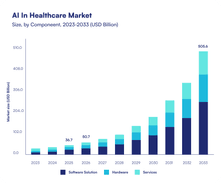
The ROI is no longer theoretical. IBM’s Institute for Business Value found that 50% of healthcare executives report AI has already improved patient outcomes at their organizations. From predictive analytics to NLP-driven documentation tools, the investment case for AI for the healthcare industry is now backed by hard data and competitive urgency that only intensifies by the quarter.
The next section cuts straight to outcomes, real ROI figures, what’s driving full-scale AI deployment in 2025, and why healthcare executives are finally moving past proof-of-concept. If you’re building the business case for AI in your organization, this is exactly where you want to start.
The bottom line up front: What AI development for healthcare actually delivers
Let’s skip the pitch deck and get to what actually matters: results. AI development for healthcare isn’t about innovation optics; it’s about hard, defensible outcomes. When deployed with the right architecture and clinical alignment, AI-powered healthcare applications reduce operational costs, improve patient safety, accelerate diagnoses, and give your clinical teams the capacity to do what they trained for.
Real numbers, real results, what the ROI looks like in 2025
The 2025 numbers are impossible to dismiss. Accenture projects AI clinical applications could generate USD 150 billion in annual US healthcare savings by 2026. A Deloitte analysis found hospitals using predictive analytics saw up to 20% reductions in 30-day readmission rates. AI-driven administrative automation can cut per-transaction costs by as much as 60%, per the American Hospital Association. These aren’t projections; they’re baseline performance expectations in 2025.
Why healthcare CEOs and CIOs are finally moving from pilot programs to full deployment
For years, healthcare AI was stuck in pilot purgatory. That calculus has fundamentally shifted. A 2024 Gartner survey found 72% of healthcare CIOs plan to increase AI investment over the next 12 months, with full enterprise deployment now prioritized over experimentation. The maturation of FHIR-based interoperability standards, proven compliance frameworks, and improved model explainability has de-risked the path from pilot to production. The infrastructure is ready. The cost of waiting is not.
What’s actually under the hood: AI ML development services for healthcare
Saying ‘we use AI’ is the easy part. Understanding what’s actually powering these systems separates smart buyers from organizations that end up with expensive, underperforming tools. When you engage a qualified team for AI ML development services, you’re not licensing a chatbot; you’re deploying a layered stack of machine learning models, real-time data pipelines, and clinical intelligence tools purpose-built for the complexity of healthcare.
Machine learning models that flag patient risk before it becomes a liability
Modern healthcare AI uses supervised and unsupervised ML models trained on millions of patient records to identify early warning indicators, such as sepsis risk, deterioration trajectories, medication non-adherence, and readmission likelihood. These models continuously process real-time data from EHRs, wearables, and monitoring systems, generating clinical risk scores hours before situations become critical. A study in Nature Medicine found AI sepsis detection models improved survival rates by up to 20% versus standard protocols, with measurable, board-ready clinical value.
Predictive analytics, NLP, and computer vision, which ones move the needle for your org
Three AI disciplines consistently deliver outsized ROI in healthcare. Predictive analytics enables proactive care by anticipating patient deterioration and population health trends. Natural Language Processing (NLP) extracts actionable insights from unstructured clinical notes, cutting documentation time dramatically. Computer vision powers AI-assisted radiology and pathology tools that detect imaging anomalies with specialist-level precision. A Stanford Medicine report found AI radiology tools reduced diagnostic turnaround by up to 30% in high-volume departments. Your priority depends on your care gaps and data maturity.


AI for healthcare industry: The core use cases worth your budget
Healthcare organizations don’t have unlimited capital, so where AI earns its place in your budget matters enormously. The highest-ROI deployments aren’t the most technically complex; they’re the ones solving your most expensive, most recurring operational and clinical problems. To get this right from day one, it pays to hire AI architect professionals with deep healthcare domain knowledge, generic AI talent doesn’t account for the regulatory and interoperability demands specific to clinical environments.
Remote patient monitoring and real-time alerts
AI-powered remote patient monitoring (RPM) systems continuously analyze patient vitals from connected devices, triggering real-time alerts when readings fall outside safe parameters. According to the American Heart Association, AI-supported RPM programs reduced hospital readmissions by up to 38% for chronic condition patients. For health systems managing large Medicare or Medicaid populations, AI-powered RPM is one of the fastest paths to measurable, reimbursement-defensible outcomes in today’s value-based care environment.
Clinical decision support that cuts diagnostic errors
AI-powered clinical decision support systems (CDSS) are reducing diagnostic errors at unprecedented scale. A JAMA Internal Medicine study found AI-assisted CDSS reduced medication errors by 48% in participating hospital systems. These tools synthesize patient history, labs, imaging, and clinical guidelines in real-time, surfacing recommendations that support physician judgment, not replace it. In high-acuity settings like EDs and ICUs, that level of decision support directly impacts patient survival rates.
Automating the admin work draining your staff’s time and your bottom line
Administrative costs account for roughly 34% of total US healthcare expenditure, per the New England Journal of Medicine. AI automation tools are now handling prior authorization, medical coding, patient scheduling, and claims adjudication with dramatically fewer manual touchpoints. Health systems using AI-driven revenue cycle management report up to 40% faster claims processing and a 25% drop in denial rates, directly freeing clinical staff from documentation burdens that fuel burnout.
AI Integration for Healthcare: Plugging into your existing systems without the headache
Here’s what we hear from healthcare IT leaders constantly: ‘Our systems are a mess, how do we integrate AI without making things worse?’ It’s a valid concern, and it’s also the most common reason AI initiatives stall before they scale. The answer lies in partnering with the right AI ML development company that brings a disciplined integration architecture, not promises of seamless plug-and-play that fall apart the moment you touch your EHR environment.
EHR compatibility, HL7/FHIR standards, and what to ask your vendor
Nine questions that will separate vendors who actually deliver from those who create costly technical debt:
- Does your platform natively support HL7 FHIR R4, or will we require a middleware layer to bridge the gap?
- How do you handle bi-directional integration with our specific EHR — Epic, Cerner, Meditech, or otherwise?
- Can your system ingest and normalize data from multiple source systems simultaneously without performance degradation?
- How do you manage data mapping when field definitions differ across departments, facilities, or care settings?
- How do you handle API rate limits and latency constraints when pulling real-time patient data at enterprise scale?
- What is your documented support process when EHR version upgrades break existing integrations?
- Do you provide pre-built connectors for major EHR platforms, or is every integration custom-built from scratch?
- How do you conduct integration testing in a sandboxed environment before production rollout?
- What contractual SLA guarantees cover integration uptime, incident response time, and escalation paths?
Legacy system integration, what’s realistic and what’s a red flag
What’s realistic:
- API wrappers around legacy systems enabling structured data extraction without system replacement
- Batch processing pipelines that sync legacy data on a defined, scheduled basis
- Read-only integration layers pulling structured data without modifying source systems
- Middleware platforms such as Mirth Connect or Microsoft Azure Integration Services
- Phased migration strategies modernize one department or module at a time
- Custom ETL pipelines designed around your existing legacy data schema
- Hybrid architectures where new AI modules run in parallel with legacy infrastructure
Red Flags:
- Vendor promises ‘seamless integration’ without asking a single question about your current tech stack
- No mention of FHIR or HL7 compliance anywhere in vendor architecture documentation
- Insistence on full EHR replacement as a precondition for any AI deployment
- No dedicated integration engineering team or defined post-launch support structure
- Zero client references from organizations running comparable legacy system complexity
- Vague integration timelines with no defined UAT process or acceptance criteria
- No documented data mapping, schema validation, or error-handling procedures

Choosing the right AI ML development company: A no-fluff buyer’s guide
The healthcare AI vendor market is loud and crowded. Every provider claims to be the most compliant, the fastest to deploy, and the most clinically proven. To understand how AI is shaping the future of healthcare, you have to look beyond the demo and into the delivery record. Effective AI integration for healthcare requires vendors with healthcare-specific regulatory experience, deep interoperability expertise, and a post-deployment accountability structure that doesn’t evaporate the moment the contract is signed.
Seven questions every decision-maker should ask before signing a contract
- What is your documented track record of HIPAA-compliant deployments at organizations of our size and complexity — and can you provide verifiable, referenceable case studies with clinical outcome data?
- How do your AI models handle data drift and model decay over time, and what is your standard retraining and ongoing performance monitoring protocol?
- What is your explainability approach — can frontline clinicians understand why the AI is making a specific recommendation without requiring data science expertise?
- How do you handle FDA Software as a Medical Device (SaMD) classification if our intended use case triggers regulatory review requirements?
- What does your post-deployment support structure look like — dedicated customer success team, contractual SLA guarantees, and clearly defined escalation paths?
- Who owns the trained model and the underlying training data after deployment — our organization, your company, or a shared arrangement negotiated in the contract?
- What is your documented liability framework if the AI produces a clinically harmful recommendation — and how is that accountability structured in our agreement?
In-house vs. outsourced development — where most healthcare orgs get it wrong
| Factor | In-house development | Outsourced development |
|---|---|---|
| Upfront Cost | High salaries, tooling, infrastructure build-out | Lower — project-based or retainer model |
| Time to Deploy | Longer — team hiring, ramp-up, then development | Faster — experienced healthcare AI team ready |
| Domain Expertise | Variable — entirely dependent on hiring success | High — if vendor is healthcare-specialized |
| Regulatory Knowledge | Must be built from the ground up internally | Should be pre-existing in any qualified vendor |
| Scalability | Slower — headcount-dependent to scale up or down | Flexible — elastic resource allocation |
| IP Ownership | Fully retained in-house | Must be explicitly negotiated in the contract |
| Ongoing Maintenance | Full internal team responsibility | Shared or fully vendor-managed per SLA terms |
Compliance, Security, and HIPAA: Non-negotiables your dev partner must own
There is zero room for ambiguity here. In healthcare AI, compliance is not a checkbox item or an upsell, it is the non-negotiable foundation that everything else rests on. When evaluating AI ML development services, HIPAA compliance, end-to-end data encryption, comprehensive audit trails, and role-based access controls must be baseline expectations before any contract discussion begins. Any vendor that positions compliance as a secondary conversation is one you walk away from immediately.
FDA SaMD guidelines and what they mean for your app roadmap
If your AI application influences clinical diagnosis, treatment planning, or patient triage, the FDA may classify it as Software as a Medical Device (SaMD). The FDA’s Digital Health Center of Excellence applies a tiered, risk-based classification framework, Class I, II, or III, which determines the level of regulatory scrutiny required before market deployment. For Class II SaMD, you will typically need to file a 510(k) premarket notification, demonstrating substantial equivalence to a predicate device already on the market.
What this means for your roadmap: build in 6 to 12 months for FDA review on a 510(k) pathway. Your AI development partner must have documented, hands-on experience navigating SaMD submissions, pre-submission meetings, clinical validation protocols, and post-market surveillance obligations, or your remediation costs will far outpace your original development budget. Verify this before signing anything.
Data governance frameworks that keep your legal team off your back
A robust data governance framework for AI in healthcare addresses four pillars: data access controls, data lineage documentation, consent and de-identification protocols, and breach response procedures. HIPAA’s Security Rule mandates administrative, physical, and technical safeguards for all electronic protected health information (ePHI). For AI systems processing ePHI at scale, governance requirements extend well beyond HIPAA’s baseline.
Your development partner should implement role-based access controls (RBAC), end-to-end encryption, AES-256 at rest, TLS 1.3 in transit, full audit logging for all ePHI access events, and documented data retention and deletion policies. Business Associate Agreements (BAAs) must be in place with every vendor and subcontractor who touches ePHI. A qualified AI development partner won’t just accommodate these requirements, they’ll proactively raise them at the table.
The cost conversation: Budgeting for AI development for healthcare
Let’s talk real dollars. Budgeting for AI in healthcare requires a fundamentally different lens than standard software procurement. The cost structure is more layered, the compliance overhead is real and non-trivial, and the ROI timeline, while compelling, is rarely linear in the first year. CFOs and COOs who go in with fully-loaded, realistic cost modeling will avoid the budget surprises that derail the majority of healthcare AI initiatives before they reach scale.
Build vs. buy – a straight breakdown for CFOs and COOs
| Factor | Build (Custom development) | Buy (Vendor platform) |
|---|---|---|
| Initial investment | High — $500K to $5M+ depending on scope and complexity | Lower — $50K to $500K setup and annual licensing |
| Time to value | 12 to 24 months from kickoff to deployment | 3 to 9 months with structured onboarding |
| Customization | Fully tailored to your specific clinical workflows | Constrained to the vendor’s existing feature roadmap |
| Scalability cost | Scales linearly with engineering and infrastructure resources | Tiered pricing with potentially steep volume jumps |
| Compliance ownership | Fully your organization’s ongoing responsibility | Shared with vendor per Business Associate Agreement |
| Vendor lock-in risk | None — your organization owns all IP | High — data portability terms vary significantly |
| Long-term TCO | Lower if well-architected from the initial build | Higher due to compounding annual licensing fees |
Hidden costs most vendors won’t tell you upfront
The sticker price is never the full price. Healthcare organizations consistently encounter unexpected costs that weren’t surfaced in the sales cycle. Integration engineering, the actual work of connecting AI tools to your EHR and data infrastructure, can add $100K to $500K depending on legacy system complexity. Ongoing model maintenance, retraining, and performance monitoring are rarely included in base licensing. Staff training, clinical change management, and adoption programs are almost always out of scope. Compliance audits, penetration testing, and potential FDA filing fees add further overhead. Push every vendor for a fully-loaded cost estimate before the contract stage.
What good looks like – Real-world outcomes from US healthcare organizations
Theory is fine. Outcomes are better. Across the US, health systems that have partnered with the right AI ML development company are posting measurable, board-ready results that validate their investment and reset performance benchmarks for competitors. From large academic medical centers to regional community hospitals, the pattern holds: AI-powered tools deliver what traditional approaches simply cannot.
Reduced readmission rates, faster triage, and lower operational overhead
Health systems deploying AI predictive readmission models have reported 20 to 38% reductions in 30-day readmission rates, a metric directly tied to CMS value-based care reimbursement. In emergency departments, AI-assisted triage has cut average door-to-physician times by 18 to 27%, according to research in the Annals of Emergency Medicine. Health systems applying AI to revenue cycle management and scheduling are reporting 15 to 25% reductions in administrative labor costs, savings that flow directly to the bottom line and free capacity for patient care.
Metrics your board will actually care about
- 30-day readmission rate reduction — target 20 to 38% improvement post-AI deployment
- Average ED door-to-physician time — target 18 to 27% reduction with AI-assisted triage tools
- Diagnostic error rate in AI-assisted workflows — target 40 to 50% reduction
- Claims denial rate — target 20 to 30% decrease driven by AI-powered medical coding accuracy
- Administrative labor cost per patient encounter — target 15 to 25% reduction
- Patient safety incident rate — measurable, sustained year-over-year decline post-deployment
- Clinician documentation time per patient — target 30 to 40% reduction through NLP automation
- AI model accuracy and precision — maintained above defined clinical performance thresholds quarterly
- Return on AI investment — positive ROI achieved within 18 to 24 months of full production deployment
Your next move: How to greenlight an AI healthcare initiative in 90 days
Ninety days is an aggressive but achievable timeline for moving from executive alignment to a funded AI initiative with a defined deployment roadmap. The sequencing matters more than the speed: successful initiatives start with a clearly defined clinical or operational problem — not technology selection. AI ML services deliver maximum impact when the organizational foundation is solid before development begins.
Building internal buy-in across clinical, IT, and finance stakeholders
Getting clinical, IT, and finance aligned requires more than a vendor demo or an executive mandate. Clinicians need evidence that AI will reduce their burden, not add to it. IT needs assurance the solution integrates cleanly without creating new security exposures. Finance needs a defensible business case with realistic ROI timelines. Run structured cross-functional working sessions early, tie your AI initiative to existing strategic priorities — patient safety, cost reduction, or value-based care performance — and build durable executive momentum from the start, not as an afterthought.

A practical roadmap from discovery to deployment
Stage 1: Problem discovery (Weeks 1–2)
Define your highest-priority clinical or operational challenge, quantify its current cost impact on the organization, and confirm executive sponsorship and cross-functional readiness before any vendor conversations begin.
Stage 2: Vendor evaluation (Weeks 3–5)
Issue a structured RFP to qualified AI development partners, conduct technical assessments against your EHR environment, verify compliance credentials, and shortlist two to three finalists using healthcare-specific evaluation criteria.
Stage 3: Architecture design (Weeks 6–8)
Finalize integration architecture with your chosen partner, confirm HL7/FHIR compatibility, define data governance protocols, and establish HIPAA compliance checkpoints before any development work formally commences.
Stage 4: Pilot development (Weeks 9–12)
Build and test a focused pilot with a defined patient cohort or clinical department, validate AI model performance against clinical benchmarks, and document integration stability, system usability, and frontline staff feedback.
Stage 5: Scale deployment (Post-Day 90)
Apply pilot learnings to refine the model and UX, execute a phased enterprise rollout plan, establish ongoing monitoring and retraining protocols, and tie performance metrics directly to board-level KPIs for ongoing accountability.
Conclusion
The evidence is clear: AI in healthcare industry deployments are no longer experimental; they are operational, scalable, and generating measurable ROI across US health systems of every size. For business leaders mapping their next strategic move, the question is not whether to invest in AI, but how to invest with precision, clinical alignment, and compliance discipline at the center. To understand the full scope of what lies ahead, explore the Future of AI in Healthcare and the compounding advantages early adopters are already building. The organizations winning today matched the right technology to the right clinical problem, selected partners with proven regulatory expertise, and aligned internal stakeholders before spending a dollar on development.
If you’re ready to move from evaluation to execution, the single most consequential step you can take is to hire AI ML developers with a documented track record in healthcare-specific environments, teams who understand HIPAA, HL7/FHIR, FDA SaMD requirements, and the real-world constraints of clinical workflows. Generic AI talent won’t get you there. Start with a defined problem. Build a defensible business case. Demand clinical and compliance credentials from every vendor you evaluate. Set your first milestone at 90 days. The competitive advantage that AI delivers in healthcare compounds over time; every month you delay is a month your peers are pulling ahead.