
Quick Summary: What does it actually take to make patient data both AI-ready and fully HIPAA-compliant? This guide walks through the complete architecture behind a modern healthcare data pipeline, from EHR integration and encryption to role-based access and real-time analytics. It also features a real case study on building a compliant, scalable patient data platform. Read on now for the full roadmap.
$150 billion. That's what research estimates AI could save the U.S. healthcare system annually, but only if the underlying data is clean, connected, and compliant. Let's learn more!
Healthcare organizations are drowning in data they can't use. Data engineering services now sit at the center of every serious healthcare AI initiative, because algorithms are only as good as the pipelines feeding them. McKinsey has estimated that AI could unlock over $150 billion in annual savings for the US healthcare system, but only when data is clean, connected, and compliant.
Yet most hospitals and digital health companies still operate on fragmented records scattered across EHRs, lab systems, and spreadsheets. IBM and Deloitte have both flagged interoperability as the single biggest blocker to healthcare AI adoption. Building a HIPAA-ready data pipeline isn't a technical nice-to-have anymore, it's the foundation every predictive model, chatbot, and clinical dashboard depends on.
1. Why Healthcare Data Pipelines Are Becoming a Strategic Requirement
The Problem With Fragmented Patient Data: Patient records are often split across a dozen disconnected systems — EHRs, billing platforms, lab portals, and wearables. Deloitte has noted that this fragmentation directly delays diagnoses and duplicates tests, driving up costs while eroding the quality of care patients receive.
Paper Forms, Manual Entry, and Disconnected Systems: Many clinics still rely on paper intake forms and manual re-entry into digital systems. Every manual touchpoint introduces transcription errors and delays. McKinsey research consistently shows that manual clinical data handling is one of the largest preventable sources of avoidable errors in care delivery today.
Why Healthcare AI Depends on Reliable Data: AI models trained on incomplete or inconsistent patient data produce unreliable predictions, which is a patient-safety risk in clinical settings. IBM has emphasized that AI accuracy in healthcare is bounded by data quality first, and model sophistication only ever comes second in importance.
From Data Collection to Actionable Insights: Turning raw clinical data into something a clinician can act on requires ingestion, cleaning, transformation, and delivery — a full pipeline, not a single database. Organizations that invest in this pipeline see measurably faster time-to-insight and are able to operationalize AI use cases sooner.
2. What is a Healthcare Data Pipeline?
Healthcare Data Pipeline Explained Simply: A healthcare data pipeline is the automated system that moves patient data from its source, an EHR, a lab system, a wearable device, through cleaning and transformation, and finally into a place where analysts, applications, or AI models can use it reliably.
Sources, Ingestion, Transformation, and Serving: Every pipeline follows a similar shape. Data is pulled in from source systems (ingestion), cleaned and standardized (transformation), stored in a structured warehouse or lakehouse, and then served out to dashboards, reports, or machine learning models that clinicians and administrators actually use.
Batch vs. Streaming Pipelines: Batch pipelines process data on a schedule, nightly claims reconciliation, for example, while streaming pipelines process data the instant it's generated, such as real-time vitals monitoring. Most modern healthcare platforms use a hybrid of both depending on how time-sensitive the use case is.
Where Analytics and AI Fit Into the Pipeline: Once data is clean and centralized, it becomes the fuel for everything downstream: population health dashboards, readmission-risk models, care-plan recommendation engines, and AI copilots. Without a reliable pipeline underneath them, none of these AI layers can be trusted in a clinical environment.
3. What Makes a Healthcare Data Pipeline HIPAA-Ready?
PHI Protection: Protected Health Information (PHI) must be identified, classified, and handled differently from ordinary data at every stage of the pipeline, from the moment it's ingested to the moment it's deleted or archived, with no exceptions for internal analytics use.
Encryption and Authentication: PHI must be encrypted both at rest and in transit, typically using AES-256 and TLS 1.2 or higher. Strong authentication, including multi-factor authentication for anyone accessing the pipeline's infrastructure, closes off one of the most common breach vectors in healthcare IT.
Role-Based Access Control: Not every engineer, analyst, or application needs access to raw PHI. Role-based access control (RBAC) ensures each user or service can only see the specific fields and records their job actually requires, following the principle of least privilege throughout the system.
Audit Trails and Monitoring: HIPAA requires a documented, tamper-evident record of who accessed what data, when, and why. Continuous monitoring and alerting on unusual access patterns lets a healthcare organization detect and respond to a potential breach long before it becomes a reportable incident.
Secure Storage and Data Transmission: Data at rest should live in HIPAA-eligible cloud storage with encryption and strict access policies, while data in transit should move only through secure, authenticated channels such as HTTPS or VPN tunnels, never over plain, unencrypted connections.
Compliance-Aware Architecture HIPAA readiness has to be designed into the architecture from day one- data classification, encryption, access boundaries, and logging- rather than bolted on afterward. Retrofitting compliance into an existing pipeline is dramatically more expensive than building it in from the start.
4. The Core Components of Healthcare Data Engineering
Data Ingestion pulls raw data from EHRs, medical devices, claims systems, and third-party APIs into the pipeline, using batch extracts or real-time streaming depending on the source and use case.
ETL/ELT processes extract, transform (or load first, then transform), and load data so it lands in a consistent, query-ready format, rather than the dozens of inconsistent formats healthcare source systems typically produce.
Data Integration stitches together records from separate systems — an EHR, a pharmacy system, a lab, into a single, coherent view of the patient, resolving mismatched identifiers and formats along the way.
Data Transformation cleans, standardizes, and enriches raw records: normalizing units, mapping codes to standards like ICD-10 or LOINC, and removing duplicate or invalid entries before the data moves further downstream.
Data Warehouses and Lakehouses provide the structured storage layer where transformed data lives, combining the strict schema of a warehouse with the flexible, large-scale storage of a data lake for both structured and unstructured clinical data.
Data Quality processes continuously check completeness, accuracy, and consistency, flagging records that fall short of the standard before they ever reach a clinician's dashboard or an AI model's training set.
Data Observability monitors the health of the pipeline itself, latency, freshness, schema drift, and failure rates, so engineering teams catch pipeline problems before they silently corrupt downstream analytics.
Governance and Lineage track exactly where every piece of data came from, how it was transformed, and who can access it, which is essential both for HIPAA audits and for trusting AI outputs.
Data Serving for Analytics and AI is the final layer, exposing clean, governed data to BI tools, reporting dashboards, and machine learning pipelines through APIs or direct warehouse connections.
5. How to Integrate EHRs and Other Healthcare Systems
EHR Integration Challenges: EHR platforms like Epic, Cerner, and Allscripts each store and expose data differently, often behind proprietary APIs. Integrating them typically requires specialized connectors and deep familiarity with healthcare data standards rather than generic integration tooling.
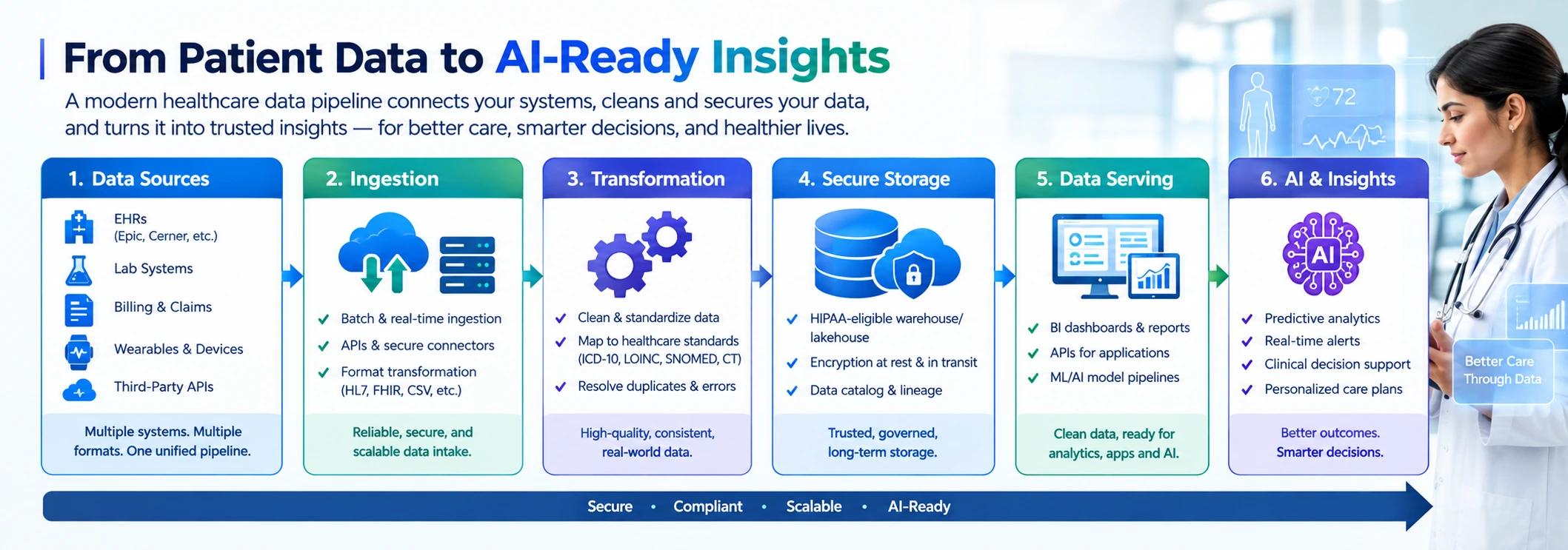 From Patient Data to AI-Ready Insights: a modern healthcare data pipeline connecting data sources, ingestion, transformation, secure storage, data serving, and AI & insights
Different Data Formats and Systems: Healthcare data arrives in a mix of formats — HL7, FHIR, CSV exports, PDFs, and proprietary database schemas. A robust integration layer needs to translate all of these into one consistent internal format the pipeline can process.
APIs and Integration Layers: Modern EHRs increasingly expose FHIR-based APIs, which are far easier to integrate than older HL7v2 messaging. A well-built integration layer abstracts these differences so downstream systems never need to know which source system the data originally came from.
Data Normalization: Codes, units, and identifiers must be mapped to common standards — such as SNOMED CT for clinical terms or LOINC for lab results — so that data pulled from different systems can actually be compared and combined meaningfully.
Patient-History Enrichment: Integration isn't just about pulling in new records; it also means enriching a patient's historical record with data arriving from newly connected systems, building a fuller longitudinal picture clinicians and AI models can both rely on.
Maintaining Reliable Synchronization: Once systems are connected, ongoing synchronization keeps records current as new data arrives from each source, with monitoring in place to catch and resolve sync failures before they create gaps or duplicate records.
6. How to Handle Incomplete, Inconsistent or Unreliable Patient Data
Automated Validation: Every incoming record should pass through automated validation rules that check required fields, valid value ranges, and referential integrity before it's allowed further into the pipeline, catching problems immediately rather than downstream.
Missing-Data Detection: Systems flag records with missing critical fields, such as a diagnosis code or a timestamp, so teams can decide whether to backfill the value, route the record for manual review, or exclude it from certain analyses.
Schema Validation: Incoming data is checked against expected schemas so that a source system change, like a renamed field or a new data type, is caught immediately instead of silently breaking transformations further down the pipeline.
Quality Scoring: Records can be scored on completeness, accuracy, and freshness, giving downstream consumers, dashboards, reports, AI models, a clear signal of how much to trust a given dataset before acting on it.
Error Handling: Well-designed pipelines isolate and log bad records instead of failing the entire pipeline run, routing errors to a review queue so a handful of malformed records never blocks the rest of the day's data.
Monitoring Data Quality Throughout the Pipeline: Quality checks shouldn't happen only at ingestion, they need to run at every stage, since transformations and integrations can introduce new errors even into data that started out clean and valid.
7. Designing Healthcare Data Pipelines for AI
Creating AI-Ready Datasets: AI models need consistently structured, labeled, and de-identified datasets. Building this layer on top of a clean pipeline means data scientists spend their time modeling instead of repeatedly cleaning the same messy source data.
Feature Engineering: Raw clinical data is transformed into meaningful features — such as a patient's readmission history or medication-adherence pattern — that machine learning models can actually learn from, often the single highest-leverage step in the whole workflow.
Predictive Analytics Pipelines: Purpose-built pipelines feed models that forecast readmission risk, disease progression, or resource demand, refreshing predictions automatically as new patient data arrives instead of relying on stale, manually-run reports.
Real-Time AI Inference: Some use cases — sepsis alerts, vitals monitoring — need predictions the instant new data arrives. This requires a streaming pipeline architecture that can score data in near real time rather than waiting for a nightly batch job.
RAG and Healthcare Knowledge Systems: Retrieval-augmented generation (RAG) lets AI copilots answer clinical questions by pulling from a governed, HIPAA-compliant knowledge base of guidelines and patient records, reducing hallucination risk compared with an ungrounded language model alone.
Connecting Data Engineering With AI/ML Development: Data engineering and AI/ML development have to be planned together from the start; an AI model is only as reliable as the pipeline delivering its data, which is why leading data engineering and AI ML services treat both as one workstream.
8. Case Study: How Agile Infoways Built NextBillion's Patient Data Platform
NextBillion approached Agile Infoways with a workflow still rooted in the original paper-based workflow: intake forms, chart notes, and care plans that lived on paper and were transcribed by hand into spreadsheets, creating delays and inconsistent records across locations.
Agile Infoways engineered digital patient data collection that captured intake and clinical information directly at the point of care, removing manual transcription entirely and feeding structured data straight into the platform's pipeline from day one.
With clean, structured data flowing in, the team built automated analysis capabilities on top of it, giving care teams instant visibility into a patient's status instead of waiting on manually compiled reports days after an appointment.
That analysis layer powered personalized care-plan recommendations, using patient history and clinical indicators to help care coordinators tailor next steps for each individual rather than applying a one-size-fits-all protocol.
Throughout the build, Agile Infoways treated HIPAA requirements as a first-class design constraint, encryption, access control, and audit logging were built into the architecture from the start rather than layered on after launch.
The platform required deep EHR and medical-system integration, connecting NextBillion's various clinical and administrative systems into a single, synchronized source of truth so care teams no longer worked from fragmented records.
Data Validation rules were embedded throughout the pipeline to catch incomplete or inconsistent entries early, ensuring the data feeding both dashboards and care recommendations met a consistent quality bar.
Because patient volume was expected to grow, Agile Infoways designed for scalable infrastructure from the outset, so the platform could absorb new locations and data sources without a costly re-architecture down the line.
The resulting technology architecture combined a HIPAA-compliant cloud data pipeline with an analytics and recommendation layer, giving NextBillion a foundation that could support both clinical operations and future AI initiatives.
9. What Agile Infoways LLC Delivers as a Data Engineering Partner
Data Engineering Consulting helps healthcare organizations assess their current data landscape and define a realistic, prioritized roadmap before any code gets written.
Data Architecture design lays out how data will flow, where it will be stored, and how compliance and scalability requirements will be met from the ground up.
ETL/ELT Development builds the pipelines that extract, transform, and load clinical data reliably and on schedule, or in real time where the use case demands it.
Data Integration Engineering connects EHRs, billing systems, labs, and third-party APIs into one coherent, synchronized data layer.
Cloud Data Platforms are built on AWS and other leading providers, giving healthcare clients HIPAA-eligible, elastically scalable infrastructure.
Data Lakehouse Engineering combines structured and unstructured healthcare data in a single platform, supporting both traditional analytics and modern AI workloads.
Streaming Pipelines are engineered for use cases that can't wait for a batch job, such as vitals monitoring or fraud detection.
Data Quality and Observability tooling is built into every pipeline so teams can trust their data and catch issues before they reach production dashboards.
AI Data Engineering prepares and pipelines data specifically for machine learning and generative AI use cases, tying directly into Agile Infoways' broader AI ML development capabilities.
Data Governance and Security practices, including RBAC, encryption, and audit logging, are embedded across every engagement to satisfy HIPAA and other regulatory frameworks from day one.
10. Healthcare Data Engineering Architecture: A Practical Reference Model
Source Systems, EHRs, lab systems, billing platforms, wearables, and third-party APIs — generate the raw clinical and operational data that everything else in the architecture depends on.
Ingestion Layer pulls data from these sources on a batch or streaming basis, handling authentication, rate limits, and format differences so the rest of the pipeline receives data in a consistent shape.
Transformation Layer cleans, standardizes, and enriches the ingested data — normalizing codes, resolving duplicates, and mapping fields to shared healthcare data standards like FHIR or HL7.
Storage Layer holds the transformed data in a HIPAA-eligible warehouse or lakehouse, structured for both fast analytical queries and long-term, auditable retention.
Quality and Governance Layer continuously validates data, tracks lineage, and enforces access policies across the entire architecture, satisfying both operational and regulatory requirements.
Analytics Layer exposes governed data to BI tools and dashboards, giving administrators and care teams visibility into operational and clinical performance.
AI/ML Layer consumes the same governed data to train and serve predictive models, from readmission-risk scoring to care-plan recommendation engines.
Application and Workflow Layer delivers insights directly into the tools clinicians and staff already use, closing the loop between raw data and real-world clinical action.
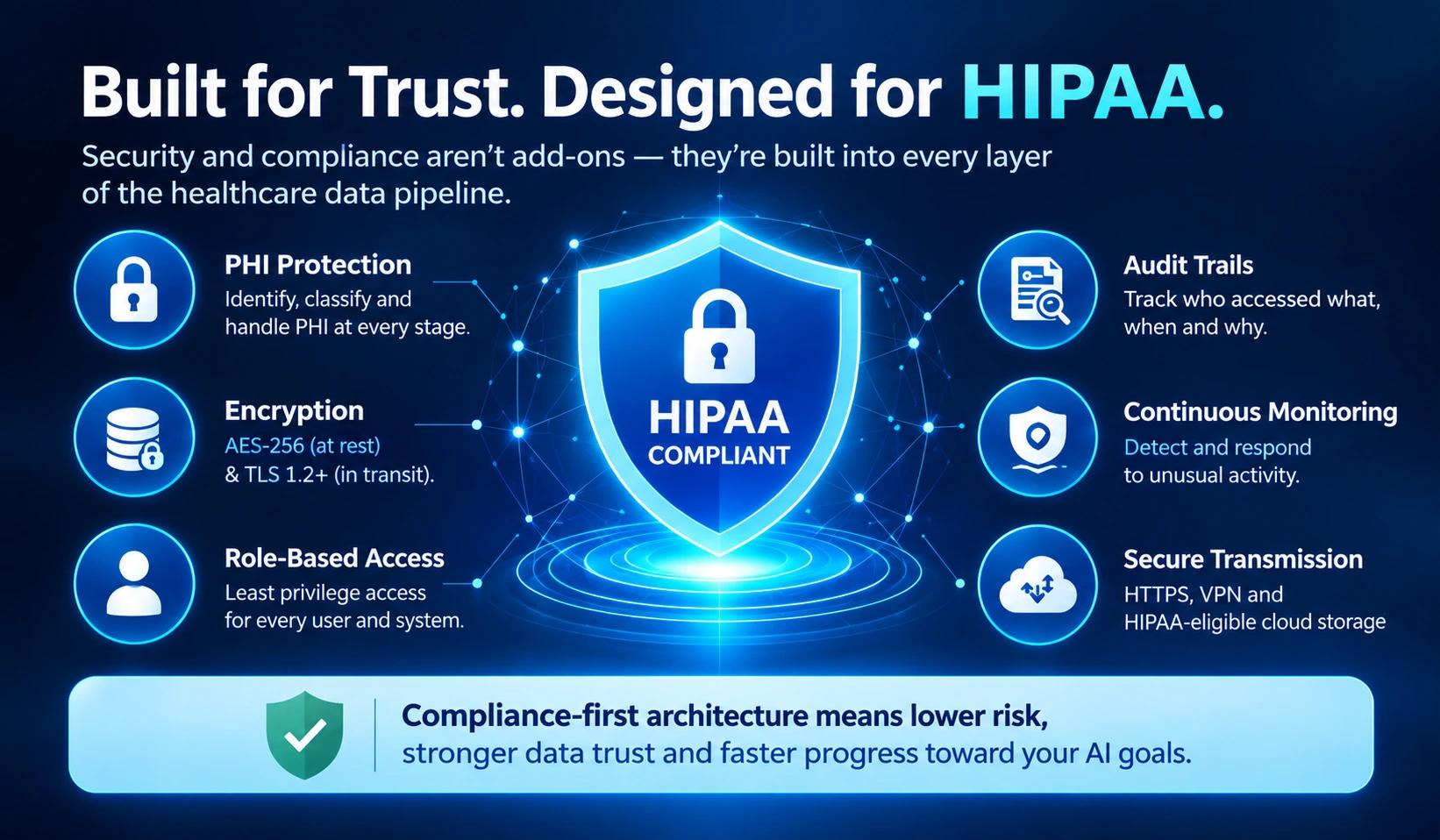 Built for Trust. Designed for HIPAA. — PHI protection, encryption, role-based access, audit trails, continuous monitoring, and secure transmission built into every layer of the pipeline
11. Healthcare Data Engineering Use Cases
Patient Data Management centralizes records from every touchpoint into one longitudinal patient view, reducing duplicate charts and giving care teams a complete clinical picture.
Clinical Analytics turns aggregated patient data into dashboards that reveal treatment effectiveness, outcome trends, and areas where care protocols could be improved.
Population Health pipelines aggregate data across entire patient populations to identify at-risk groups and target preventive interventions before conditions escalate.
Predictive Analytics models forecast readmission risk, disease progression, or resource needs, letting care teams intervene earlier and more precisely.
Care-Plan Automation uses patient data and clinical rules to generate and update personalized care plans automatically as new information arrives.
Patient Engagement platforms rely on clean, connected data to deliver timely reminders, educational content, and personalized outreach that keeps patients engaged in their own care.
Healthcare AI Applications — from clinical copilots to diagnostic support tools — all depend on the same underlying pipeline delivering clean, governed, AI-ready data.
Operational Analytics gives administrators visibility into staffing, capacity, and billing performance, supporting decisions that keep a healthcare organization running efficiently.
12. How Much Do Healthcare Data Engineering Services Cost?
Factors Affecting Project Cost include the scope of source systems, the complexity of compliance requirements, and whether the organization needs a one-time build or ongoing engineering support.
Data Volume and Complexity — a single-clinic pipeline costs far less than one handling multi-facility, high-volume clinical and billing data across many source formats.
Number of Integrations directly drives cost, since each additional EHR, lab system, or third-party API requires its own connector, mapping logic, and testing effort.
Compliance Requirements add engineering overhead for encryption, access control, audit logging, and documentation, but this investment is far cheaper than the cost of a HIPAA violation.
Batch vs. Real-Time Architecture affects cost significantly, since streaming pipelines generally require more sophisticated infrastructure and monitoring than scheduled batch jobs.
Cloud Infrastructure costs scale with data volume and compute needs, though a well-architected pipeline can control this through efficient storage tiering and processing design.
Build vs. Dedicated Engineering Team is a key cost decision — a one-time build has a defined cost, while an ongoing dedicated team offers continuous support and iteration at a predictable, recurring cost.
13. How Long Does It Take to Build a Healthcare Data Pipeline?
Discovery and Data Assessment typically takes two to four weeks, during which the team inventories source systems, data formats, and compliance requirements before any architecture is finalized.
Architecture design usually takes another two to three weeks, mapping out ingestion, transformation, storage, and serving layers in detail before development begins.
Integration and Pipeline Development is the longest phase, often eight to sixteen weeks depending on how many EHRs and third-party systems need to be connected.
Validation and Testing run in parallel with development and continue for several weeks afterward, ensuring data quality rules and transformations behave correctly across edge cases.
Security and Compliance Work — encryption, access control, audit logging — is built throughout the project rather than as a final phase, though formal compliance review typically adds two to four weeks.
Production Deployment generally takes one to two weeks, including final testing in a production-like environment before the pipeline goes fully live.
Scaling and Optimization continue well beyond launch, as usage grows and new data sources are added — which is often when organizations choose to hire data engineers or AI engineers on an ongoing basis rather than project by project.
14. How to Choose a Healthcare Data Engineering Services Provider
Healthcare Domain Experience matters more in this space than general data engineering skill, since healthcare data carries unique standards, terminology, and regulatory constraints that generic providers often miss.
HIPAA and Security Knowledge should be demonstrable, not assumed — ask for specifics on encryption, access control, audit logging, and how the provider has handled compliance reviews in past engagements.
Data Architecture Capabilities should include real experience designing warehouses, lakehouses, and streaming systems, not just running pre-built ETL tools without deeper architectural judgment.
Cloud Expertise, particularly with AWS and other HIPAA-eligible providers, is essential for building infrastructure that's both compliant and cost-efficient at scale.
Integration Experience with EHR platforms like Epic and Cerner, plus healthcare data standards like FHIR and HL7, separates specialized providers from generalist software vendors.
AI/ML Readiness matters if healthcare AI is on the roadmap — a provider who understands both data engineering and AI/ML development, as a data engineering company in USA like Agile Infoways does, can design pipelines that are AI-ready from day one.
Production Support — ongoing monitoring, incident response, and iteration — is what separates a provider who ships a working pipeline from one who genuinely stays accountable for its long-term reliability.
15. FAQ: Healthcare Data Engineering
What are data engineering services?
Data engineering services design, build, and maintain the pipelines that move data from source systems into a clean, structured, analysis-ready format for reporting, analytics, and AI applications across an entire organization's operations.
What's included in data engineering services?
Services typically include data architecture design, ETL/ELT pipeline development, data integration, data quality and governance, cloud infrastructure setup, and ongoing monitoring and optimization of the entire data pipeline over time.
What is healthcare data engineering?
Healthcare data engineering is the practice of building HIPAA-compliant pipelines that ingest, clean, and integrate patient data from EHRs and other clinical systems into a governed, analytics- and AI-ready data foundation.
How does healthcare data engineering support AI?
It supplies AI models with clean, structured, de-identified data on a reliable schedule, without which predictive analytics, clinical copilots, and diagnostic support tools cannot produce trustworthy, clinically usable results for patients.
How do data engineers handle HIPAA?
Data engineers build encryption, role-based access control, audit logging, and secure transmission directly into the pipeline architecture, treating compliance as a core design requirement rather than a bolted-on afterthought later.
What is the difference between data engineering and data science?
Data engineering builds and maintains the pipelines and infrastructure that move and clean data, while data science uses that prepared data to build models, run analysis, and generate predictive clinical insights.
How much do healthcare data engineering services cost?
Cost depends on data volume, number of system integrations, compliance requirements, and whether an organization needs a one-time build or an ongoing dedicated engineering team supporting the pipeline over the long term.
How do you integrate EHR data?
EHR integration uses APIs — increasingly FHIR-based — combined with data normalization and mapping to standards like SNOMED CT and LOINC, unifying records from different systems into one consistent, usable format.
When should a healthcare company hire a data engineering partner?
Organizations should engage a partner once fragmented data starts blocking reporting or AI initiatives, or before launching any project that depends on clean, compliant, integrated patient data at meaningful scale.
What is a healthcare data warehouse?
A healthcare data warehouse is a structured storage system that consolidates clinical, operational, and financial data from multiple sources into one place, optimized for fast, reliable analytical querying and long-term reporting.
What are the best ETL tools for healthcare data?
The best tools support HIPAA-eligible infrastructure, healthcare data standards like HL7 and FHIR, and both batch and streaming workloads, rather than being generic, general-purpose ETL tools with no healthcare-specific features built in.
16. Build a HIPAA-Ready Data Foundation for Healthcare AI
A HIPAA-ready healthcare data pipeline isn't a one-time project — it's the foundation an organization builds on for years, supporting every future analytics dashboard, predictive model, and AI copilot without requiring a costly re-architecture down the line.
Agile Infoways brings healthcare engineering capabilities that combine deep data engineering expertise with hands-on AI/ML development experience, having already built HIPAA-compliant platforms like NextBillion's patient data system from the ground up.
Because data engineering and AI engineering are treated as one connected workstream rather than separate projects, clients get pipelines that are AI-ready from day one, not retrofitted for AI use cases after the fact.
Every engagement starts with a discovery and architecture consultation, assessing your current systems, data quality, and compliance posture before recommending a realistic roadmap tailored to your organization's actual needs and constraints.
If fragmented patient data, HIPAA compliance gaps, or AI readiness are on your roadmap this year, you should hire data engineers and start building a healthcare data pipeline engineered to support your organization's next decade of growth.

Written by
Pratik Kantesiya
AI Engineering Lead
Pratik leads AI engineering at Agile Infoways, where he architects production AI systems for enterprises across healthcare, BFSI, and logistics. He writes about practical AI delivery — what works, what does not, and what most teams miss between proof-of-concept and production.